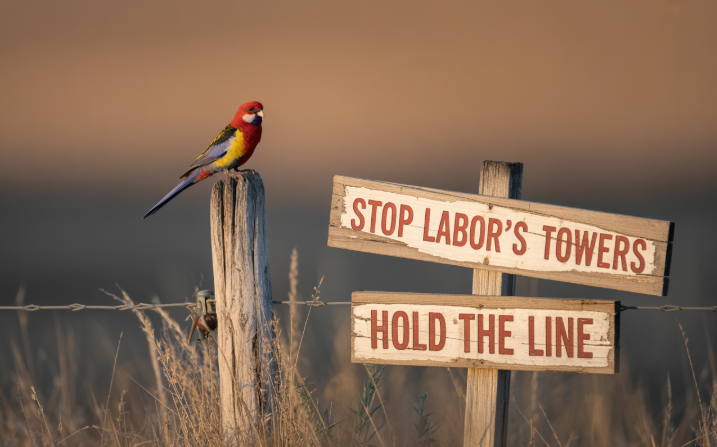
STOP LABORS TOWERS NEWSLETTER – May 25 2025
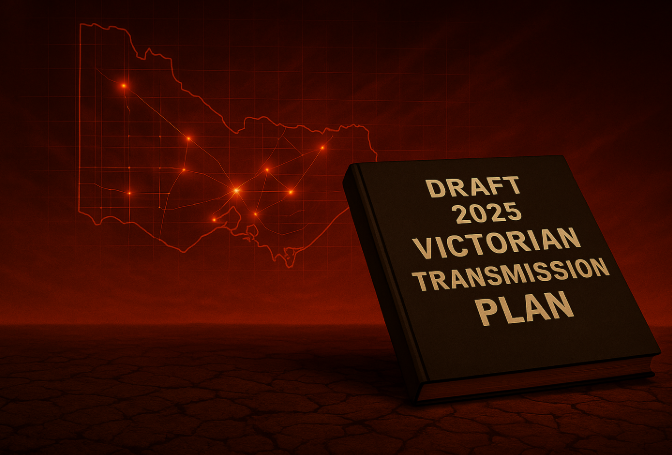
Draft Victorian Transmission Plan
Late Friday evening on 16th May 2025, the Victorian Government released the Draft 2025 Victorian Transmission Plan (VTP) with the solemn weight of inevitability. It purports to be a roadmap, bold, forward-looking, and necessary for the state's energy future. In reality, it is something altogether more brittle: a tightly curated script, written not to inform the debate, but to extinguish it.
The VTP is framed as a long-term strategic vision for Victoria's transmission infrastructure and renewable energy zone development. But this is not planning in any meaningful democratic sense. This is proclamation a policy cast in concrete before the foundations have been laid, dressed in the language of consultation but impervious to its consequences.
At the heart of the VTP, and at the center of the masquerade, sits the Western Renewables Link (WRL). A project which, by AEMO's own classification, remains "anticipated." Yet in the VTP, it is elevated to an article of faith.
There is no social, technical or economic analysis of WRL as required in the VicGrid Act, just a reckless assertion that WRL will be commissioned "before 2027". VicGrid's entire plan for transmission in Victoria therefore depends on setting the bulldozers running through our farms, rivers and forests by the end of this year. So prepare for a return to confrontations with bullying AusNet staff at the farm gate.
To be clear, in the VTP, there is no room for deviation no scenario in which the WRL is delayed, modified, or rejected. It is, in effect, the plan's original sin: not an option to be evaluated, but an outcome to be defended at all costs.
From this unquestioned premise, spills a series of contradictions:
-
WRL's cost has been entirely left out of the VTP, with estimates now indicating it will be Billions more than initaily estimated and that WRL alone will double Victoria's household power bills. And that cost is on top of the $4 Bn of additional projects now included in the VTP to reinforce existing transmission lines in Western Victoria in order to address the engineering shortcomings of that project. With this slight of hand, VicGrid's collides openly with AEMO's frameworks, breaching both the National Electricity Rules and the AER's cost-benefit guidelines by embedding WRL into every baseline assumption. Projection becomes inevitability; scrutiny becomes heresy.
-
Community resistance and Traditional Owner concerns are acknowledged with bureaucratic courtesy, then swiftly cast aside. The plan openly concedes its heritage impact assessment is incomplete yet charges ahead regardless. But, make no mistake, this token engagement with community will be used by the Government to short-cut environmental approvals, fast-track planning decisions and justify police action to break-up protests protecting our forest from the bulldozers.
-
Ideas once rejected are now quietly repurposed. The planned Ballarat Terminal Station is re-instated in the VTP despite being deleted in 2022 after a successful community campaign. The VTP also depends on engineering approaches that were previously rubbished by VicGrid, like upgrading existing transmission corridors. When put forward by experts as an alternative to WRL the Government described such transmission upgrades as 'reckless' or 'too costly'. The pivot is silent; the accountability absent.
-
Crucially, no economic comparison at all is offered between WRL and better value, community-supported alternatives like the Syncline Community Cable. The cost of dissent is that it is simply erased from the ledger.
What we are left with is a pantomime of public engagement. Input is welcomed so long as it doesn't threaten the script. The process mimics dialogue but resists influence.
It is against this backdrop that the Energy Grid Alliance submitted its response to the Draft VTP. This is not opposition for its own sake. It is a call for a transmission planning process that is collaborative, transparent, and accountable as required by the VicGrid Act. A process grounded not in blind inevitability, but in genuine scenario testing, rigorous economic analysis, and community consent.
Energy Grid Alliance's submission recommends:
-
Modelling that includes scenarios without WRL.
-
Acknowledgement of the VTP's quiet convergence with the principles of Plan B.
-
Comparative economic evaluation of all viable alternatives.
-
A negotiated framework that gives landholders, Traditional Owners, and communities real power not ceremonial roles.
-
Evidence that consultation has shaped outcomes not just polished the language around them.
This is not about whether Victoria should transition to renewable energy. It must, and it will. The real questions are at what cost to our household electricity bills and whether that transition will be built with the trust of its people, or on top of their exclusion.
This Is Not a Plan. It’s a Land Grab in Disguise.
The Draft 2025 Victorian Transmission Plan isn’t a roadmap, it’s a runaway train.
It bulldozes community voices, ignores unfinished heritage assessments, and treats a highly contested project like the Western Renewables Link as a foregone conclusion.
This isn’t consultation. It’s choreography. And we’re expected to play along.
We won’t.
To break the illusion of inevitability, we must act clearly, urgently, and unapologetically.
Call out the contradictions. Expose the omissions. Challenge the process.
What You Can Do Now – Call to Action
Read the Draft VTP – Understand the assumptions they won’t admit to.
Read the Energy Grid Alliance’s Response – A blueprint for what real planning looks like.
Submit your own response by 24 June 2025 – Every voice recorded is a barrier to this plan’s false legitimacy.
Stop Labor’s Towers.
Hold the Line.
This is our land, our future and we’re not giving it away.
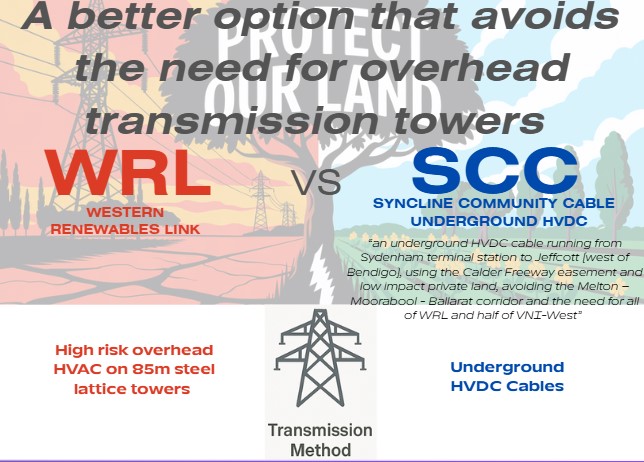
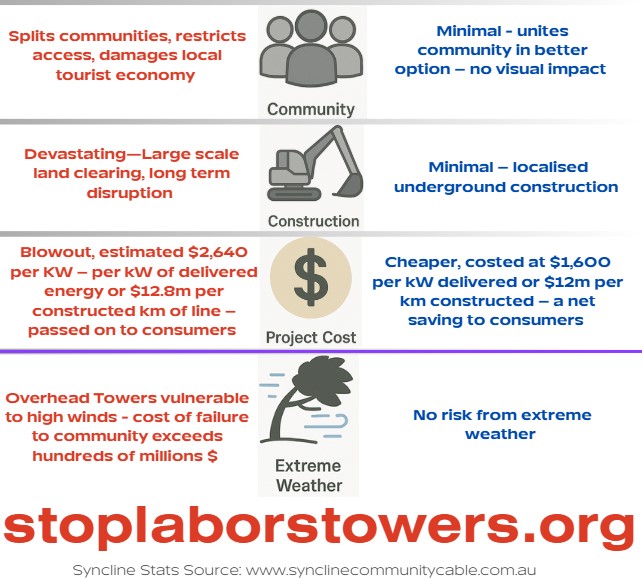
Let’s talk about the Syncline Community Cable, shall we? The credible, community-backed alternative to the WRL that, bafflingly, still hasn’t made its way into Victoria’s grand plan for the future. Inclusion in the VTP should be a no-brainer. It tells planners, policymakers, and anyone else with their hands on the levers that Syncline isn’t just some hippie concept drawn on the back of a beer coaster. It’s costed, viable, it’s realistic, and it belongs on the table.
This is important. And not in the vague, wave-your-hands-around way the WRL’s defenders like to talk about “futureproofing” and “unlocking value,” but in the actual, real-world sense. WRL is increasingly viewed as a high-impact, low-flexibility dinosaur, built for a generation landscape and policy framework that are already shifting under its feet.
The planning process? Let’s just say the words “serious consideration of alternatives” appear to have gone the way of transparent government communication and basic respect for landholders. No scenario modelling where WRL doesn’t proceed. No imagining a world where energy generation is, shockingly, more distributed and community-driven. It’s all straight lines and foregone conclusions.
Meanwhile, trust in this entire charade has collapsed. Vanished. Gone the way of WRL’s original budget. People see what’s happening. They see the predetermination, the baked-in assumptions, the box-ticking consultations designed to politely ignore them.
And then there’s the small matter of the WRL itself, which despite being treated like Moses brought it down from Mount Transmission, is not guaranteed to go ahead. There’s strong opposition. Massive cost blowouts. Repeated delays. It’s more likely to wind up a case study in how not to plan energy infrastructure than an actual piece of infrastructure.
So here we are. If VicGrid is even faintly serious about “least-regret” planning, then it needs to model Syncline. It needs to test it. It needs to give it the same consideration given to WRL’s increasingly fantastical assumptions. Because public confidence is not a renewable resource. And if Victoria is going to build the grid it actually needs not the one dictated by inertia and political convenience it starts with putting Syncline in the plan. No more excuses. No more pretending.
Just include it.
The Syncline Community Cable represents more than an alternative to the Western Renewables Link (WRL). It is a credible, community-backed solution that deserves serious consideration in Victoria’s energy planning. Its inclusion in the Victorian Transmission Plan (VTP) is not just a matter of equity. It is a matter of public trust, economic prudence, and infrastructure resilience.
If Syncline has been excluded from the VTP in the hope that farmers would quietly sign-up to AusNet’s land grab, then VicGrid is mistaken. Famers and community are against WRL and its impact on power bills, environment, communities and lifestyles. VicGrid should not confuse our attempt at a constructive discussion of alternatives with a complete surrender of our land.
For planners, policymakers, and investors, inclusion of Syncline in the VTP signals that modern underground HV DC can be considered in Victoria as it is all over the world. It is a technically sound, regionally supported, and strategically relevant option for Victoria as the transmission landscape and technologies evolve.
Why this matters:
-
The WRL is structurally flawed. It is increasingly viewed by experts and communities alike as a high-impact, low-flexibility project that was conceived under outdated assumptions about where energy would be generated and how it would flow. It does not align with the emerging reality of more distributed, flexible energy systems.
-
The planning process has failed the public test. Despite claims of engagement, no meaningful alternatives have been modelled. No scenario in the VTP entertains the possibility that WRL might not proceed. Alternatives like Syncline are not even acknowledged, let alone explored.
-
The legitimacy of the process is eroding. Communities and Traditional Owners have raised serious concerns about cultural heritage, property rights, and land use. These concerns have been noted, but not answered. The perception, widely shared, is that decisions are being made in advance of consultation and then retrofitted with justification.
-
WRL is far from guaranteed. The project faces well-organised and expanding opposition across multiple regions. Costs have escalated, timelines have slipped, and public confidence has deteriorated. In practical terms, it is no longer the reliable default the VTP assumes it to be.
-
Syncline is low-impact and highly strategic. By following existing infrastructure corridors and connecting emerging renewable zones with minimal disruption, Syncline offers a technically feasible and socially supported pathway to grid expansion. It aligns with international best practice for infrastructure development in sensitive landscapes.
-
It has strong regional backing. The Syncline proposal is not a fringe idea. It is being advanced by landholders, engineers, energy experts, and community leaders who understand the terrain, the energy system, and the stakes.
-
It addresses risk. In an era of rising fire threat, mounting insurance pressure, and heightened scrutiny of land use decisions, the Syncline route reduces exposure. It delivers the infrastructure needed without igniting the backlash now surrounding WRL.
If VicGrid is serious about “least-regret” planning, then Syncline must be placed on equal footing. It must be modelled. It must be stress-tested. It must be subject to the same scrutiny and the same opportunity as the WRL.
Inclusion of Syncline in the VTP would not only correct a critical oversight in Victoria’s transmission strategy. It would signal that the government is prepared to plan with its citizens, not despite them.
Because this is no longer a debate about engineering. It is about credibility. And whether Victoria is building an energy future that communities will trust, or one they will resist until it breaks.
A Smarter Path Forward: Why Syncline Deserves a Place in Victoria’s Energy Plan
Technically feasible and globally proven
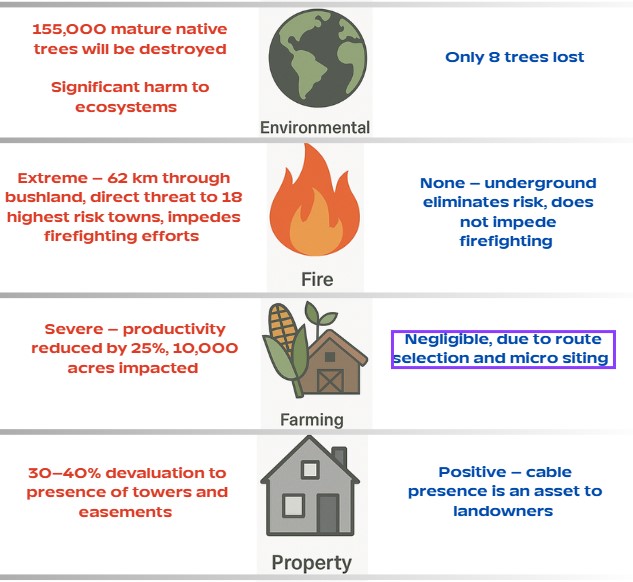
Underground HVDC technology used in the SCC is already in operation in countries like Germany, Japan, the US, and parts of Australia. It is not experimental. It is reliable, efficient, and modern.
Eliminates catastrophic fire risk
Unlike the overhead Western Renewables Link (WRL), the SCC is fully underground, removing the risk of bushfire ignition, interference with firefighting aircraft, or emergency redirection away from communities.
Protects agriculture and food security
SCC avoids placing towers on farmland, preserving full farm productivity. WRL would reduce crop yields, restrict operations over thousands of hectares, and devastate sectors like Ballarat’s potato industry and the equine economy.
Respects cultural heritage and the environment
SCC avoids destruction of trees, bushland, and Indigenous sites. It drastically reduces environmental disruption by following road and utility corridors. WRL, by contrast, threatens over 155,000 trees and hundreds of square kilometres of ecosystems.
Minimises visual and landscape impact
SCC’s underground route prevents the permanent scarring of iconic landscapes, unlike WRL’s imposing towers that violate Significant Landscape Overlays and regional heritage.
Backed by communities, not imposed on them
The SCC has widespread community and landholder support. It includes a trust model to return value to host communities. WRL faces mass opposition, legal threats, and refusals of land access.
Economically prudent and costed
The SCC has been scoped, costed, and can be delivered faster and more efficiently than WRL, which is already plagued by delays, budget blowouts, and outdated planning assumptions. Syncline’s capital cost is only a small part of the equation because HV DC has much lower energy losses, lower operating costs and less impact on the environment.
Supports a fair and credible transition
SCC aligns with international best practice for transition infrastructure: low impact, high efficiency, and community-integrated. Including it in the VTP restores public faith in a planning process that currently lacks transparency and trust.
The WRL is not inevitable, nor assured
WRL remains an “anticipated” project under AEMO’s classifications. It is not committed, and its continued inclusion in all planning scenarios without credible alternatives violates basic planning integrity.
A necessary test of institutional credibility
The SCC now also stands as a test of whether Victoria’s infrastructure planning is open to better value alternatives, or whether it is locked into past decisions at the cost of public trust and democratic process.