STOP LABORS TOWERS
NEWSLETTER – September 13 2025
Authoritarian Legislation, Unbreakable Resistance: Victoria’s Rural Communities Rise
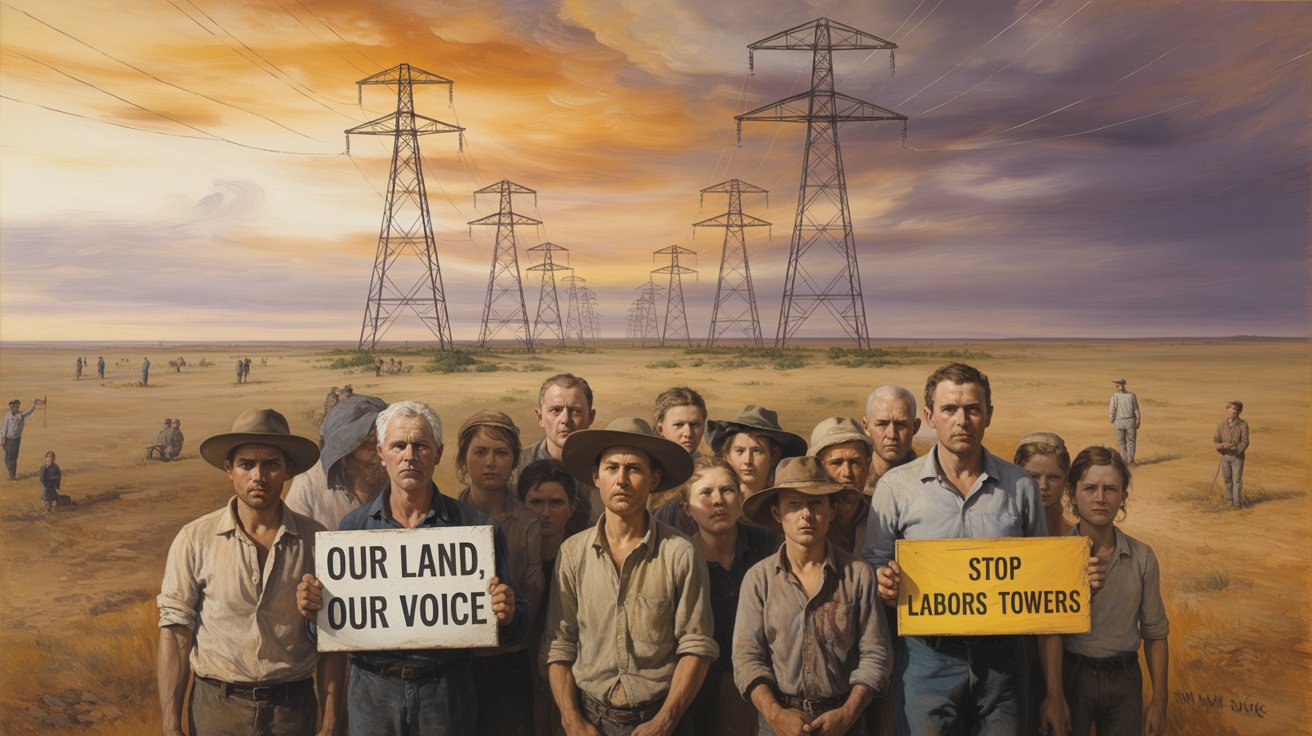
Our Land, Our Voice: Standing Against the Premier’s Towers
Let’s be very clear. Across the world, people are rising because governments no longer listen to them. And right here in Victoria, we see the same story playing out under this State Government and its Premier. They have become authoritarian, arrogant, and utterly disconnected from the people they were elected to serve.
Why are communities in Western Victoria standing up? Because they are being told, not asked. Because decisions that will devastate their livelihoods, their farms, their safety, and their environment are being rammed through without consultation, without transparency, without care. The Western Renewables Link is the perfect example of this.
This project, as designed, is unnecessary, reckless, and destructive. Instead of exploring safer, smarter alternatives, the Premier’s Government has chosen to bulldoze communities, to ignore local expertise, and to gamble with fire, agriculture, and the environment. They tell us it is progress. But let me ask: whose progress? For whom? Because it sure as hell isn’t for the people who live on the land that will be scarred by these towers.
This is what authoritarianism looks like. A government that no longer answers to its citizens, but to its own self-serving agenda and the corporations waiting at the end of the line. They cloak it in the language of climate action, but in reality they are pushing forward projects that create enormous risks and irreversible damage while silencing the very people who must bear those costs.
The people of Victoria know better. Farmers know the risks of fire. Families know the value of the land they live on. Communities know the worth of their environment, their wildlife, their way of life. And when a government refuses to hear them, refuses to even look them in the eye, then those communities will rise.
The fight against the Western Renewables Link is not just about one transmission line. It is about democracy itself. It is about whether we allow governments to ride roughshod over ordinary people, or whether we stand together and say: No. Not here. Not like this.
We have a duty – to ourselves, to our children, to the land and the environment – to stop this project, to expose this Premier’s authoritarian agenda, and to demand that the government serve the people, not the corporations, not themselves. Because this is our land. Our environment. Our future. And we will not let it be sacrificed for the greed and arrogance of a government that has forgotten who it works for.
Authoritarian Legislation, Unbreakable Resistance: Victoria’s Rural Communities Rise
Authoritarian Legislation, Unbreakable Resistance: Victoria’s Rural Communities Rise
The passage of the National Electricity (Victoria) Amendment (VicGrid Stage 2 Reform) Bill 2025 may have granted the government and VicGrid unprecedented powers to access and control private farmland for transmission infrastructure – but it has not cowed regional communities. Instead, this legislation has entrenched and energized community resistance like never before. Rather than paving the way for an “orderly transition,” it has become a rallying point uniting landholders, farmers, and rural advocates against what is widely seen as state-sanctioned overreach and disregard for local rights.
By wielding the threat of forced entry, heavy fines, and token compensation, the government has only hardened the resolve of regional Victoria to fight for land, livelihood, and basic justice. This authoritarian approach has demolished trust, galvanizing opposition movements that openly promise not only protest but also ongoing legal, political, and public campaigns against those seeking to profit at the expense of rural land and heritage.
No amount of compensation or spin can now hide the reality: the legislation’s true legacy is not smoother infrastructure rollout, but a deepening fault line between city-led powerbrokers and the people who feed, supply, and protect Victoria. Regional resistance is entrenched, and the government and proponents have sown turmoil they are unprepared to reap. The community’s fight is far from over – it is entering its strongest, most unified phase yet.
The Victorian parliament has now passed the National Electricity (Victoria) Amendment (VicGrid Stage 2 Reform) Bill 2025, granting VicGrid and state-appointed officers sweeping powers to forcibly enter private farmland for the construction and maintenance of transmission towers and related infrastructure. Officials may now use “reasonable force”—including cutting locks and breaking open gates—and landholders who obstruct VicGrid can be fined up to $8,000, though this penalty was reduced from the initial $12,000 after community backlash.
Despite amendments, the legislation has sparked fury and deep disappointment among farmers, rural communities, and regional organizations, who warn that it erodes property rights and ignores basic fairness and genuine community engagement. Critics condemn the measures as overreach, saying they lock in a process where rural Victoria bears the burden of massive new energy infrastructure, while the benefits flow elsewhere.
There are also ongoing payments for hosting transmission lines, indexed for inflation. However, these changes have not diminished concerns about the lack of transparency, respect, and social licence. The Victorian Farmers Federation and other community advocates insist that trust has been further eroded and warn the government is repeating past failures – especially on projects like the Western Renewables Link.
The passage of the bill means the fight for community voice, regional equity, and farmland protection now moves to new ground, with protest, advocacy, and legal recourse remaining crucial tools for landholders and their allies.
WRL EES Directions Hearing – Monday September 15th 2025
The WVCA will be present at the WRL EES Directions Hearing on Monday, September 15th, 2025 – a critical juncture that will shape the very framework for how our community can participate in the fight for a fair assessment at the upcoming EES Hearing. This Directions Hearing, while not taking evidence, stands as a battleground where rules of engagement are set – yet what we have witnessed to date are blatant actions by VicGrid, AEMO, and AusNet designed to sideline, silence, and outmanoeuvre the very people affected by this project.
Repeatedly, these organizations have abused their influence, orchestrating strategies to steer the process away from true community scrutiny and towards their own agenda. We face a concerted campaign of overreach and misdirection: conflicts of interest are ignored, high-level policy rhetoric is used to drown out local realities, basic data is withheld from property owners, and new evidence is hidden or released long after consultation deadlines pass. Their actions amount not to accidental shortcomings, but to a coordinated attempt to crush local opposition, diminish our voice, and force this project through without transparency or due process.
This is not just a fight against a flawed project – this is a stand against a rigged system. Every tactic deployed – whether it’s stacking the deck with government resources, rushing through reviews, or blocking access to critical information – is proof that fairness, accountability, and community rights are being trampled. The WVCA is here to demand justice, true transparency, and a complete reset of this corrupted process.
Marginalization of Community Voices
• The proponent seeks to impose restrictive timelines on the community while denying us access to critical evidence.
• Attempting to confine community participation and restrict the scope of public hearings is a blatant effort to downplay, sideline, or silence those whose lives and livelihoods are most at stake.
• We will fight for the community to be afforded the time you have requested at the hearings be that 30 minutes or two days.
Systemic Exclusion and Process Manipulation
• Both VicGrid and AEMO, who stand to benefit directly from WRL’s approval, are being positioned as “impartial” participants in the assessment, despite overwhelming conflicts of interest that taint the entire process.
• These authorities are pushing high-level policy advocacy while ignoring the specific, devastating impacts on local landholders, turning an environmental review into a platform for proponent propaganda.
• Their privileged involvement creates a grossly uneven playing field, arming government-backed agencies with outsized resources while residents are left to fight with limited means.
Denial of Information and Genuine Assessment
• AusNet, the project proponent, has deliberately withheld critical, property-specific information and refused to disclose data used in their assessments, flouting the requirement for transparent, site-level investigation.
• Despite numerous requests, basic investigative materials – photos, site notes, GIS data – remain withheld, denying affected landholders any real opportunity to scrutinize or challenge claims about their property.
• This lack of transparency is not just non-compliance – it is proof that meaningful assessment has never been conducted for some of the most impacted properties, fatally undermining the legitimacy of the WRL EES process.
Procedural Unfairness and Rushed Timelines
• The community was given just 40 days to review and respond to a 10,000+ page technical document – an impossibly short window compared to the proponent’s five years of preparation.
• This manufactured urgency was not a legal necessity, but a strategic decision to suppress scrutiny and minimize public participation, directly contradicting the minister’s own discretionary powers under the law.
• The resulting constraint not only marginalized the community but undermined any claim that the process was fair or inclusive.
Withholding of Evidence and Inaccessible Peer Reviews
• Key peer review reports were either missing from the initial EES or buried online after the fact, stripping the community of any real opportunity to critique or respond to essential technical evidence.
• This retroactive, fragmented disclosure violates statutory guidelines and embodies a fundamental breach of procedural fairness and transparency.
• The inclusion of such late evidence renders the process ultra vires – any conclusions based on these supplementary materials are open to legal challenge and invalidate the integrity of the entire assessment.
These are not technical or administrative oversights – they are deliberate tactics to silence local voices and force through a flawed, unaccountable process. The community’s fight is not simply against a project, but against a system that has chosen efficiency and expediency over fairness and justice. This campaign demands that residents be heard, and that the process be halted until genuine, transparent, and equitable assessment occurs.