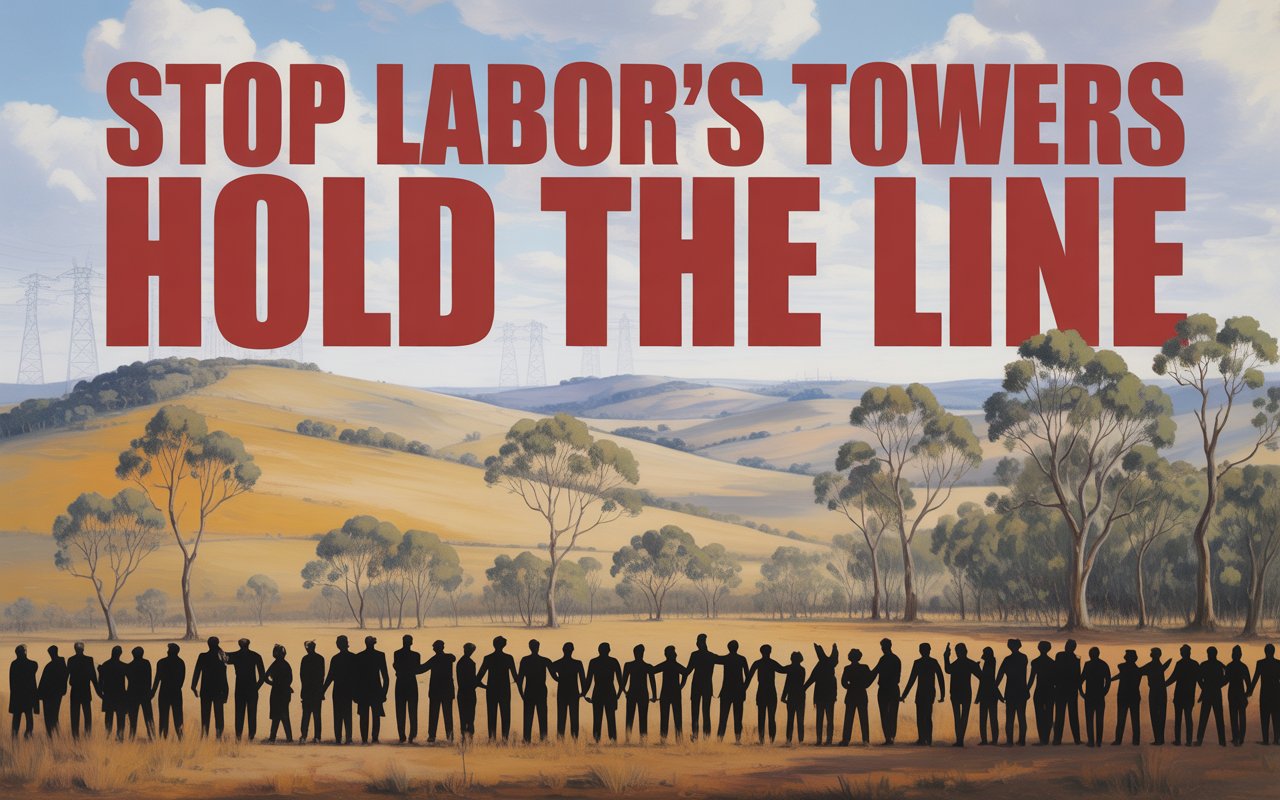
STOP LABORS TOWERS
NEWSLETTER – October 26 2025
We Are Not at War, But We Are No Longer at Peace Either
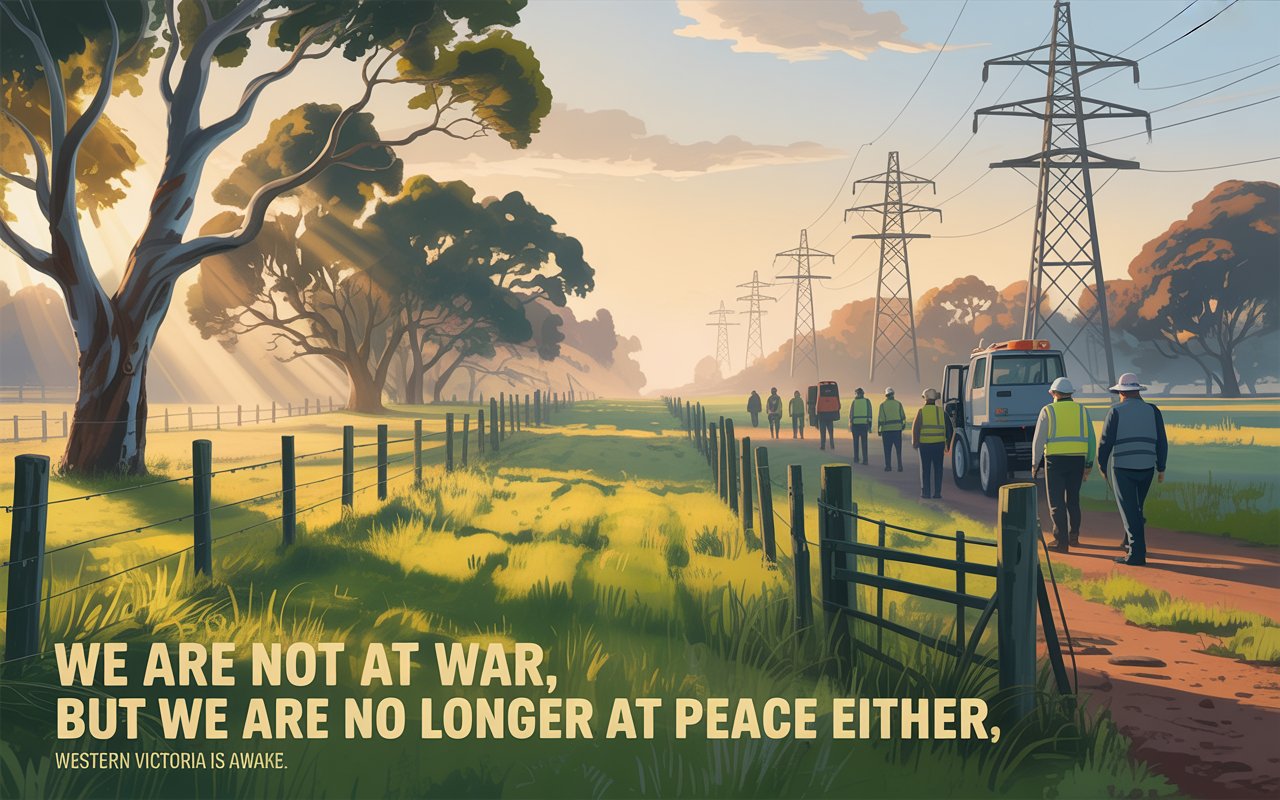
There’s a stillness that lives in Western Victoria. It’s the kind of quiet that belongs to early mornings, when the mist clings low to the paddocks and the wind moves gently through old gums. It’s a silence earned over generations by people who have worked this land with care, grit and quiet pride.
Over the last five years that stillness has been fractured. A new kind of noise has arrived, not the sound of birdsong or wind, but the low rumble of a government machine that moves without listening.
A Transition That Feels Like an Occupation
Under the green banners of “net zero,” the Victorian Labor Government has drawn its battle lines. They do not come with soldiers, but with surveyors and contractors, lawyers and planners. They speak of progress, but what they bring is power taken from communities and handed to corporations.
Projects like the Western Renewables Link have been framed as a climate solution, but on the ground they feel like an occupation. Decisions made in distant rooms now land like thunder in the quiet corners of our land, scarring landscapes, threatening livelihoods, and erasing voices that refuse to fit into a prewritten script.
The Green Cloak of Authority
“Net zero” was supposed to mean hope. Instead, it has been turned into a blunt instrument. It’s a language designed to sound benevolent, even as it bulldozes through farmland and bush. It’s a cloak for decisions that would never survive an honest conversation.
Landholders were not consulted, they were cornered. Environmental protection was promised, but destruction is what has been delivered.
A Community That Remembers Its Own Strength
But this place has a long memory. It remembers drought and flood. It remembers fire. It remembers what it takes to rebuild when others look away. And it will remember this too.
Across Western Victoria, people are resisting not out of anger alone, but out of love. Love for their land, for their heritage, for their right to be heard. We are steady. We are patient. But we are not passive.
We are not at war. But we are no longer at peace either. And when a government wages quiet wars, the resistance is born in quiet places.
A Reckoning Is Coming
True climate action is not built on coercion. Real progress does not silence the people it affects. If the Victorian Labor Government does not change course, it will meet a community that stands its ground. Not with rage, but with resolve. Not with slogans, but with truth.
Because this land is more than a line on a map. And its people are more than a policy inconvenience.
The fight has found its footing.
The silence has broken.
Western Victoria is awake.
WRL EES Hearings: Start Date, Schedule and Key Facts
The Western Renewables Link Inquiry and Advisory Committee (IAC) Hearing will commence at 10:00am on Monday, 27 October 2025 in Melbourne. The hearings are scheduled to run across multiple blocks through to at least March 2026 – making this one of the longest and most complex planning panel processes in recent Victorian history.
First Main Session:Melbourne hearings (Weeks 1–10, plus Week 15) at Kartsens Conference Centre, 123 Queen Street.
Regional Focus: Ballarat hearings (Weeks 11–14) at Mercure Ballarat Hotel & Conference Centre.
Online Access: All hearings can be joined via Microsoft Teams for remote participation; key links, meeting IDs and access instructions are provided for both locations.
Site Inspections: Commence Tuesday, 28 October and Wednesday, 29 October before main evidence sessions.
Proponent Evidence: AusNet’s detailed expert evidence will be presented in an extended block, followed by cross-examination and submissions from councils, community groups, and landholders.
Community Participation:Dedicated timeslots for residents, groups, and councils are spread throughout the schedule, with major blocks in January–March 2026 for submitters from Western Victoria and other impacted regions.
Hearing Platform: All material must be exchanged electronically via Dropbox, and technical support is available for participants.
Document Sharing:Presenting parties must upload hearing evidence and materials to Dropbox by 12 noon the day before their appearance.
Takeaway: This is a marathon hearing process – spanning Melbourne, Ballarat, and remote access – with opportunities for community input. Mark your diaries for October 27 and prepare for an extended schedule of submissions, cross-examinations, and site visits. Details on upcoming submitter slots will follow.
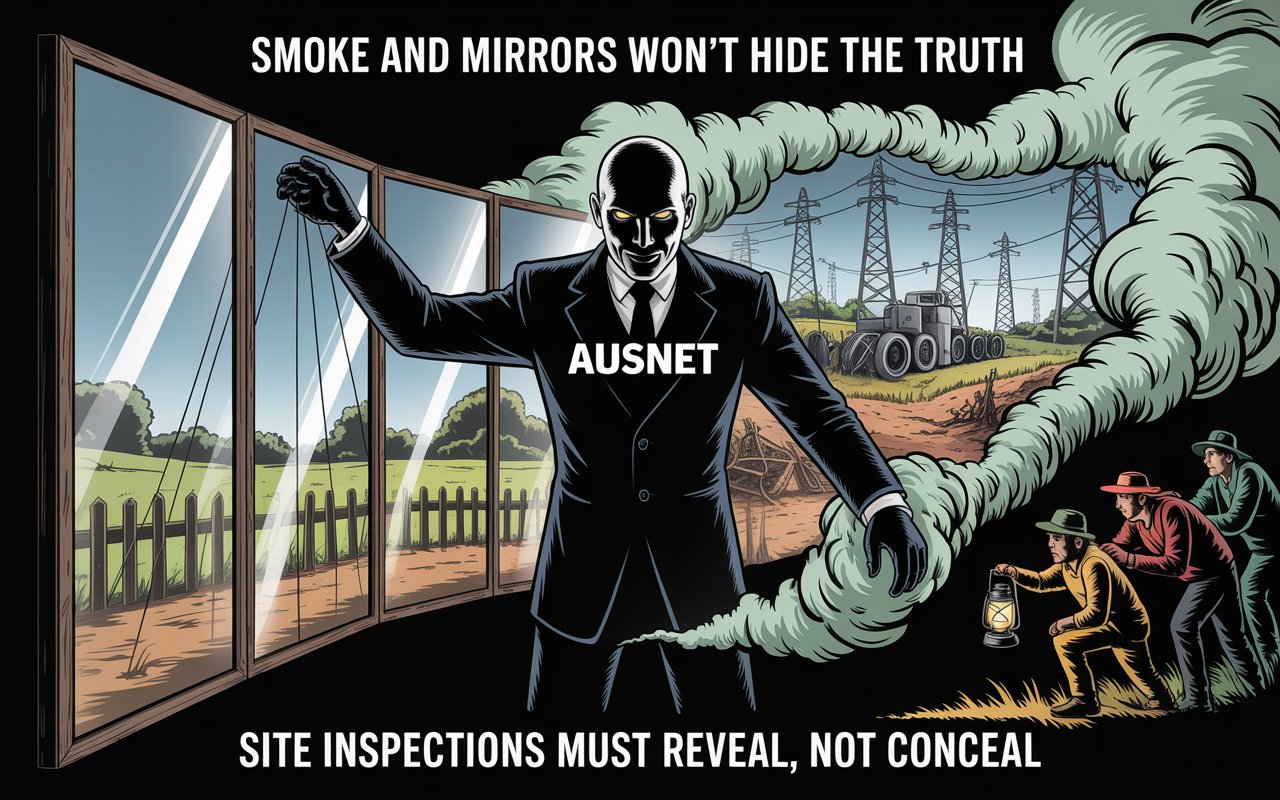
Site Inspections Must Reveal, Not Conceal, as WRL Hearings Begin
This week marks the opening of the Western Renewables Link EES hearings. For us-farmers, landholders, community members-the stakes are not abstract. Decisions will echo in soil, memory, livelihood. Our urgency is real because the threat is real.
What is most revealing, and most disturbing, is the curated nature of these site inspections. Planned by the project proponent, their itinerary privileges public roads and safe vantage points. The intention is comfort, not confrontation. The reality most affected-our private land, our homes, our histories-is kept at the margins, hidden out of sight.
This is not just administrative oversight; it’s a strategy. A strategy that sanitises impact, erases struggle, and delivers decision-makers an airbrushed version of the truth. It is an evasion-the kind of evasion that tells the world “there is nothing to see here,” while scars are carved into the land just beyond the fence.
Why Our Land Matters
These are not anonymous properties-they are working farms, generational stories, habitats for native life. They represent the complexity of coexistence, the friction between progress and permanence. Towers and transmission lines do not pass harmlessly overhead: they intrude, divide, diminish. The risk to safety, the disruption of operations, the permanent alteration of landscape-none of it can be glimpsed from the shoulder of a highway. Only presence on the ground exposes the full cost.
A Call for Fairness and Recognition
We call on the Inquiry and Advisory Committee to step into the places where impact is not hypothetical, but real. To actually see-not just theorise-the ordinary ground that will bear extraordinary burden.
Anything less is not fairness. Anything less is not justice.
This is not a plea for special treatment but a demand for honest accounting. The hearings must be expanded, the timetable adjusted, so the full, uncomfortable story is encountered, not evaded.
We Deserve to Be Seen
Trust is not built by gesture, but by witness. We need our lived reality recognised-not edited for the sake of convenience. If these hearings mean to serve the public interest, they must see all of it, including the parts that challenge, discomfort, and disrupt.
We stand together-our voices, our land, our resolve. We insist upon visibility, upon reckoning. Because abstract decisions produce concrete consequences, and the only fair outcome is one that confronts what is truly at stake.
Western Victoria has become ground zero for Australia’s backlash against a renewable agenda driven by profit, not principle.
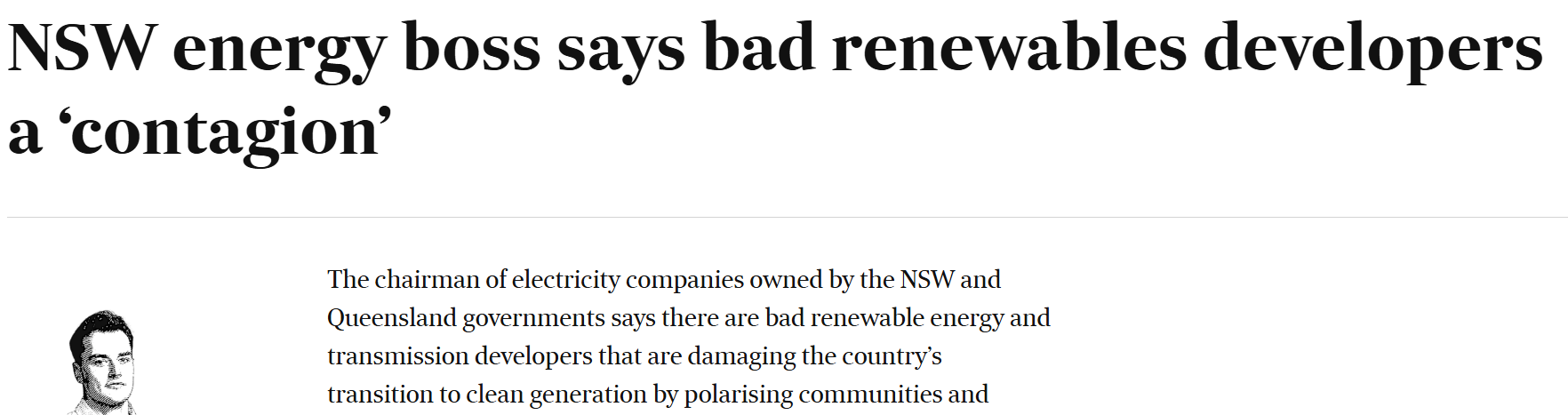
The AFR article reveals that NSW energy chief Paul Moy has warned of a growing “contagion” of reckless renewable developers chasing profit over principle – and he singles out Western Victoria as a prime example of where communities have had enough and are saying “no.”
Moy pointed to Western Victoria’s strong resistance to large-scale power line and wind projects as evidence of what happens when governments and corporations bulldoze through local opposition. He said poor industry behaviour – marked by secrecy, disregard for landholders, and short-term gain – has eroded trust to the point that entire regions are pushing back.
His words echo what Western Victorian landholders have been voicing for years: the renewable energy boom is being hijacked by corporate greed and political vanity. Instead of building cleaner, smarter systems, governments are enabling an industrial land grab – one that profits developers while communities and the environment pay the cost.
In short, the article confirms what locals have long known: Western Victoria has become ground zero for Australia’s backlash against a renewable agenda driven by profit, not principle.
The Hidden Costs of Doing What We’ve Always Done
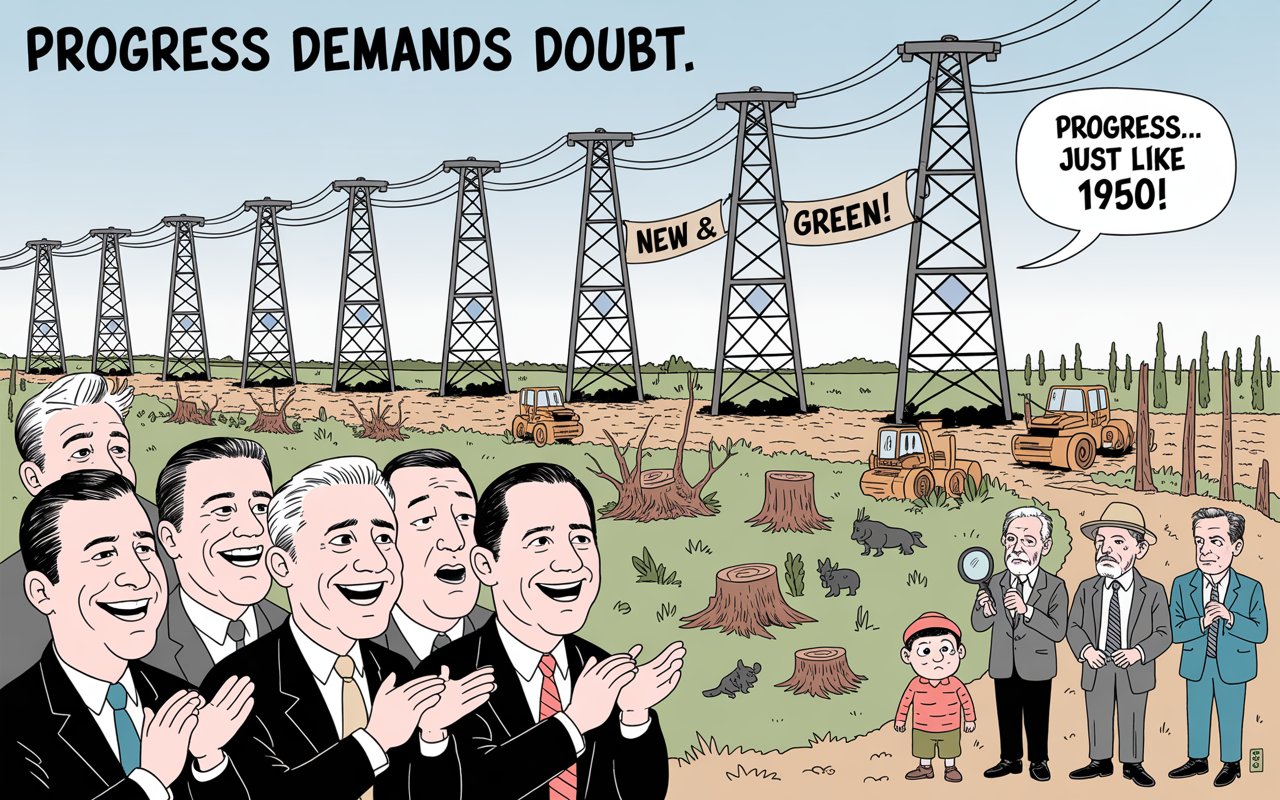
Let’s start with something obvious, but easy to overlook: High-voltage overhead transmission lines aren’t just visible, they’re relics. They’re the telephone poles of heavy industry-a leftover technology stamped across the past century, designed for a problem that’s changed.
Now, here’s where this becomes interesting. Every leap in science-the ones we celebrate in textbooks-began with someone asking a simple question: “What if the experts are wrong?” For decades, x-rays were given as tonics. Lead was everywhere, from gasoline to paint to pipes. The wrong idea, at the wrong time, protected by the right people. Until someone noticed the cost.
Today, we find ourselves in a familiar story. The world is warming. Climate change is real. But the group-think that’s followed-the rush to build, to claim urgency, to install more and more towers as proof of progress-feels less like innovation and more like inertia. Instead of evolution, we double down on what’s easiest for the biggest players.
We standardize pain, not progress.
If we step back-from roadsides, from boardrooms, from environmental platitudes-what pattern emerges? We see governments and corporations lining up to sell “solutions.” Only now, the solutions look increasingly like the problem. Billions of dollars and “green” dreams are reshaping forests and farmland into grids of steel and wire. All justified by the same logic that says “We must act,” but never stops to ask, “Is this the right way to act?”
Here’s the twist: When challenging this model becomes taboo, you can be sure someone-some corporation, some agency-is making good money out of old technology. Scrutiny, after all, is the enemy of easy profit. So high-voltage overhead lines remain not because they’re the best choice, but because they’re the entrenched one.
The irony? In the name of saving the planet, we’re carving it up faster than ever-with little push for safer, smarter undergrounding, distributed energy, or real local innovation. Those who question this aren’t Luddites. They’re asking what everyone should: Are we repeating out-of-date solutions just because they serve the system already in power?
Progress demands doubt. It demands that we keep asking, keep testing, keep improving. Right now, the biggest threat is not to the towers, but to the possibility we might imagine better. The longer we let inertia masquerade as urgency, the more we’ll regret the opportunity wasted.
That’s how real change happens. Not by building more of the same, but by having the courage to say: “Let’s do it differently this time.”