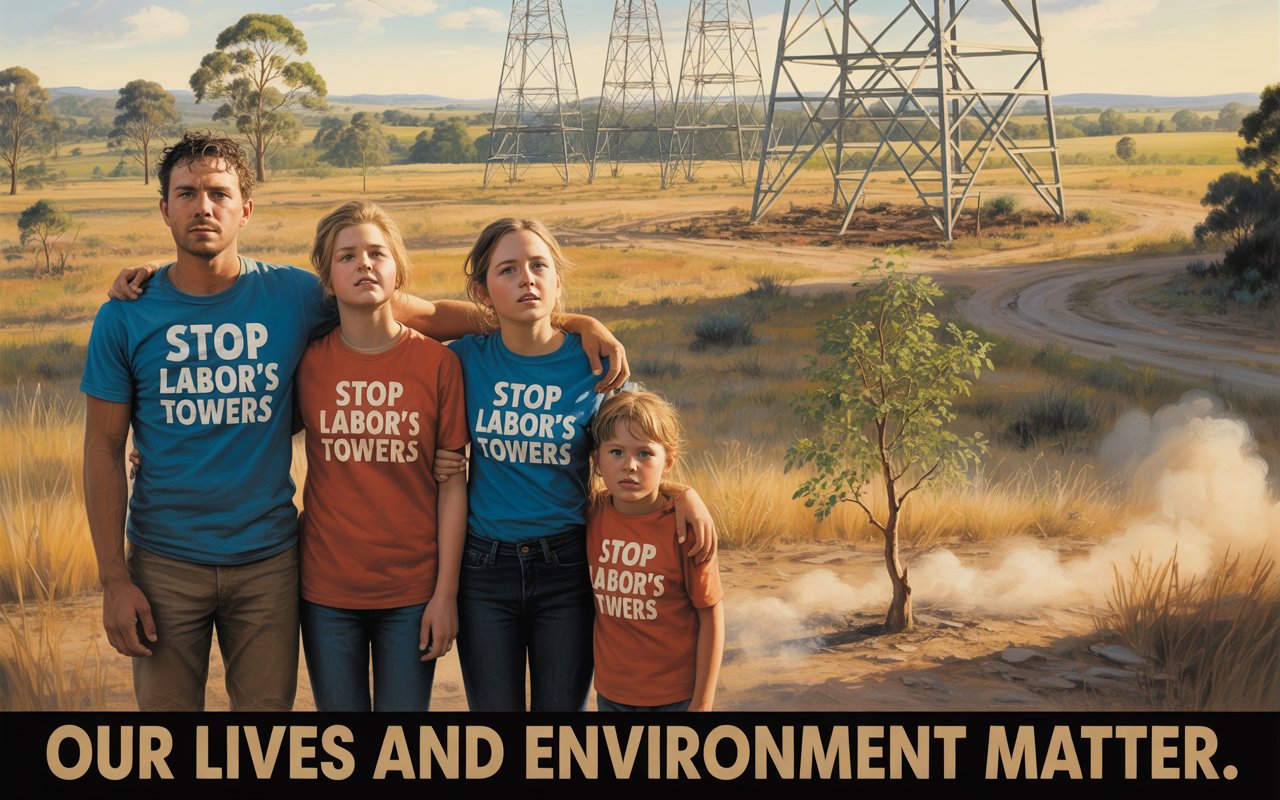
STOP LABORS TOWERS
NEWSLETTER – November 30 2025
WRL EES Hearing – End of Week Four – Community Voices at the WRL Hearing
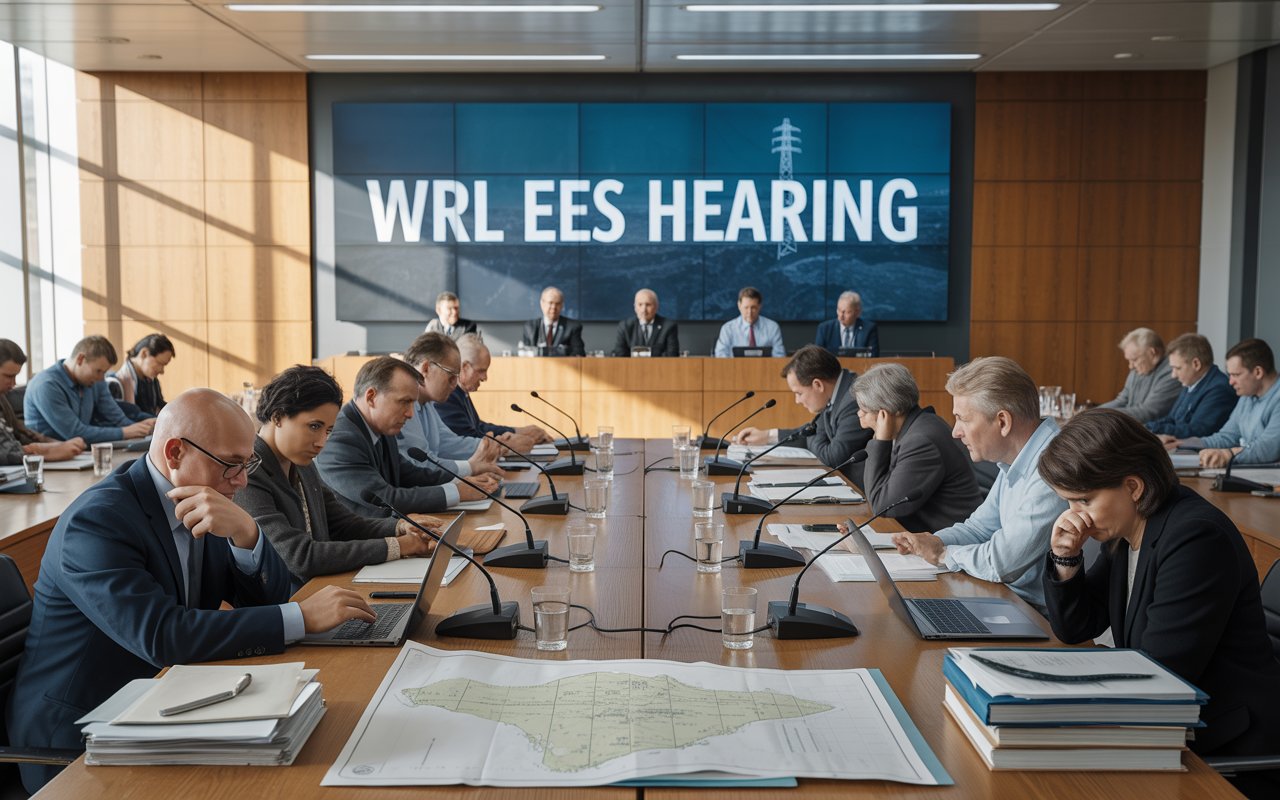
WRL EES Hearing – End of Week Four and the Week Ahead
Last week’s Western Renewables Link (WRL) EES Hearing made one thing brutally clear: to the project’s proponents (AusNet), individual lives don’t matter.
For five years, landholders have endured an aggressive, dismissive, and at times openly hostile approach – and now that same behaviour is on full display in the hearing room.
This is no longer about “engagement.”
It is about power, pressure, and pushing people aside.
A Turning Point: Steve Curry (re)joins the Fight
Actor Steve Curry, a proud member of Stop Labor’s Towers and whose family property lies inside the proposed corridor, joined the hearings this week. His message resonated deeply across regional Victoria.
“This isn’t a script. It’s real families whose lives are being dismantled one decision at a time.”
His presence drew statewide attention to the mental health crisis unfolding in the corridor – a crisis the proponent continues to treat as a minor footnote.
Curry highlighted what many already know: the psychological pressure, the fear of bushfire entrapment, the loss of safety and connection to home – none of this is being taken seriously.
The Realisation That Shocked the Room
A defining moment came when it became clear that Victoria’s Principle of the Primacy of Life – the highest standard in bushfire safety – is being treated as secondary to commercial return.
In simple terms:
So long as a foreign-based corporation can secure its profit, the heightened risk to life in Western Victoria is being deemed “acceptable.”
This is not planning. This is sacrifice – and the people being sacrificed are us.
A Pattern of Dismissal and Institutional Betrayal
The hearing again revealed a disturbing pattern:
- Community submissions missing or “lost”
- Key evidence overlooked
- Mental health impacts minimised
- Bushfire risks downplayed
- Social harm treated as an inconvenience
Independent experts have already described the social impacts as “unmitigable.”
Yet the proponent continues insisting that no “material increase” in risk exists – a claim completely disconnected from on-the-ground reality.
“When people feel dismissed or unheard, that’s not just bad policy – it’s psychological injury.” – Steve Curry
Next Week: A Major Moment for the Truth
Next week, the hearing enters a critical phase.
Moorabool Shire will present their undergrounding expert, Les Brand from Amplitude.
Les will be giving detailed evidence on the feasibility of undergrounding – an alternative the proponent has repeatedly misrepresented or ignored.
This will be followed by closing submissions from Moorabool Shire before the IAC hands the process over to the City of Melton.
What the Hearing Exposed
- The proponent is willing to gamble with bushfire lives.
- Social and mental health harm is being downplayed or dismissed.
- The process itself is becoming a source of injury.
- Communities are being treated as obstacles, not stakeholders.
- Profit is being placed above the Primacy of Life – the exact opposite of Victorian bushfire policy.
Where We Stand
We stand firm. We stand united.
And we stand as proof that regional Victoria will not accept being treated as expendable.
The WRL cannot be allowed to proceed in its current form. Not when safer, modern options exist including undergrounding and use of existing easements.
Not when our wellbeing, our environment, and our lives are at stake.
As the hearing enters its next stage, Western Victoria’s message remains unchanged:
This is our home.
These are our lives.
And we will not be sacrificed for corporate profit.
Please share this with your Networks of community members.
Hearing Details
Location:
Victorian Planning Panels – WRL EES Hearing
Karstens, Level 12, Rooms 1203 & 1204
123 Queen Street, Melbourne
(approx. 15-minute walk from Southern Cross Station)
Moorabool Shire Presentation Schedule:
(Links below to Expert Witness Statements)
- Monday 01/12 (10:00am – 4:30pm) – Les Brand – Undergrouding
- Tuesday 02/12 (10:00am – 4:30pm) – Moorabool Shire Submission and Closing
- Wednesday 03/12 (10:00am – 4:30pm) – Melton City Coucil with Landscape and Visual Amenity Expert – Chris Goss of Orbit Solutions
- Thursday 04/12 (10:00am – 4:30pm) – Melton City Coucil with Social from Robert Panozzo of ASR Research and Aviation from Bryan Fitzgerald of Airport Surveys Pty Ltd
Attend one day, half a day, or all four — every bit of presence counts.
How You Can Participate
- Attend in person if possible — the impact is real and immediate.
- Watch online — your presence still counts.
- Share this message widely through your networks.
- Support each other — coordinate attendance, carpool, and encourage one another.
Please attend — online or in person — and help strengthen the communites voice against the WRL.
Hold the line.
Community Action Guide: Western Renewables Link (WRL) EES Hearings
Holding Power to Account
A strong community presence is essential to hold the proponent (AusNet) and its so-called independent experts accountable. In Week 1, we have already seen examples of the proponent’s witnesses downplaying significant and life-threatening risks associated with the project.
This disingenuous and dangerous approach must be confronted.
Your participation matters. Each voice contributes to transparency, truth, and community strength.
Below is a practical step-by-step guide to help you follow the hearings, access documents, and take part directly in questioning.
Step 1 – Access the Hearing Timetable
The Western Renewables Link (WRL) Environment Effects Statement (EES) Public Hearingscommenced on Monday, 27 October 2025, and will run through to Thursday, 5 March 2026.
How to Find It
- Visit the Inquiry and Advisory Committee (IAC) main page:
🔗 WRL EES Hearing Main Page - Go to “Tabled Documents.”
🔗 Tabled Documents Page - Download the latest Hearing Timetable (Document Here)
The timetable lists:
- Which expert witnesses are scheduled to appear,
- Their topics (e.g., bushfire risk, landscape and visual impacts, agriculture), and
- The session dates and times.
Community Submissions
The current timetable lists expert evidence, councils, and agencies through to late December 2025.
Community submitters are expected to present between January and March 2026, with Ballarat hearings (Weeks 11–14) scheduled for February 2026.
Keep checking for timetable updates to confirm your appearance date.
Step 2 – Review Expert Materials
Before each presentation, the proponent’s “independent” experts usually upload an overview of their evidence to the Tabled Documents section.
You can find them here:
🔗 Tabled Documents – Expert Evidence
Examples of Key Expert Documents
- Joint Expert Statement – Economics (AusNet)
- Joint Expert Statement – Bushfire (AusNet)
Tip
Read these expert summaries before their scheduled presentation.
They reveal the assumptions, omissions, and technical biases underpinning the evidence – crucial for preparing questions or identifying misleading claims.
Step 3 – Request to Cross-Examine (Ask a Question)
If you wish to pose a question or cross-examine an expert, you must register your intent with the IAC Secretariat no later than 12:00 pm the day beforethe expert is due to appear.
| Requirement | Action to Take | Details / Contact |
| Notify the IAC | Email your intention to cross-examine. | 📧 planning.panels@transport.vic.gov.au |
| Deadline | Before 12:00 PM (noon) on the day prior to the expert’s scheduled appearance. | Confirm the expert’s date in the hearing timetable. |
| Email Content | Simply state your name, the expert or topic, and the approximate time required. | Example: “[Your Name] requests time to cross-examine [Expert Name] on [Topic] and estimates [X] minutes is required.” |
| Your Safeguard | You are formally listed as a participant for that part of the evidence. If your question is answered during the session, you may simply pass. | This ensures your right to speak is protected and recorded. |
Why This Matters
By following these steps, you help ensure the WRL hearing process remains transparent and accountable.
Every individual who observes, questions, or challenges the evidence strengthens the integrity of the process.
The hearings are not merely procedural – they are a test of truth.
When the facts are distorted, community participation becomes the only real counterbalance to corporate spin and political complacency.
Quick Links Recap
MEDIA RELEASE 29th, November 2025
“IT’S THE VIBE”: STEVE CURRY BRINGS THE CASTLE TO VICTORIA’S LONGEST ENVIRONMENTAL HEARING
MELBOURNE – The fight for Western Victoria’s future took a powerful turn this week as actor Steve Curry joined the Western Victoria Community Alliance (WVCA) at the Western Renewables Link (WRL) Environment Effects Statement (EES) Hearing – now the longest environmental inquiry in Victoria’s history.
Curry, whose own family property lies inside the proposed transmission corridor, told the panel that the mental health and social trauma being inflicted on rural communities was “far more real and far more devastating” than anything portrayed on screen.
“In The Castle we were acting out a story about ordinary people pushed around by big corporations,” Curry said. “But what’s happening here isn’t a script. It’s real families whose lives are being dismantled one decision at a time. The stress, the uncertainty, the fear of losing home – it takes a toll you can’t unwind.”
A Historic Fight With Historic Human Impacts
Running for 15 weeks until March 2026, the WRL hearing surpasses even the North East Link and Metro Tunnel inquiries. This extraordinary duration reflects the profound social and psychological harm being exposed in evidence.
For weeks, the panel has heard that landholders are experiencing chronic stress, loss of community, financial insecurity, fear of bushfire entrapment, deteriorating mental health, and what independent experts have called “unmitigable social harm.”
The WVCA argues that the proposed WRL’s design of 80-metre lattice towers cutting through farms, homes, and high value environmental landscapes including some of Victoria’s highest bushfire-prone ridgelines – directly undermines the wellbeing, safety, and dignity of the people it affects.
“People out here are exhausted,” Curry told the panel. “They’re trying to farm, raise families, and keep their lives steady, while a project of this scale sits over them like a permanent shadow. The mental pressure is relentless.”
Institutional Betrayal: When the Process Causes the Harm. Independent expert evidence presented on behalf of Moorabool Shire has highlighted serious failures in the Proponent’s Social Impact Assessment (SIA). Curry pressed the expert with questions that forced the panel to confront the psychological reality faced by affected communities:
On Institutional Betrayal: “Does the SIA’s failure to recognise deeper harms reflect a broader pattern where the process itself becomes a source of injury? When people feel dismissed or unheard, that’s not just bad policy – it’s damaging to mental health.”
On Bushfire Anxiety and Safety: “In high bushfire-risk areas where residents have only one escape route, does living with the permanent fear of being unable to evacuate amount to an ongoing breach of safety and wellbeing?”
On Unacceptable Harm: “When people lose their sense of home, place, safety, and certainty, at what point does that become an impact that no reasonable person would accept?”
A Broken Plan – and Real Alternatives
The WVCA maintains that while renewable energy is essential, destroying the social and environmental fabric of Western Victoria is not. Modern undergrounding technology and the use of existing easements represent feasible alternatives that would avoid:
- irreversible environmental loss
- heightened bushfire risk
- severe mental health and social impacts
- generational agricultural loss
- landscape and amenity destruction
“People aren’t anti-renewables,” Curry said. “They’re anti being run over by a process that ignores the human consequences. If the transition to clean energy destroys the communities it claims to protect, then something has gone very wrong.”
The Hearing Continues
The inquiry resumes next week with further evidence on bushfire risk, transmission safety, and underground feasibility.
About the Western Victoria Community Alliance (WVCA)
The WVCA is a community-led incorporated association representing affected landholders, businesses, and organisations across Western Victoria. The Alliance advocates for least-impact infrastructure solutions and the protection of regional agricultural, environmental, and social assets.
Ground Zero of Net Zero
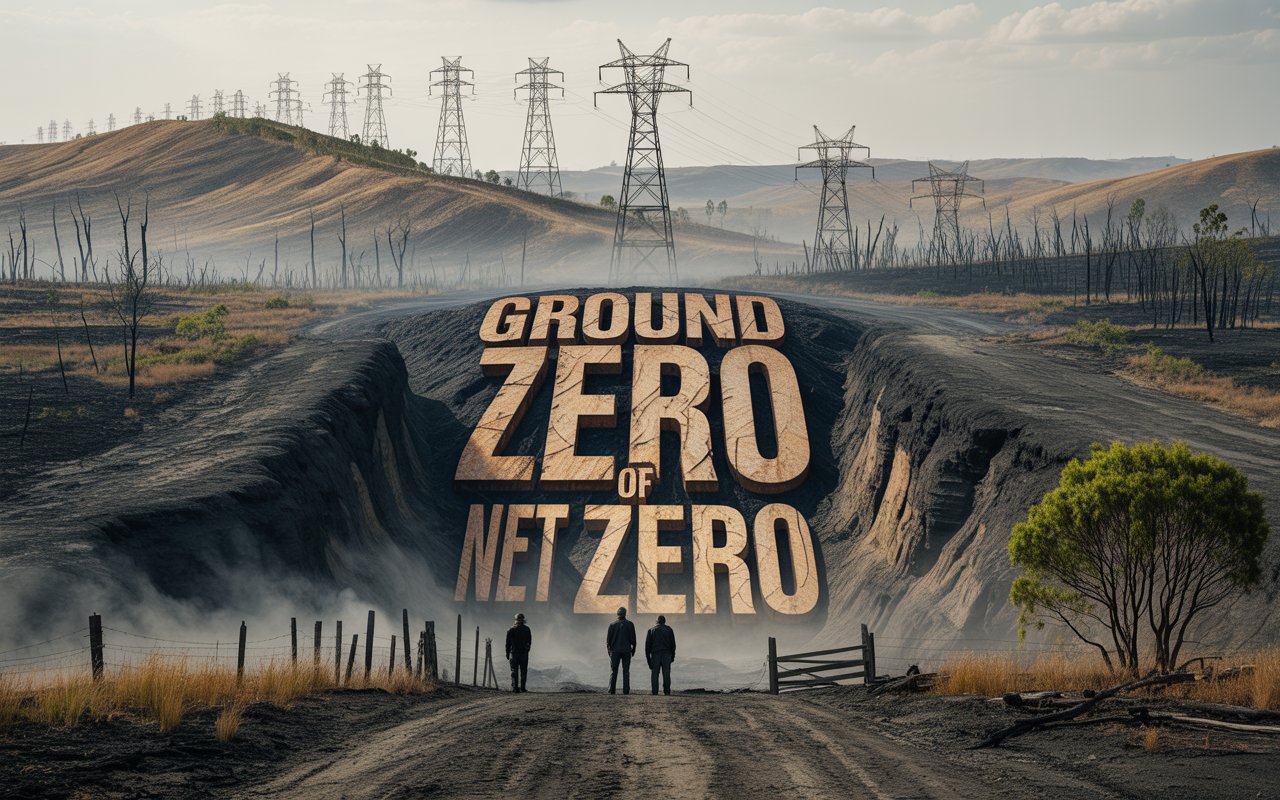
A reflection on resilience in Western Victoria
For more than five years, our communities have stood in the path of a project that treats Western Victoria as expendable. We’ve been told the transition is inevitable, the route unavoidable, and our concerns incidental. But for those of us who live here, the reality looks very different to the glossy brochures and city press conferences.
We are not simply part of a “renewables corridor.”
We are Ground Zero of net zero – the place where theory becomes impact, where decisions made in offices land on real families, real farms, and real futures.
The analogy is hard to ignore. Once, the coal face was where workers carried the burden of the nation’s energy. Now, we are asked to stand at the edge of a new kind of extraction – a transition trench dug through communities, landscapes, and livelihoods, while the benefits flow elsewhere.
We are told the short-term gains justify the long-term costs, but those costs are borne by us:
- heightened bushfire risk
- mental and social harm
- loss of amenity and land
- uncertainty that eats away at wellbeing
- environmental damage that cannot be undone
And yet, through all of this, our communities have shown something the proponent did not foresee – resilience.
The land teaches it. After fire, the grass returns. After drought, the roots hold on. We, too, have learned to endure, to organise, and to stand our ground.
They may think of us as obstacles.
But we know the truth: we are guardians of this place.
They may hope fatigue will silence us.
But we rise – again and again – with deeper conviction.
No trench, no tower, no corporate forecast can erase the bond between people and country. And no transition is just if it destroys the very communities expected to host it.
As this hearing continues, and as the fight for fair and responsible energy infrastructure intensifies, one simple message remains:
We are still here.
We are not moving.
And we will not be sacrificed for profit.
Victoria’s Climate Agenda: Policy or Political Spin?
Jacinta Allan’s aggressive climate and renewable energy agenda touts “world leading” emissions targets and a 95% renewable electricity goal by 2035, claiming this will “drive down power bills” and create “tens of thousands of jobs”. The state has even pulled forward its net-zero deadline to 2045, cementing Victoria’s self-described place at “the forefront of global climate action”. The rhetoric paints an urgent picture of climate necessity – but is this agenda driven by environmental need or political ambition?
Grand Promises vs. Ground Realities
Closer scrutiny suggests Victoria’s climate push is heavy on spin. For one, Victoria produces only a tiny fraction of global emissions (around 1.2% of the world’s emissions come from all of Australia, with Victoria contributing about one-fifth of that). In other words, even sweeping decarbonization in Victoria would barely register globally. Yet the government exaggerates the local impact and urgency, implying its “bold” action will significantly help “save the planet.” Meanwhile, the promised economic upside is questionable. Officials project 59,000 new jobs from the green transition, but such rosy forecasts rarely account for jobs lost or the high costs passed to taxpayers. In fact, key costs have been downplayed – a recent analysis found the price tag for the required new “green” electricity grid was at least $16 billion higher than the government admitted.
Those extra billions will hit consumers: building all the new poles, wires and backup systems needed will see power bills rise by roughly 50% under the plan, not fall as promised. Even a state-appointed expert concedes Victoria’s plan faces “tensions among regional electorates pushing back against new transmission infrastructure” – a polite way of noting fierce rural backlash as farms are targeted for massive wind, solar and power line projects. (A now-deleted government report even floated converting up to 70% of Victoria’s farmland to renewable energy sites.) These on-the-ground realities starkly contrast with the triumphant narrative from Spring Street.
A History of Misleading Narratives
The pattern is familiar: when political leaders smell advantage, spin often trumps substance. Fomer Premier Andrews himself was adept at this – he “saw the political opportunity” in the green transition, even marketing the coal phase-out as a nostalgic return of a state-owned power company to win public sentiment. And Labor is hardly shy about shaping narratives. Consider its infamous “Mediscare” antics: the party has repeatedly pushed misleading claims that conservatives would scrap Medicare, most recently circulating a deceptively edited video to falsely imply the Opposition Leader said “Medicare is dead”. This willingness to bend the truth for political gain spans the political spectrum – a reminder that lofty causes can be used as convenient cover for winning votes.
Political Theatre vs. True Climate Need
Allan’s ramped-up climate agenda appears less about physics or finance than about politics. The government’s over-the-top sales pitch – urgent warnings, grandiose benefits, vows of “cheap” clean power – serves to galvanize a desired public image: Victoria as a climate champion leading the charge. In reality, the state is barreling ahead of even national targets (which experts doubt will be met), risking massive bills and infrastructure upheaval for minuscule global effect. Climate change is real, but Victoria’s response seems calibrated more to score political points than to materially alter the climate. The people of Victoria deserve an honest conversation about costs and benefits, not a green veneer over political theatre. In the end, tackling emissions is important – but so is tackling the spin that exaggerates their urgency and payoff for self-serving ends. Victoria’s climate policies should be driven by pragmatism and necessity, not just the siren song of political PR.