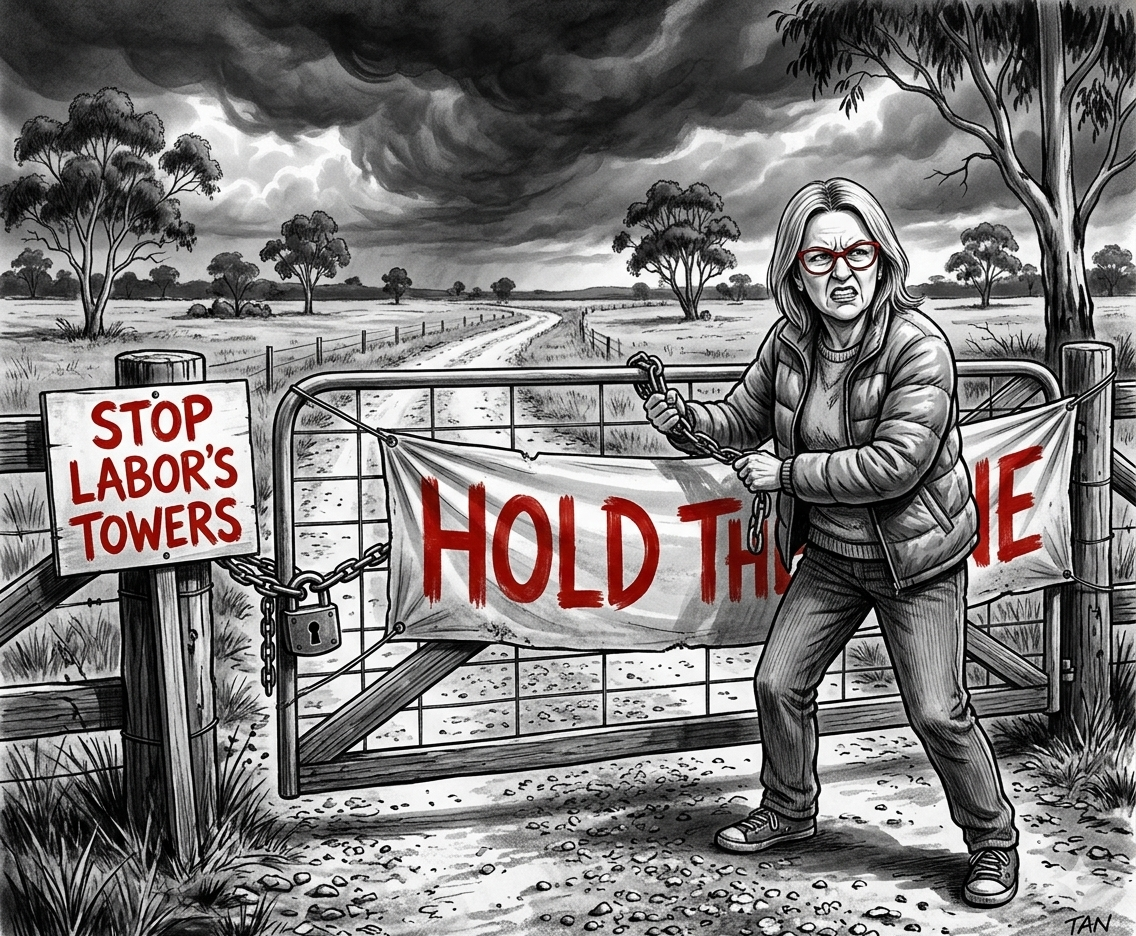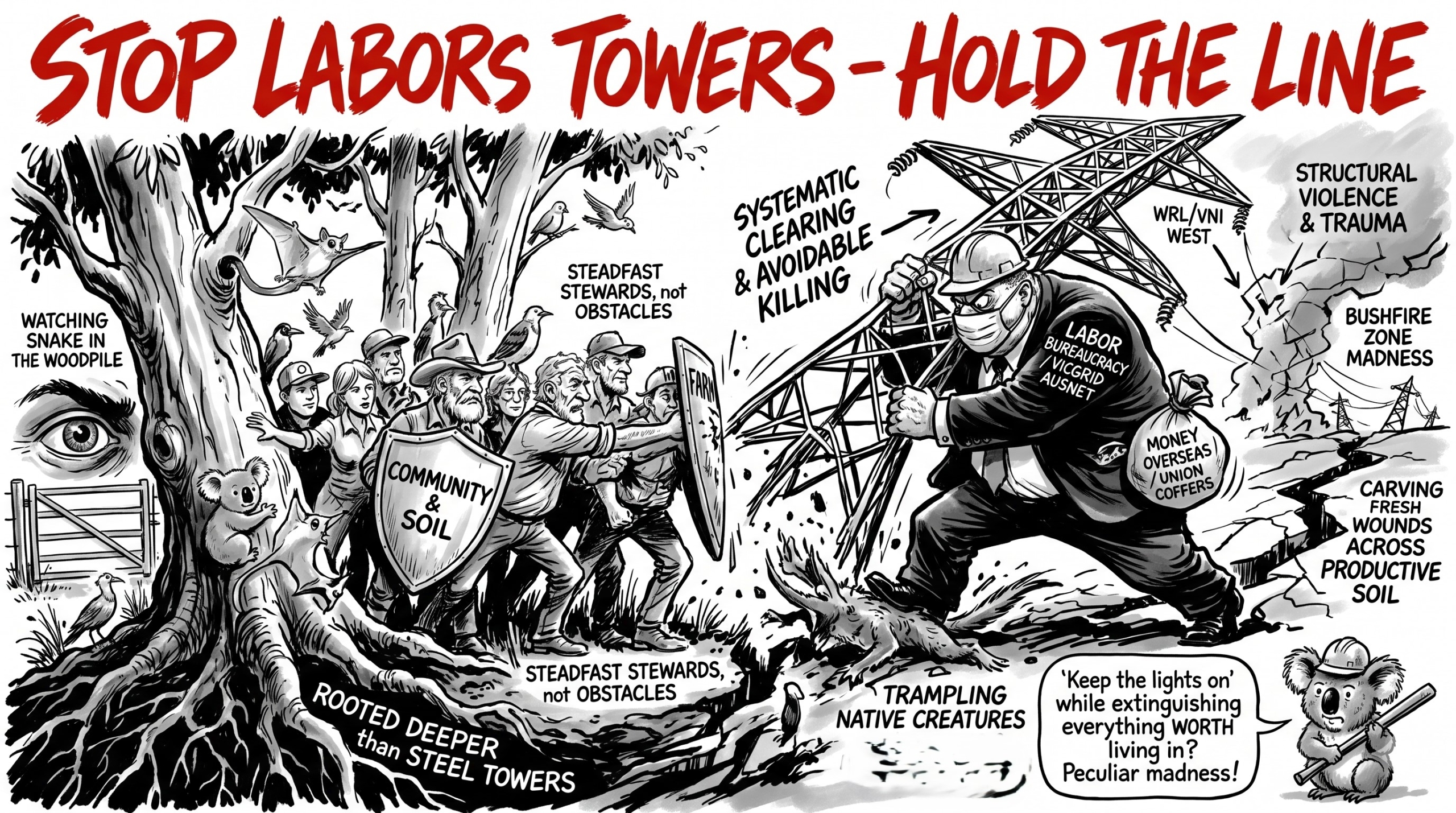
STOP LABORS TOWERS
NEWSLETTER – May 8, 2026
COALITION VOWS TO PULL THE PLUG ON WRL AND VNI WEST

The state election in November sits on the horizon like a storm cloud that might actually bring rain instead of more dry lightning. The Coalition – leader Jess Wilson and Danny O’Brien – have stepped onto the porch and promised to halt this steel procession of the Western Renewables Link (WRL) and VNI West. They’ve vowed to pull the plug on the rollout, offering a pause that feels like a long-overdue breath for a man being throttled. It is a promise to look at the “Plan B” of using old easements – land that has already been broken to the harness of the wire – rather than carving fresh wounds across the productive dirt of Western Victoria.
For close to six years, ten’s of thousand in this community have stood at their gates, watching the surveyors and the bureaucrats with the same steady, unblinking eye one keeps on a snake in the woodpile. We have remained politically neutral, not out of indecision, but because the land doesn’t care about parties – it only cares about who is trying to kill it. The recent Environmental Effects Statement (EES) confirmed what the local heart already knew: these projects offer nothing but irreversible damage to the environment and the agriculture that feeds the very people who would destroy it. To run high-voltage lines through one of the state’s most ferocious bushfire zones is not progress; it is a peculiar kind of madness that invites a devastation no insurance check could ever square.
While the Labor government speaks in the high, thin tones of “keeping the lights on,” it is hard not to see the self-preservation lurking behind the rhetoric. There is a crookedness in turning off the lights yourselves and then claiming to be the only ones who can find the switch. Their agenda serves a master that doesn’t live here – money flowing overseas for materials while feeding the coffers of unions that bolster the very people holding the pen. They have hired VicGrid and Ausnet to do their bidding, but in the eyes of this community, those entities are not public servants; they are the enemies of the environment they claim to be saving.
A cynic might say the Liberals are just playing at politics, but there is a difference between a man who talks and a man who finally hears. They seem to be listening to the reality of food production, the environmental destruction that will never recover and the weight of a community that has been ridden roughshod over for too long.
To the Victorian Labor government: understand that we have everything to lose, and there is a grim, immovable power in a community that has already looked into the eye of its own destruction and refused to blink. We are rooted in this soil deeper than any steel tower can be driven. We will not be cleared like scrub to make way for your ledger. We aren’t going anywhere. We will remain a permanent judgment upon your plans until you offer a result that treats this land with the respect its survival demands.
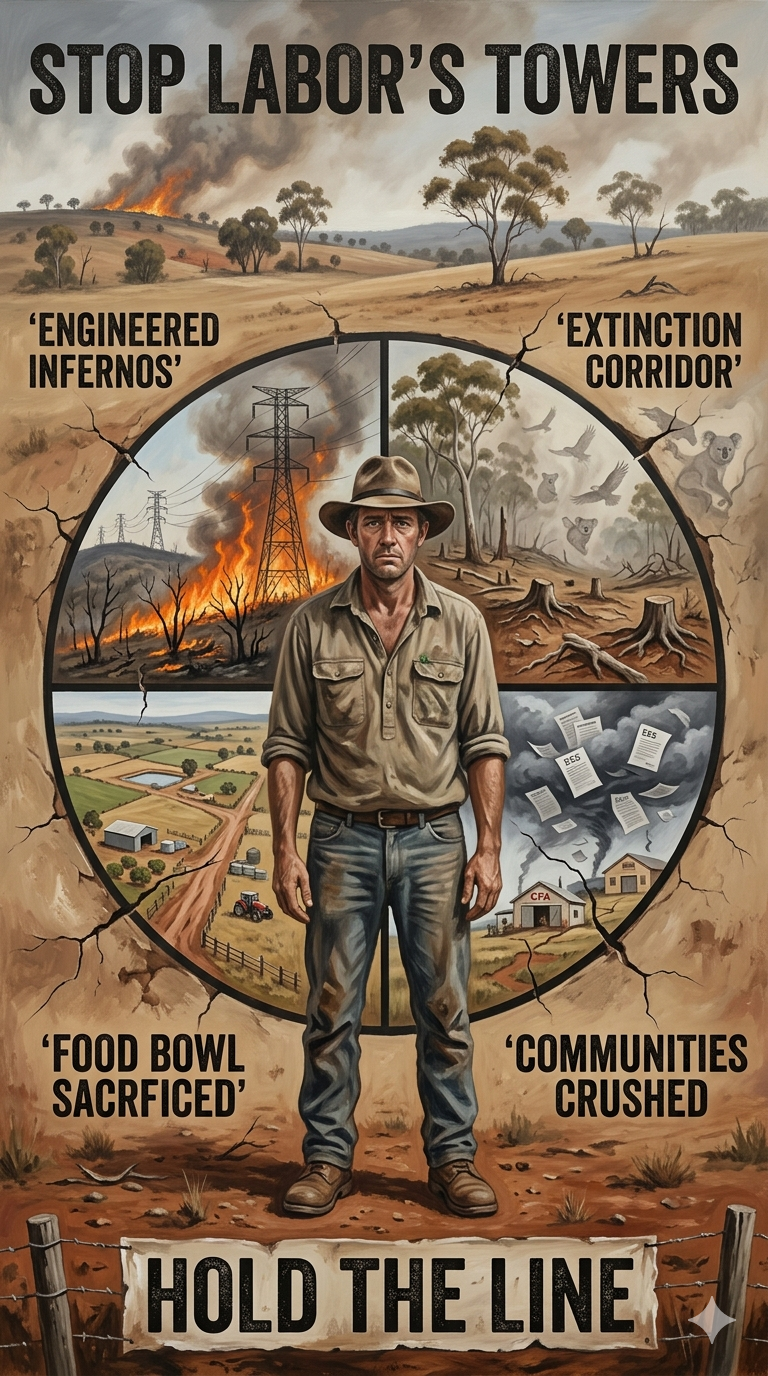
A recent, harrowing investigation by Greg Roberts in The Australian has finally pulled back the curtain on the “dirty secret” of our national energy transition: the emergence of industrial “killing fields” stretching across the Australian wilderness.
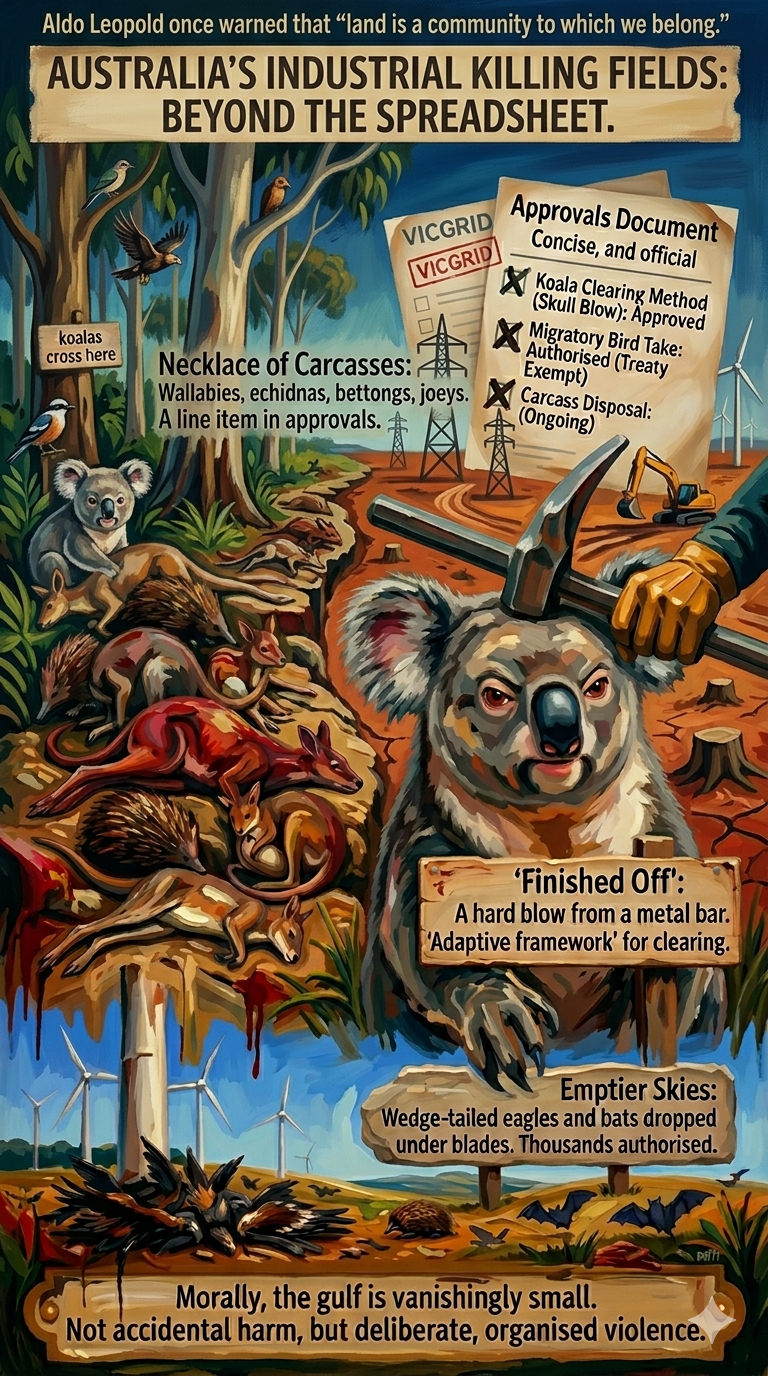
From the mangled carcasses of joeys on Queensland access roads to the chilling bureaucratic protocols for “finishing off” injured koalas with a blunt metal bar, Roberts reveals a scale of ecological carnage that has remained largely invisible to the urban public.
This clinical, organized destruction is more than just a series of unfortunate accidents; it is the physical manifestation of a philosophy that views the living world as a mere obstacle to be “optimized.” As we see these same patterns of abstraction and enforcement moving south through the transmission corridors of Victoria, it becomes clear that this is not just an environmental crisis – it is a moral one.
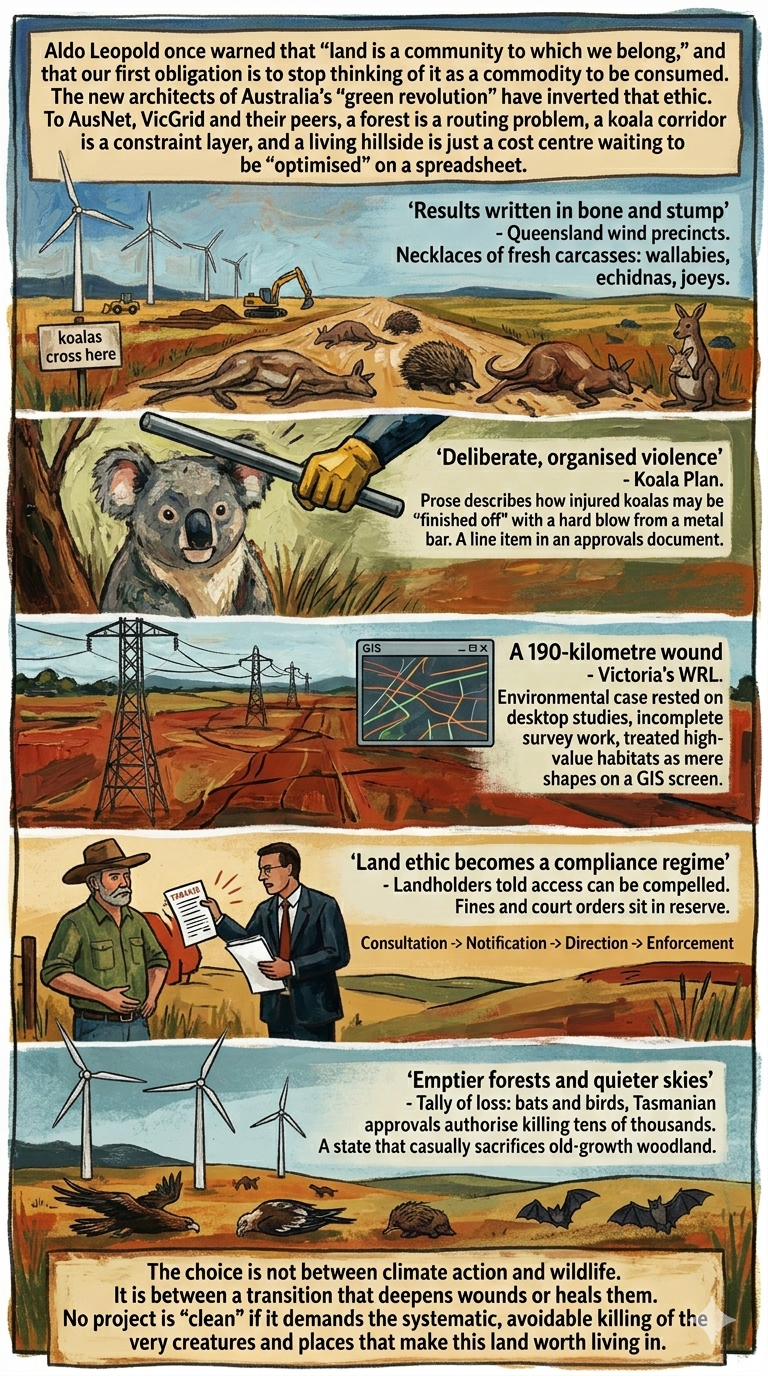
Aldo Leopold (an American ecologist, forester and writer, widely regarded as a founding figure of modern wildlife management and environmental ethics) once warned that “land is a community to which we belong,” and that our first obligation is to stop thinking of it as a commodity to be consumed. The new architects of Australia’s “green revolution” have inverted that ethic. To AusNet, VicGrid doing the bidding of the Labor Goverment and their peers, a forest is a routing problem, a koala corridor is a constraint layer, and a living hillside is just a cost centre waiting to be “optimised” on a spreadsheet.
Walk the country where this theory is being applied and you see the results written in bone and stump, not in glossy ESG reports. In Queensland’s wind precincts, dawn traffic to sites like MacIntyre and Clarke Creek leaves behind a necklace of fresh carcasses: wallabies, echidnas, joeys still in the pouch, rufous bettongs under signs politely reminding drivers that koalas cross here. The turbines themselves add their own tally – bats and birds dropped under the blades, wedge‑tailed eagles and flying‑foxes recorded in collision reports that almost never see daylight. On the ridgelines, dynamite turns mountaintops into level pads for steel towers, and the last intact glider and koala habitat in places like Lotus Creek is converted into haul roads and turning circles.
This is not accidental harm at the margins of an otherwise gentle enterprise. It is deliberate, organised violence against land and life, written into “management plans” and “adaptive frameworks”. One biodiversity plan for a major wind project spells out, in cool bureaucratic prose, how koalas injured during clearing may be “finished off” with a hard blow to the back of the skull from a metal bar. If the same method were used on a worker in a hard hat, there would be sirens and royal commissions. Applied to animals, it becomes a line item in an approvals document. The only difference is that the victim wears fur instead of a name badge; morally, the gulf is vanishingly small.
Leopold argued that “a thing is right when it tends to preserve the integrity, stability, and beauty of the biotic community.” By that standard, much of our present rush to renewables is wrong in almost every particular. Australia’s new industrial killing fields now run from those Queensland ranges all the way to the long transmission corridors planned by companies like AusNet, threading through remnant forest, koala habitat and working farms so that foreign utilities and listed infrastructure funds can keep the transition on their balance sheets. In Victoria, the Western Renewables Link is proposed as a 190‑kilometre wound across the state – a corridor whose environmental case, as aired in EES hearings, rested on desktop studies, incomplete survey work and a routing exercise that treated townships, productive soils and high‑value habitats as mere shapes to be stepped around on a GIS screen.
When challenged, the response was not to go back to the land and learn it, as Leopold did with his sand counties, but to retreat further into abstraction. Gaps in biodiversity data became “limitations”; unresolved impacts were deferred to later “performance requirements”; hard questions about alternative siting and undergrounding were brushed aside as uneconomic or “out of scope”. This is not a planning system learning from the land; it is a bureaucracy trying to manage public outrage while the route inches forward. A proponent that is willing to push overhead steel through some of the best remaining country on the strength of contested modelling and half‑finished ecology has already told us how it will behave once the bulldozers arrive.
Out front, VicGrid and its political masters recite a different story – of net‑zero targets, cheaper bills, “renewables zones” and community benefit funds. But in the paddocks and gullies where the survey pegs appear, another reality asserts itself. Landholders along the paths of VNI West and WRL are told that access, if not granted, can be compelled; that fines and court orders sit in reserve if “engagement” fails; that compulsory acquisition can proceed even before the full measure of ecological damage is known. Consultation drifts into notification, notification into direction, direction into enforcement. The land ethic becomes a compliance regime enforced by threat.
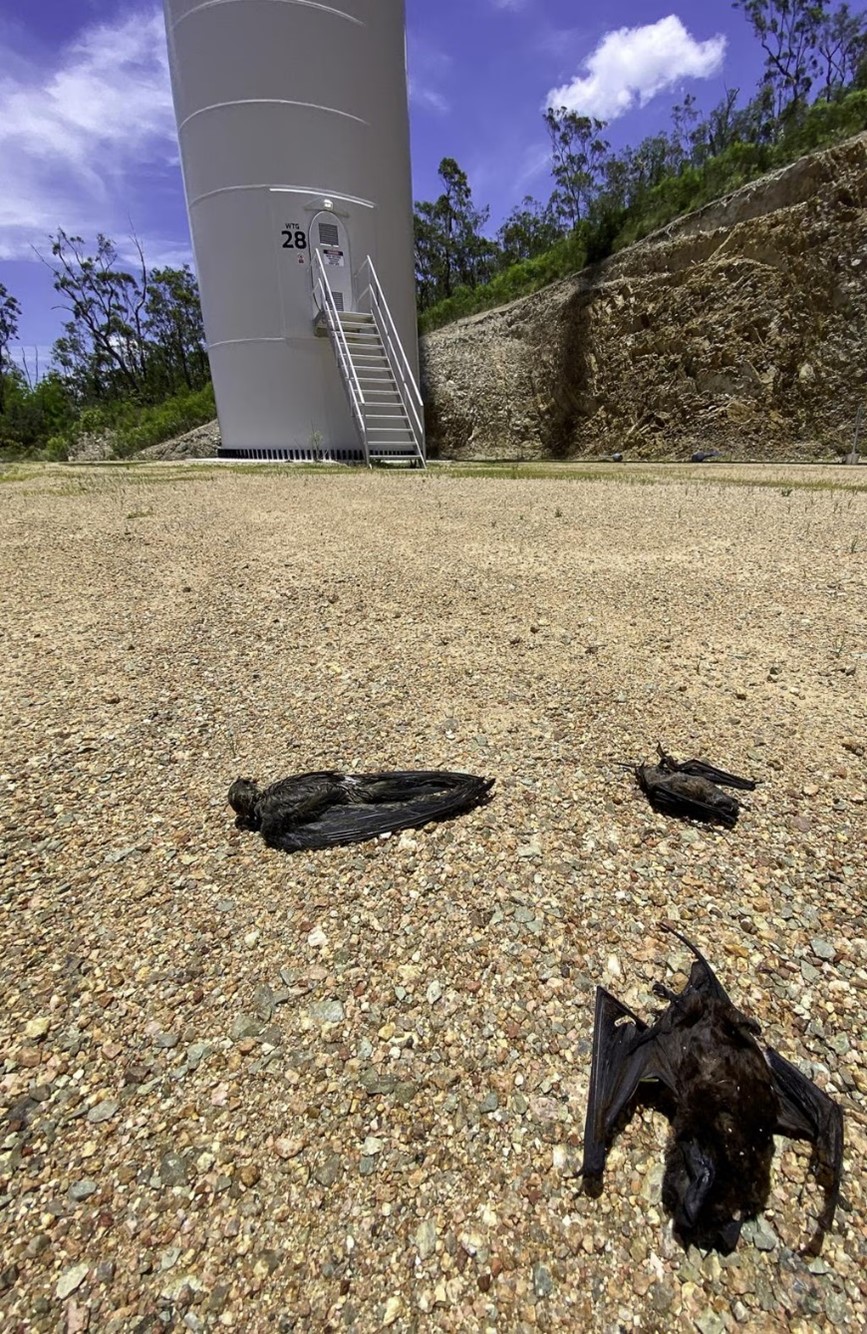
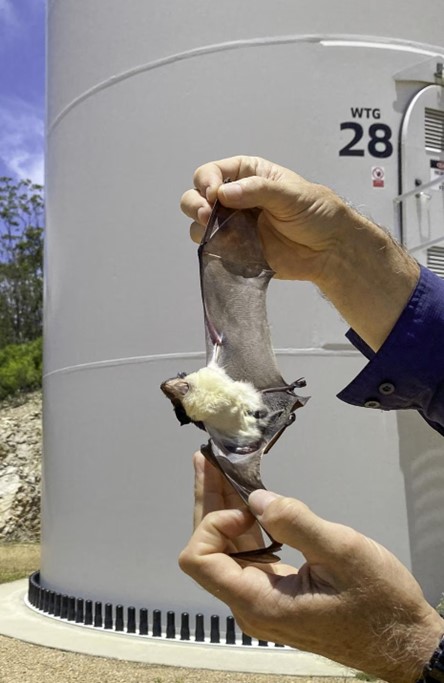
Leopold understood that violence against nature and violence against people are twinned. A state that will casually sacrifice old‑growth woodland, koala country and glider habitat because they lie in the “easy” corridor is the same state that will treat the people who live there as obstacles rather than fellow members of the community. We see this in the communities blindsided by projects like MacIntyre, where residents woke to find gigantic turbines rising in what they thought was safe bush; in the farmers who now look out on towers they never agreed to host; in the Tasmanian approvals that calmly authorise the killing of tens of thousands of birds and bats, including migratory species we are bound by treaty to protect.
None of this is inevitable. Modelling from independent ecologists shows that many projects could be moved onto less sensitive land, away from high‑biodiversity ridgelines, without sacrificing the energy transition. Better routing, genuine avoidance of key habitats, slower and more careful design would cost money and time, but they would honour the simple truth that the land is not just a platform for infrastructure.
Instead, governments desperate to brandish progress are throwing biodiversity under the bus and calling it leadership.
Aldo Leopold spent a lifetime arguing that we are plain members and citizens of the biotic community, not its conquerors. The conduct of AusNet, VicGrid and too many of their peers suggests they have adopted the opposite creed: that the land and everything that lives on it exists to serve the quarterly report, and that any damage can be managed on paper. If we continue down that path, we will get the grid we deserve: miles of steel and fiberglass, humming over emptier forests and quieter skies, in a country that has traded living richness for the appearance of virtue.
The choice before us is not between climate action and wildlife, between lights on and koalas alive. It is between a transition that deepens the wounds in our land community, and one that finally learns to heal them. The first is what we have now – a green‑tinted extension of the same old frontier mentality. The second will only begin when we are prepared to say, with something more than rhetoric, that no project is “clean” if it demands the systematic, avoidable killing of the very creatures and places that make this land worth living in.
___________________________________________________________________
Aldo Leopold (1887–1948) was an American ecologist, forester and writer, widely regarded as a founding figure of modern wildlife management and environmental ethics.
He began his career with the U.S. Forest Service in the American Southwest, where he helped create the Gila Wilderness in New Mexico in 1924—the first officially designated wilderness area in the national forest system. Later, as a professor at the University of Wisconsin, he wrote Game Management (1933), which laid the groundwork for scientific wildlife conservation, and A Sand County Almanac (1949), a classic that introduced his influential “land ethic”: the idea that people are “plain members and citizens” of the land community, morally bound to preserve the integrity, stability and beauty of ecosystems.
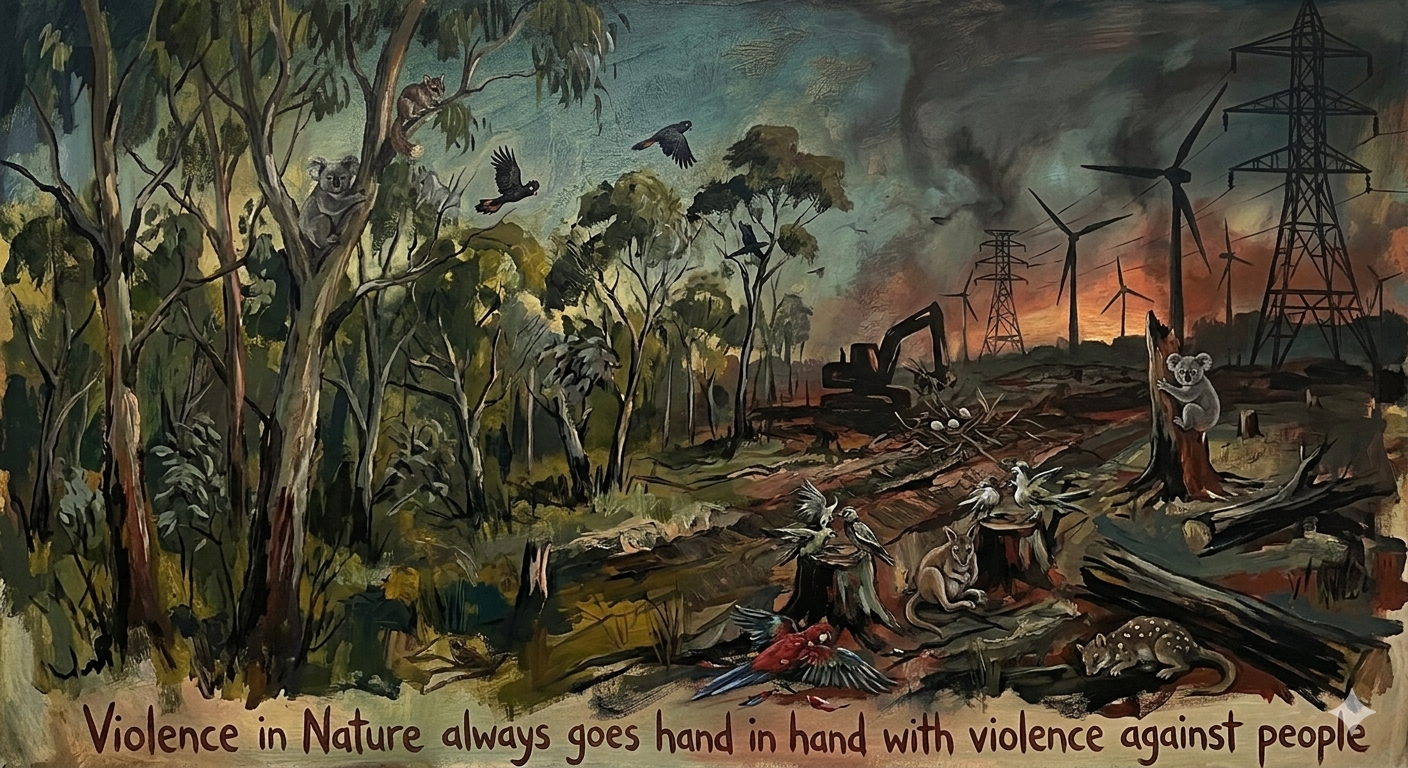
VIOLENCE IN NATURE ALWAYS GOES HAND IN HAND WITH VIOLENCE AGAINST PEOPLE
When the land is treated as expendable, the people who depend on it are treated the same way. You don’t have to farm the land to depend on it.
The premise that violence against nature and violence against people are inseparable is not merely a theoretical observation; it is a fundamental sociological and ecological truth. To argue this effectively in the context of the Western Renewables Link (WRL) and the critical importance of Western Victoria’s environment, we must recognize that the landscape is not an empty canvas or a set of resources, but the very substrate of human identity, community heritage, and regional viability.
Here is an articulation of why these two forms of violence are inextricably linked when applied to the regional scale of Western Victoria.
The False Dichotomy of “Environment” vs. “Society”
The primary error in industrial planning is the assumption that nature is a commodity – an inanimate resource to be rearranged or sacrificed for a “greater good.” When this view takes hold, the land of Western Victoria is effectively dehumanized, stripped of its history, and relegated to the status of a utility corridor.
However, for our community of Western Victoria, the land is not merely a geographic coordinate. It is a living extension of our regional identity.
- Ontological Security: When a community dedicates itself to agriculture, land stewardship, and the preservation of native biodiversity, their identity becomes woven into the soil, the grasslands, and the ecological corridors of the region. Violence against that environment – tearing it apart for high-voltage infrastructure, destroying native vegetation, and permanently altering the landscape’s character – is not just an environmental cost; it is an attack on the labour, love, and multi-generational purpose invested in that land.
- The Erasure of Agency: To impose a project like the WRL upon a region against its manifest opposition is an act of epistemic violence. It tells the people of Western Victoria: Your knowledge of this place, your vision for its economic and ecological future, and your connection to this landscape are irrelevant. This devaluation of the human connection to the land is the first step toward the dispossession of the people themselves.
The Mechanics of Structural Violence
When large-scale industrial projects are forced upon a region, they enact violence in ways that transcend the physical construction. This is a form of structural violence that targets the social, mental, and economic health of the region.
- The Dislocation of Steward-Identity
Across Western Victoria, the primary directive for landholders and residents is to nurture and protect. The WRL project forces these communities into a position of helplessness. The violence here is the inversion of the regional role: the community is forced to become a combatant in a fight to save their home rather than a curator of its health. This enforced shift creates chronic, low-grade trauma that wears down the community’s capacity to innovate, grow, and plan for the future.
- The “Sacrifice Zone” Mentality
By framing the landscape of Western Victoria as a mere “corridor” or an “easement,” planners strip the area of its human meaning. If the environment is treated as disposable, the people living within it are treated as obstacles to be managed rather than citizens with rights. This mentality creates a hierarchy of value that treats regional lives as inherently less significant than the demands of industrial progress.
- The Erosion of Resilience
Industrializing a rural landscape does not just damage the skyline; it damages the social fabric. The psychological toll of the uncertainty – the prolonged fight against the WRL – is a form of structural violence. It erodes the region’s resilience by creating constant anxiety, fracturing community cohesion through stress, and exhausting the time and financial resources that would otherwise be used to build a thriving, sustainable, and productive regional life.
The WRL as an Extension of this Logic
In the context of the Western Renewables Link, the project serves as a clear study of how the violence is compounded.
The physical violence is apparent: the clearing of significant vegetation, the scarring of the landscape, and the introduction of industrial-scale infrastructure into sensitive ecosystems. However, the violence against the people of Western Victoria is found in the systemic dismissal of their sovereignty. By treating the WRL as an inevitability that must be “mitigated” rather than a choice that should be challenged, the process acts as a form of institutional erasure. It seeks to break the community’s connection to the land by rendering the region an intolerable place to live or work. When a community is forced to watch their landscape – and the ecological integrity that supports it – be rendered unrecognizable, the violence against nature has successfully culminated in the destruction of the community’s future.
Conclusion
The violence is one continuous loop. You cannot “save” the WRL project’s objectives by sacrificing the Western Victorian environment, because the people who hold that region together are not separate from it.
To destroy the ecological integrity of a landscape is to destroy the foundation of the human life anchored to it. Any project that requires the desecration of the Western Victorian environment is, by definition, an act of violence against the people who sustain, reside, and find meaning within that environment. Defending the environment is not a peripheral concern; it is the act of defending the only context in which the regional community’s life, work, and legacy have meaning.