Stop Labors Towers Newsletter – May 16, 2026
SHARE THIS NEWSLETTER
If you’re getting this newsletter, you’re already part of the front line.
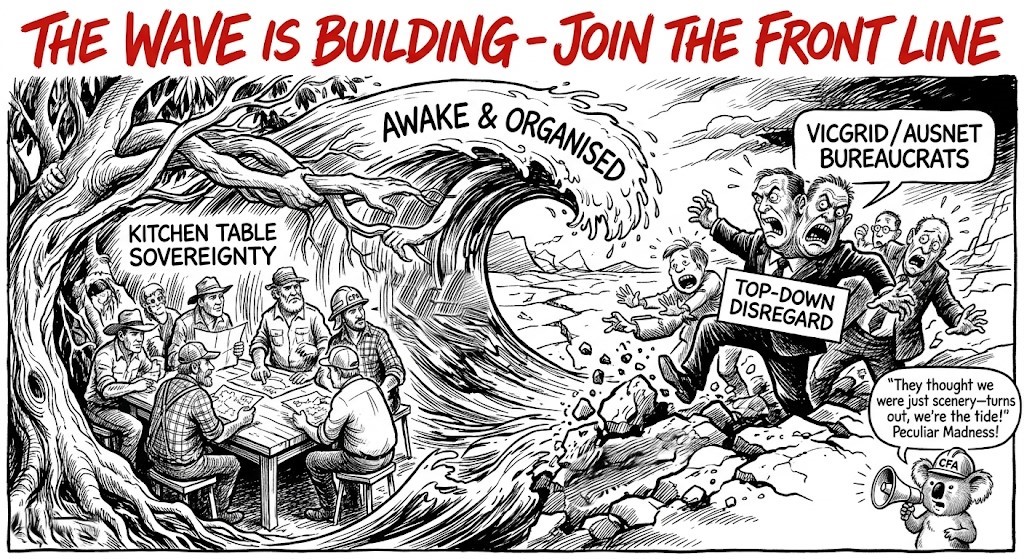
Right now, a movement is building across western Victoria – not in party rooms or boardrooms, but at kitchen tables, farm gates and CFA sheds. We are not just reacting to the Western Renewables Link; we are creating the wave that will decide what happens next.
If you believe in:
- · protecting our farms, bush and wildlife from being treated as a sacrifice zone
- · defending communities from top‑down projects imposed without real consent
- · a genuine transition that respects people, place and country
…then we need you to do one simple, powerful thing:
👉 Share this newsletter widely.
- · Post it on your Facebook, Instagram, X and community pages
- · Email it to family, neighbours, workmates and local groups
- · Send it to councillors, MPs and candidates and ask them where they stand
Every share puts pressure where it belongs. Every forward tells decision‑makers that communities are awake, organised and not going away.
We don’t have the advertising budget of big corporations.
We have something stronger: each other.
Please share this newsletter today – and help turn concern into a force they can’t ignore.
FARRAR BY-ELECTION
On a narrow street in Sarajevo in 1914, a single gunshot cracked the summer air. The death of Archduke Franz Ferdinand set in motion events no one could fully control. It was not just the violence of the moment, but the long, enduring consequences that followed, reshaping nations, economies, and lives for decades.
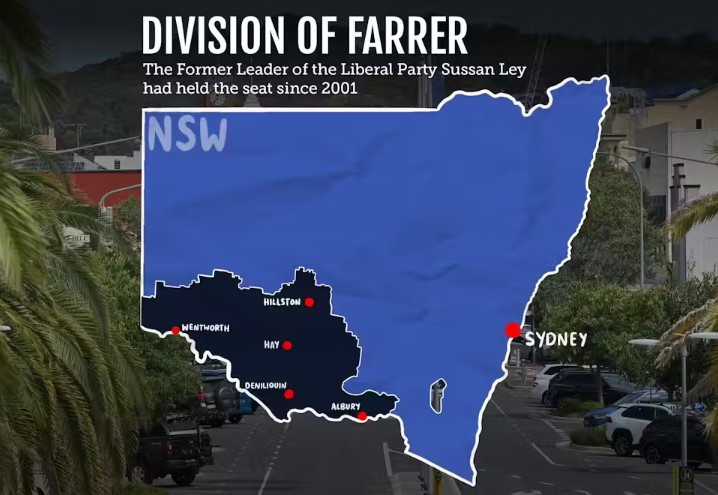
More than a century later, in the quiet rhythm of an Australian evening, votes were counted in Farrer. No violence, no rupture, just the steady mechanics of democracy. Yet the outcome carried its own signal.
When One Nation secured a Senate seat, it reflected a shift that has been building across regional communities. For many, concerns around the direction of energy policy, particularly net zero targets and the impact of large-scale infrastructure on agricultural land and local environments, are not theoretical. They are immediate, lived, and personal.
This is not about a single vote or a single issue. It is about a growing sense that decisions with long-term consequences are being made without sufficient regard for those who will live with them. Land once used for production, community, and continuity is increasingly seen through a different lens, and that change is being felt deeply.
The comparison is not one of scale or consequence. One moment unleashed global conflict, the other reflects a democratic choice. But both speak to a common truth.
Turning points are not always explosive. Sometimes they are quiet, almost procedural, yet they carry real and lasting effects.
In Sarajevo, the consequences were immediate and devastating. In Farrer, they will be slower, but no less real for the communities involved. Decisions made now about land, infrastructure, and policy will shape regional Australia not just in the present, but for generations to come.
WHY THIS MATTERS
For communities along the path of the Western Renewables Link (WRL), this is not a distant policy debate; it is the frontline of that very turning point. The deadly impact and risks of high-voltage transmission lines across regional property represents exactly this kind of top-down decision, where the long-term cost of national energy targets is disproportionately borne by individual landholders. Just as a single procedural shift can signal a deeper regional pushback, the fight against the WRL matters because it ceases to be just about infrastructure – it becomes a critical stand for local sovereignty, the protection of agricultural livelihoods, and the right of a community to refuse being sacrificed for a metropolitan blueprint.
WRL – EES UPDATE
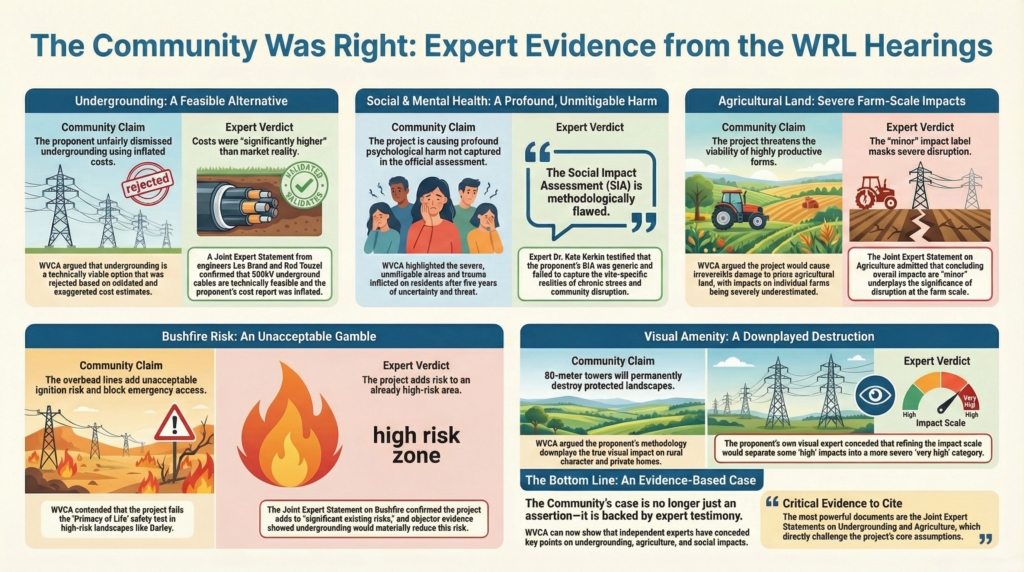
The WRL EES hearings finished in March. The Inquiry and Advisory Committee (IAC) has handed its report to the Minister for Planning. All the documents are now offline, and from here everything happens behind the Minister’s door until a formal Assessment is released – if it is released at all.
Where is the WRL EES up to?
After hundreds of written and verbal submissions, hearings and late‑night prep, the
WRL Environmental Effects Statement (EES) process has formally moved into its final phase.
1. The IAC has finished its work
- The Inquiry and Advisory Committee (IAC) submitted its report to the Minister for Planning on Friday 8 May 2026.
- From that moment, the IAC’s job was over. It cannot lobby, clarify or communicate on our behalf. Its only remaining task is administrative.
In practical terms, this means the entire WRL EES is now out of the community’s hands and entirely in the Minister’s.
2. The public record has been taken down
Planning Panels Victoria has now:
- Removed the WRL EES material from the Engage Victoria website, and
- Updated the page to state that the IAC report has been submitted.
This is standard procedure, but it is still jarring. One day there were submissions, expert evidence, and hearing audio available to anyone; the next, the shelves are bare.
Fortunately, community members have archived the material so that the public record of what was said – and how hard this region fought – cannot simply vanish. That history exists whether or not it suits the politics of the day.
3. The Minister controls what happens next
This is the critical line from Planning Panels Victoria:
“The timing and release of the Inquiry and Advisory Committee’s report is at the discretion of the Minister for Planning.”
In other words:
- Only the Minister decides if and when the IAC report is released.
- Planning Panels Victoria is not told what the Minister intends to do.
- The PPV has said it will notify submitters “if the Minister’s Assessment and the IAC report are released.”
That little word “if” should concentrate our minds. It reminds us that transparency is not automatic. Without pressure, we could see months of silence while decisions are made about a 190‑kilometre project that will reshape western Victoria for generations.
4. What the community has already achieved
Whatever the Minister now does, this region has already forced the WRL project through more scrutiny than its backers ever wanted:
- Tens of thousands of pages of evidence and hundreds of hours of verbal submissions now make one thing impossible to deny: the WRL does not “co‑exist” with western Victoria – it destroys it. It carves through productive farms, turns high‑risk bushfire country into an obstacle course of steel, shreds wildlife habitat and biolinks, and leaves already stretched communities carrying the mental, social and economic fallout along every kilometre of its length.
- Local groups, councils, experts and landholders exposed major flaws in routing, fire risk, social impact and “consultation” claims.
- The EES hearings created an on‑the‑record trail that will matter long after any single decision.
The Minister cannot honestly claim to be unaware of the scale of concern or the depth of evidence against this route.
5. Why this moment matters
Right now we are in the danger zone between process and decision:
- The public process has paused – the hearings are done, the documents are offline.
- The political process has begun – Cabinet discussions, internal briefings, election strategy.
If we go quiet now, we make it easy for the Minister to quietly sign off on a project that dozens of councils, peak bodies and thousands of landholders have told them is the wrong project in the wrong place.
Our bottom line
We have done everything that was asked of us by the process: made submissions, fronted the hearings, supplied evidence, stayed constructive. That chapter is closed.
Now the responsibility sits squarely with the Minister.
- If the EES process means anything, the IAC report should be released in full and the voices of western Victoria should be honoured.
- If the government is serious about social licence, it cannot sign off on a project that its own evidence shows will damage farms, habitats and communities along its length.
Until we see the report and the Assessment, we assume nothing – and we stay ready.
Because the WRL isn’t just an infrastructure decision. It’s a test of whether western Victoria’s communities are treated as partners in this state, or as corridors on a map.
And that decision has not been made yet.
STOP LABOR’S TOWERS – THE EVIDENCE IS IN: THE WRL IS LEGALLY UNTENABLE
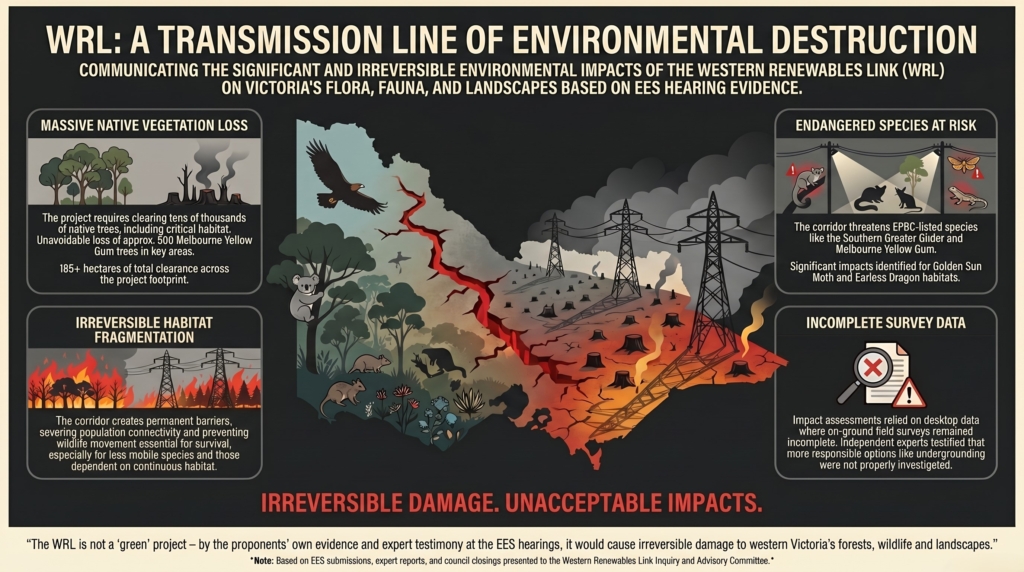
To the 10,000 members of our Alliance,
Our presentations to the WRL EES Inquiry and Advisory Committee (IAC) concluded in March, and the record now holds the truth that the proponent tried to bury under their 10,000 pages of “desktop studies.” Our community submissions were not just an expression of concern; it was a clinical dismantling of a project that is fundamentally non-compliant with Victorian law.
If the Panel followed the law, they cannot recommend approval. Here is a glance at some of the substantive evidence we placed on the record:
1. A Process Built on a Fatal Flaw: The 2019 “Locked-In” Failure
The entire Environmental Effects Statement (EES) is a retroactive attempt to justify a foregone conclusion. We proved that the project’s design – an overhead 500kV line – was “locked in” by the 2019 RIT-T process, long before any environmental or social impact work began.
The proponent admitted that the RIT-T explicitly excluded social and environmental costs unless they breached a specific law. By the time the EES began, the route was a “millstone” around the project’s neck. To approve this EES is to reward a process that ignored the community, the environmental and agricultural devastation and unmitigable bushfire impacts from day one and treated the Environment Effects Act 1978 as a post-script rather than a guide.
2. The “Data Desert”: A Breach of Scientific Integrity
The proponent is asking for permission to scar our landscape while missing the most basic information. We exposed that most of project area was never physically surveyed. In these “no-go” zones, the proponent relied on “unreliable” desktop modeling to guess impacts and risks.
Under the law, an EES must provide a baseline understanding of the environment before impacts are assessed. You cannot “manage” an impact without ground truthing.
The data vacuum that makes any claim of “minimal impact” a scientific impossibility.
3. The Systematic Dismantling of Our Ecosystem
The proponent’s claim that this is a “green” project is a profound deception. Our evidence to the Panel highlighted that the WRL will inflict irreversible trauma on our local biodiversity, including the clearing of over 50 hectares of native vegetation and the destruction of thousands of “large old trees” ancient hollow-bearers that take centuries to form and provide irreplaceable habitat for species like the Greater Glider and Wedge-tailed Eagle.
The EES process fundamentally fails to respect the complexity of our local ecology, attempting to trade our established, living ecosystems for distant “paper credits” through a flawed offset scheme. By their own admission, the proponent has failed to physically survey the project area, meaning they are prepared to bulldoze through our biological heart without even knowing what lives there. This isn’t just infrastructure; it is the systematic fragmentation of vital wildlife corridors and the permanent erasure of the “integrity, stability, and beauty” of our land community.
4. Agriculture: Statistical Averages Masking Individual Ruin
The EES treats our farms as “units of production” on a spreadsheet. We challenged the proponent’s Agricultural Impact Assessment, which uses regional averages to hide “catastrophic” property-level losses.
We provided evidence of farms that will lose 100% of their irrigation capability because center-pivots cannot operate under 80-meter towers. The proponent’s response was to suggest “mitigation” that doesn’t exist. To destroy the economic viability of multi-generational food bowls for a “corridor of convenience” is a violation of the state’s own agricultural protection policies.
5. Bushfire and Aerial Safety: The Lethal Oversight
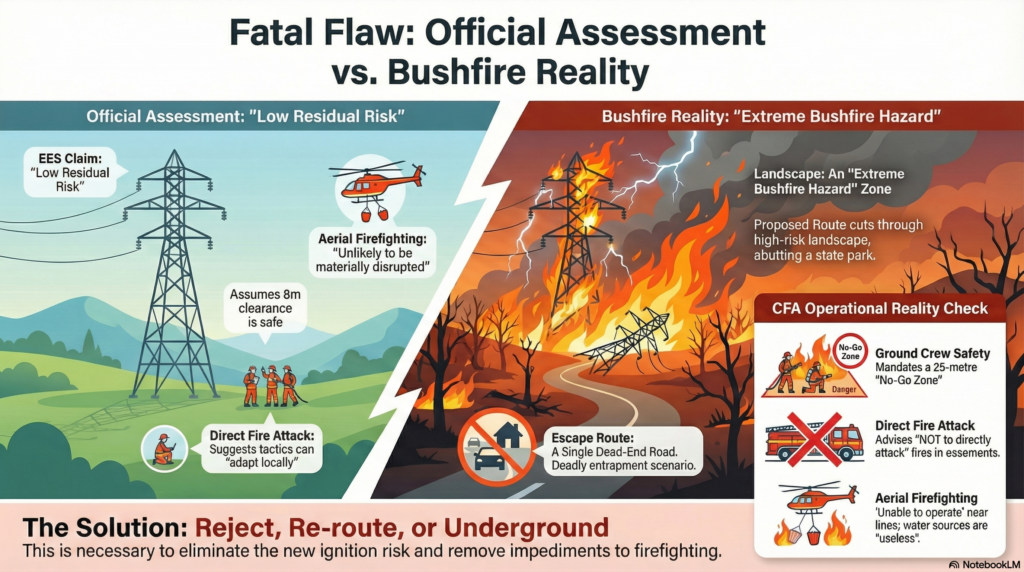
The risk to our community is not a matter of “perception”—it is a matter of physics. We presented expert analysis proving that overhead lines in our region significantly impede aerial water bombing and create “dead zones” for ground-based firefighting.
The proponent’s bushfire assessment was labeled by experts as “simplistic” and “grossly inadequate.” In a region with a history of catastrophic fire, introducing 190km of steel and catenary wire into a primary escape route is not progress; it is an invitation to disaster that the CFA cannot fully mitigate.
6. The Ignored Solution: The Undergrounding Alternative
The most damning evidence is the proponent’s refusal to genuinely assess undergrounding. We argued that the technology used in projects like the Marinus Link proves that undergrounding is not “out of scope”—it is simply “out of favour” because it requires a higher standard of care.
While the WRL creates a 190km “permanent wound” across the landscape, undergrounding offers a surgical alternative that preserves biodiversity, protects agriculture, and eliminates the bushfire risk. The proponent’s failure to provide a side-by-side, honest cost-benefit analysis of this alternative is a terminal flaw in their submission.
THE LINE IS DRAWN
We have demonstrated that the WRL is an act of institutional erasure. It seeks to treat Western Victoria as a “sacrifice zone” for an urban energy transition. But the law requires more than just “consultation” – it requires the protection of the environment, heritage, and human safety.
The evidence is now undeniable. The WRL cannot proceed in its current form if the law is to be upheld.
HOLD THE LINE.
The Western Victorian Community Alliance