Stop Labors Towers Newsletter – June 27, 2026
CAUGHT IN THE CROSSFIRE OF SELF‑SERVING INCOMPETENCE AND IDEOLOGICAL ZEALOTRY
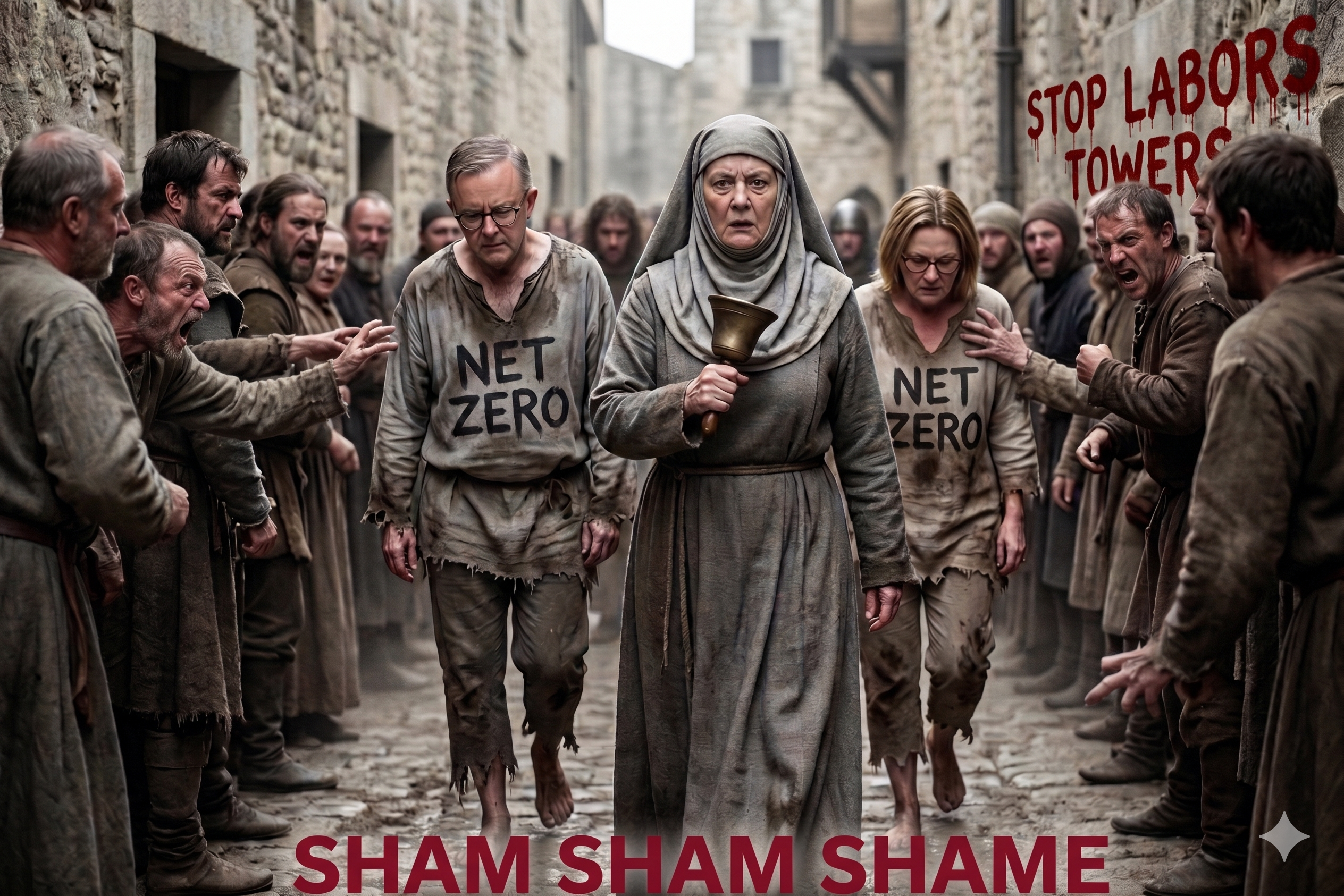
Sham, Sham, Shame.
A sham transition. A sham consultation. And a shameful willingness to sacrifice regional Victoria in the name of “Net Zero at all costs.”
The towers they plan to drive through western Victoria are not just pieces of steel and wire; they are monuments to a political class that has built a story on spin and concealment. The public is sold a shining narrative of clean energy and justice, but the lived reality under the proposed Western Renewables Link is fragmentation of farms, dramatically heightened bushfire risk, and a quiet transfer of wealth from country communities to distant investors. That is the sham.
The shame lies in how it is done: an ignorant and self‑serving state government and an ideologically zealous federal government locking us out of real debate, hiding critical reports, and treating anyone who questions this project as an obstacle to be managed rather than a community to be heard. Caught in the crossfire of their incompetence and zealotry, we are expected to accept WRL as inevitable and “for our own good.” We don’t and we won’t.
Net Zero, No Matter Who Burns
On paper, the Federal and Victorian Labor governments preach a tidy story: bold climate leadership, historic investment, a shining new grid to carry clean energy to the cities. In speeches and press releases, they wrap themselves in the language of “justice” and “transition” and “future generations”.
But on the ground, where the Western Renewables Link will cut through farms, towns and fire‑prone valleys, the story looks very different.
Here, Net Zero is not a moral horizon. It is a blunt instrument. It is used to silence questions, bulldoze objections, and declare that anyone who asks about safety, local impact or basic fairness must be “anti‑renewables” or “against the future.” It is a slogan deployed like a weapon, so that the real debate – about how, where and at whose expense this infrastructure is built – never happens.
We are caught in the crossfire of two forces: a self‑serving state government desperate to look “climate‑heroic” before an election, and a federal government locked into ideological zealotry that treats community consent as an inconvenience, not a requirement.
Self‑Serving State Government, Sacrificed Regions
Look closely at Victoria. The Allan government wants the photo‑op and the headline: billions in transmission, “nation‑leading” clean energy ambition.
But it will not be the Premier’s backyard living under 80‑metre towers, fighting the next grassfire with bombers banned from key valleys. It will not be the Minister’s children watching their cattle graze beneath a 500 kV line. It will not be the Cabinet that loses property value, irrigation efficiency, mental health or sleep.
Those costs are being quietly assigned to us.
At the same time, the same government is slugging CFA volunteers and country households with an emergency services tax spike, while trucks older than some brigade members still roll out to fires. It finds money for consultants and mega‑projects, but not for fleet upgrades, new stations or real bushfire resilience. It talks “safety” while approving a transmission project that makes actual firefighting in key corridors harder, not easier.
That is not climate policy. That is self‑preservation disguised as virtue.
A Federal Government That Won’t Look Down
In Canberra, the rhetoric is grander but the logic is the same. “Hard decisions” are invoked. “Global commitments” are waved like a shield. Any attempt to question the shape or location of projects like WRL is treated as an attack on the planet itself.
But decarbonisation done badly is not justice.
A serious government would ask:
- Why has route optimisation favoured overhead lines through fertile, fire‑prone country instead of undergrounding along existing corridors?
- Why have independent assessments of underground options been sidelined, buried or delayed?
- Why are the people bearing the physical and psychological burden of this project the last to see the full findings of the very inquiry appointed to judge it?
Instead, we get stage‑managed announcements and carefully curated “community engagement” sessions where the decision has already been made, and the locals are invited to choose the colour of the brochure.
This is not leadership. It is political theatre.
WRL: Wrong Project, Wrong Reasons
No matter how you look at it, the Western Renewables Link is the wrong project, undertaken for all the wrong reasons. It is being sold as a clean‑energy “transition,” but in practice it is about building a profit pipeline, not a renewable future.
In the official story, WRL is branded as a triumph: more renewables, more jobs, more security. Brochures show neat lines from wind farms to cities, framed by rolling hills and smiling families. But none of that changes the lived reality:
- The fragmentation of farms that have sustained families for generations.
- The creation of permanent no‑go zones for aerial and ground firefighting in some of the most dangerous fire landscapes in the state.
- The mental health strain of having your home and livelihood placed under the shadow of a project you did not ask for and cannot meaningfully influence.
- The quiet transfer of wealth from regional communities to offshore investors and city‑side beneficiaries.
This is not an honest transition to renewables. It is a destructive, top‑down infrastructure grab wrapped in climate slogans. The implicit logic is brutal: as long as someone can claim “Net Zero” at the end of it, any corridor, any impact, any level of community pain is acceptable.
That logic must be rejected. Real climate action does not demand that some communities get the branding and the benefits while others are left with the scars.
Caught Between Fire and Spin
In a functioning democracy, communities would not have to beg for transparency about projects of this magnitude. They would not have to write repeated letters asking for the release of independent inquiry reports before decisions are made about their future.
Yet here we are.
We are fighting a transmission line that will degrade our safety and livelihoods, while being told to applaud the government for its “courage.” We are watching volunteers taxed for the privilege of fighting fires under infrastructure they warned against. We are watching federal and state leaders use the language of justice to justify processes that systematically exclude the people most affected.
We are, in short, caught in the crossfire of self‑serving incompetence and ideological zealotry.
What Comes Next
If there is one lesson from the last year, it is this: silence is exactly what this model depends on. It relies on our exhaustion, on our despair, on our willingness to shrug and say “there’s nothing we can do.”
There is something we can do.
We can refuse to accept that Net Zero must mean “regional sacrifice zones.” We can insist that climate policy is judged not only by tonnes of emissions reduced, but by the fairness of its impacts and the honesty of its process. We can call out a state government that hides critical reports and a federal government that mistakes slogans for strategy.
And we can keep saying, as loudly as necessary:
- Scrap the assumption that WRL in its current form is inevitable.
- Release the evidence. Release the reports. Put the facts in the hands of the communities who will live with this corridor for the next fifty years.
No government that believes in justice should fear that level of scrutiny. If they do, the problem is not us. It is them.
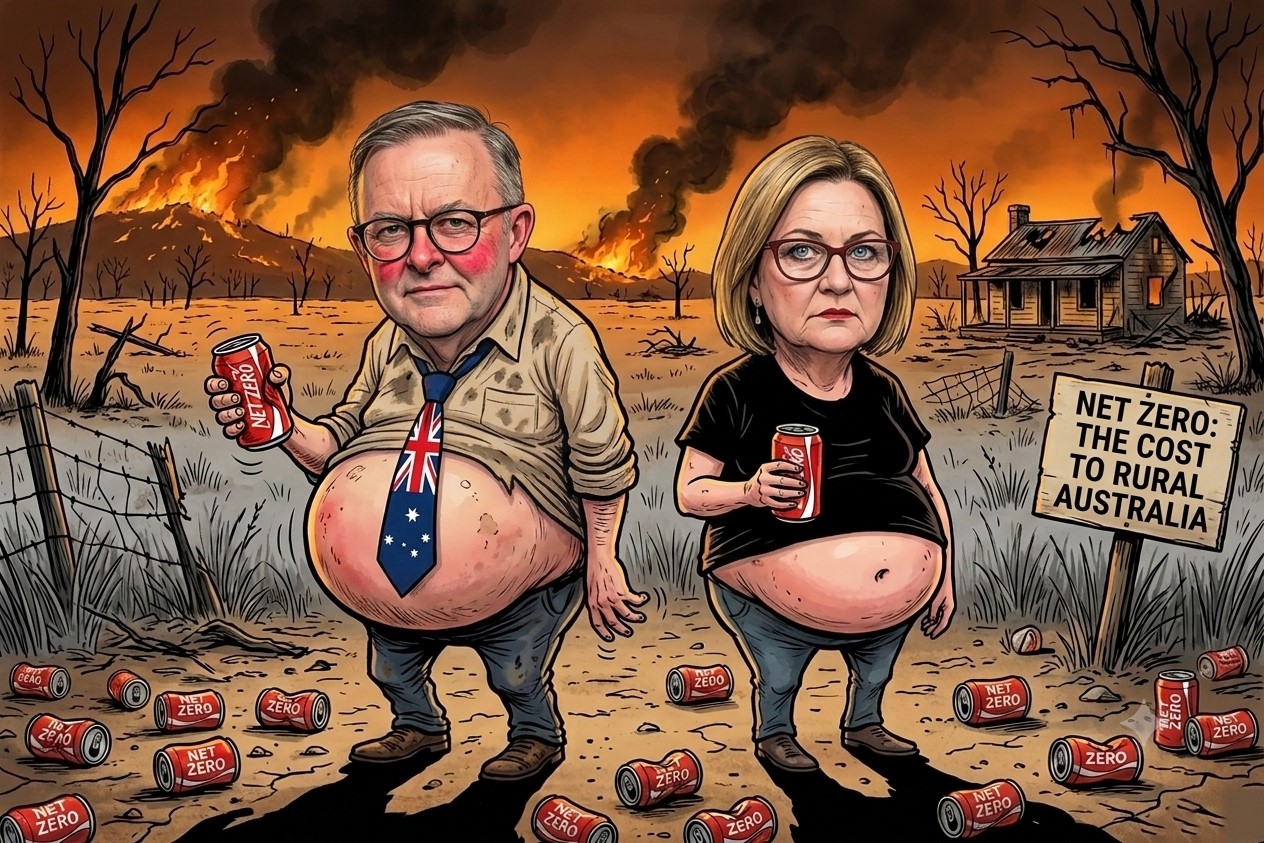
THE NET ZERO DEBT TRAP: A MULTI‑GENERATIONAL MORTGAGE ON AUSTRALIA
A transition priced in the trillions is not an abstract number; it is a structural shock to the Australian economy.
If even the “moderate” estimates are right, Australia is staring down annual capital spending on the order of $100 billion or more for three decades – on top of everything we already spend on health, education, defence, social services, and maintaining existing infrastructure. That level of investment cannot be magicked out of thin air. It means higher household power bills to fund regulated returns on new assets, heavier tax burdens, or deeper public debt that future generations must service. It means capital diverted away from other urgent priorities into a single, politically favoured project: the Net Zero transition at all costs.
At the upper end—$7 to $9 trillion—the numbers are bigger than Australia’s entire current GDP, multiple times over. That is not just “building a few wind farms”; it is an attempted rewiring of our whole economic model: phasing out lucrative fossil fuel exports, rebuilding heavy industry around new energy sources, and forcing households and businesses to rip out and replace entire fleets of cars, heaters, machinery and equipment. The disruption to regional economies, export earnings, and labour markets would be profound. All Australians would be asked to accept long-term pain in return for promises that will never materialise.
When governments sell this as “cheap renewables,” they are playing a dangerous game with language. The $122 billion AEMO headline is the sticker price on the grid hardware, not the total cost of ownership. The real bill includes trillions in private and public capital, decades of interest payments, stranded assets, and the opportunity cost of what else we could have built. Framed that way, Net Zero on current terms is not just an environmental lie; it is a multi-generational mortgage on the nation’s balance sheet, with every Australian household locked in as guarantor.
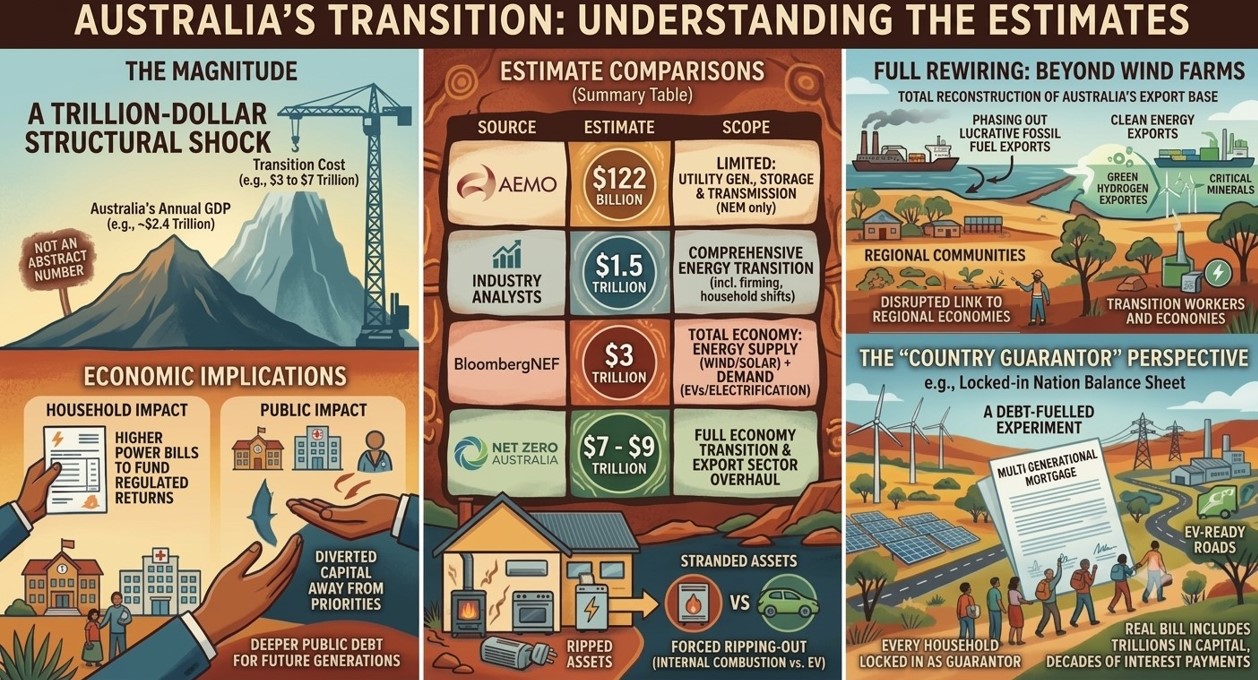
The figure of $1 trillion or more for Australia’s energy transition is not just a rumor—it is backed by several high-level economic studies, though the final “price tag” varies depending on whether you are looking only at the power grid or the entire national economy.
While the government often cites a lower figure of $122 billion (the AEMO Integrated System Plan estimate), that number only covers the cost of building large-scale generation, storage, and transmission in the National Electricity Market. It conveniently leaves out the massive costs of electrifying homes, cars, and industry.
Here is the breakdown of the factual evidence supporting the “Trillion-Dollar” narrative:
- The $1.5 Trillion “All-In” Estimate
Industry analysts and financial institutions have identified that the total capital expenditure (CAPEX) required to reach Net Zero by 2050 is significantly higher than government roadmaps suggest.
- BloombergNEF: Estimates that reaching Australia’s 2050 target requires a staggering $3 trillion ($1.9 trillion USD) in total investment.
- The Split: This includes roughly $1.4 trillion just for energy supply (wind, solar, batteries, and the grid) and another $1.6 trillion for energy demand (electric vehicles, household electrification, and industrial shifts).
- Annual Cost: This equates to roughly $100 billion per year every year until 2050.
- The Net Zero Australia Study ($7–$9 Trillion)
The most comprehensive study to date, conducted by a partnership of the University of Melbourne, University of Queensland, and Princeton, puts the total cost even higher.
- Total Economy Overhaul: They estimate the cost of achieving Net Zero across the entire economy—including the phasing out of fossil fuel exports—could be between $7 trillion and $9 trillion by 2060.
- The Support: This study highlights that the “transition” is not just about replacing coal plants with wind farms; it’s a total reconstruction of Australia’s export economy and industrial base.
- The Hidden “Grid” Costs
Even within the electricity sector alone, the $122 billion figure cited by Minister Bowen is often criticized as being narrow and “optimistic.”
- Transmission “Gold-Plating”: Critics argue that AEMO’s figures underestimate the true cost of social license, environmental offsets, and the rising cost of materials.
- The Opposition’s $1.5 Trillion Claim: The Federal Opposition has frequently cited a $1.5 trillion figure for the total transition, a number backed by some analysts who argue that “firming” the grid (making it reliable 24/7) requires far more infrastructure than the government admits.
Summary of Competing Cost Estimates
|
Source |
Estimated Cost |
Scope |
|
AEMO (2024 ISP) |
$122 Billion |
Only utility-scale generation, storage, and transmission. |
|
BloombergNEF |
$3 Trillion |
Total economy, including energy supply and EVs. |
|
Net Zero Australia |
$7 – $9 Trillion |
Full economy transition and export sector overhaul. |
|
Industry Analysts |
$1.5 Trillion |
Comprehensive energy transition (generation + firming + household shifts). |
The “Polly Toynbee” Perspective
The math is as stark as the landscape being carved up to accommodate it. The reality is measured in trillions—a debt-fuelled experiment with a price tag that exceeds Australia’s entire annual GDP. The “cheap renewables” slogan starts to look like a accounting trick when you realize the $122 billion “official” cost is merely the deposit on a multi-trillion dollar mortgage that every Australian household will be paying off for generations.