Stop Labors Towers Newsletter – July 5, 2026
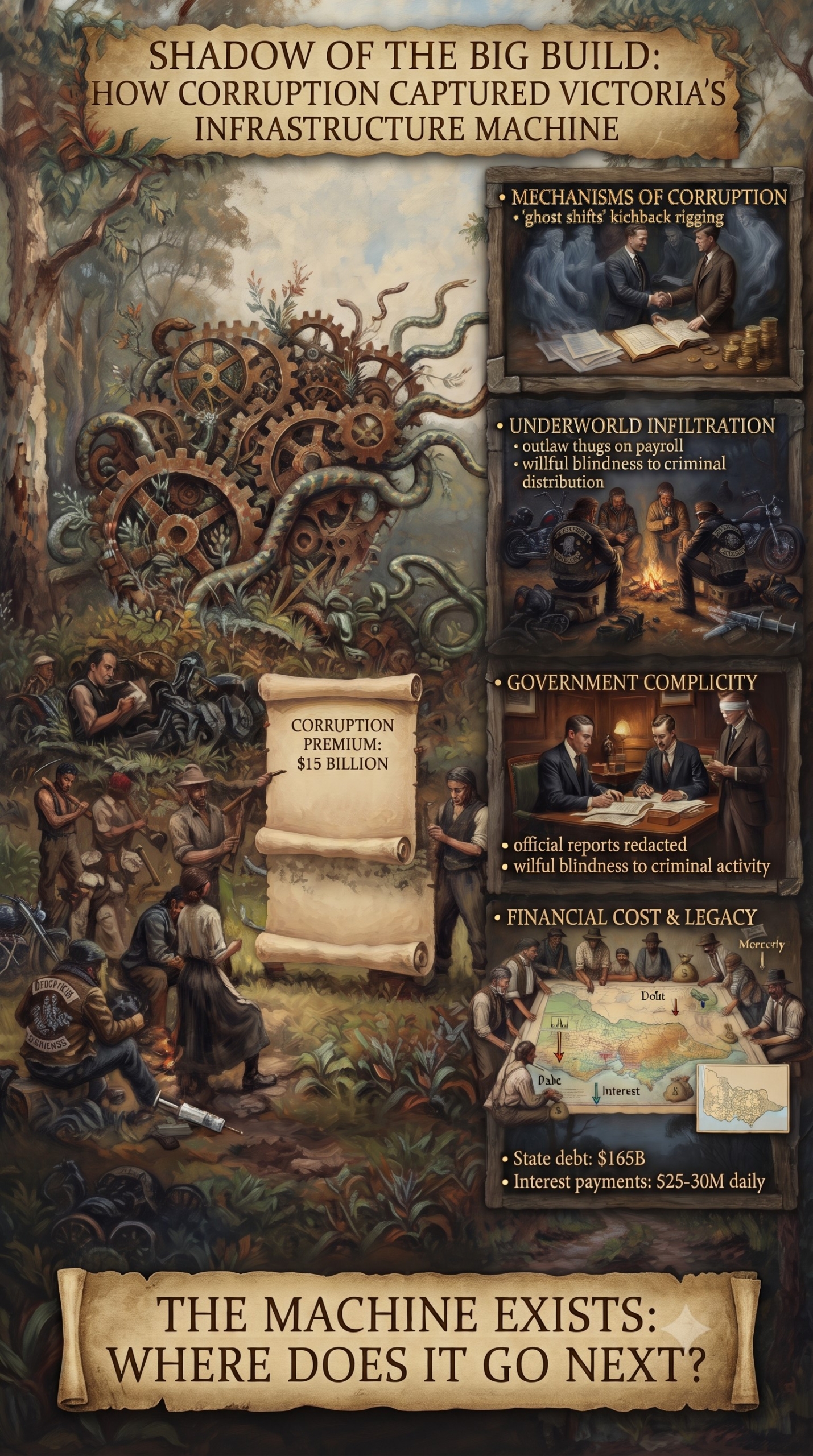
SHADOW OF THE BIG BUILD: HOW CORRUPTION CAPTURED VICTORIA’S INFRASTRUCTURE MACHINE
On paper, Victoria’s Big Build was sold as a once‑in‑a‑generation investment in trains, tunnels and roads. In reality, forensic reports and media investigations now paint a different picture: a mega‑project machine infected by systemic corruption, industrial coercion and organised crime.
In early 2026, the federally appointed administrator of the CFMEU’s construction division, Mark Irving KC, released the “Rotting from the Top” findings by barrister Geoffrey Watson SC. Watson’s work did something the Victorian Government has conspicuously avoided: it put numbers on the rot. His analysis concluded that corrupt, non‑competitive conduct linked to the Victorian and Tasmanian branches of the CFMEU had inflated the cost of major public works by a “corruption premium” estimated at around 15 billion dollars – roughly 20 to 25 per cent of the state’s 30‑year infrastructure budget.
This was not an abstract claim. Watson described specific mechanisms: coercive enterprise bargaining agreements that locked out non‑aligned contractors; ghost shifts and redundant roles forced onto project budgets; union‑controlled labour hire monopolies; and outright cash payments for access to lucrative night shifts. Outlaw motorcycle gangs, he found, had turned state‑funded construction sites into drug distribution hubs.
A leaked Metro Tunnel consortium report, later exposed in Nine’s “Building Bad” investigation, showed builders warning the government that CFMEU demands had pushed labour costs almost 30 per cent above Victorian norms, with close to a third of labour budgets going on non‑productive, union‑mandated staffing. Those warnings did not trigger a clean‑up. According to the consortium, they were told to push on – political timelines came first.
When the most explosive sections of Watson’s report – including passages suggesting the Victorian Government “knew or had a duty to know” about underworld infiltration – were redacted before release, the pattern hardened. Attorney‑General Sonya Kilkenny publicly attacked Watson’s 15 billion estimate as “unfounded”, and Police Minister Anthony Carbines dismissed integrity experts’ concerns as “florid ramblings”. Only after leaks did the public glimpse the scale of what had been buried.
Former Ombudsman Deborah Glass later warned that Victoria’s integrity system is structurally incapable of dealing with this kind of systemic “grey corruption”. Standard police investigations chase discrete criminal acts, not the long, quiet process by which a union becomes the gatekeeper of state projects, and a government becomes dependent on that gatekeeper to keep its signature program alive. IBAC, meanwhile, remains hamstrung – its powers do not extend to the full architecture of political‑industrial favouritism now embedded in the Big Build.
All of this is unfolding against a budget backdrop that has moved from perilous to acute. By mid‑2026, Victoria is carrying around 165 billion dollars in net state debt and is on track to push towards 175 billion dollars in 2026–27, with interest repayments now running at roughly 25–30 million dollars every single day. The 15 billion siphoned off as a corruption premium is not a rounding error; it is the difference between leaving core social housing needs unfunded and fully financing key parts of the 30‑year infrastructure strategy several times over.The picture that emerges is not simply of a few bad actors, but of a captured delivery system: a “delivery at all costs” culture where political legacy depends on keeping the project–union–contractor machine turning, no matter what it is costing the public.
The question now is not whether this machine exists. It is where it goes next.
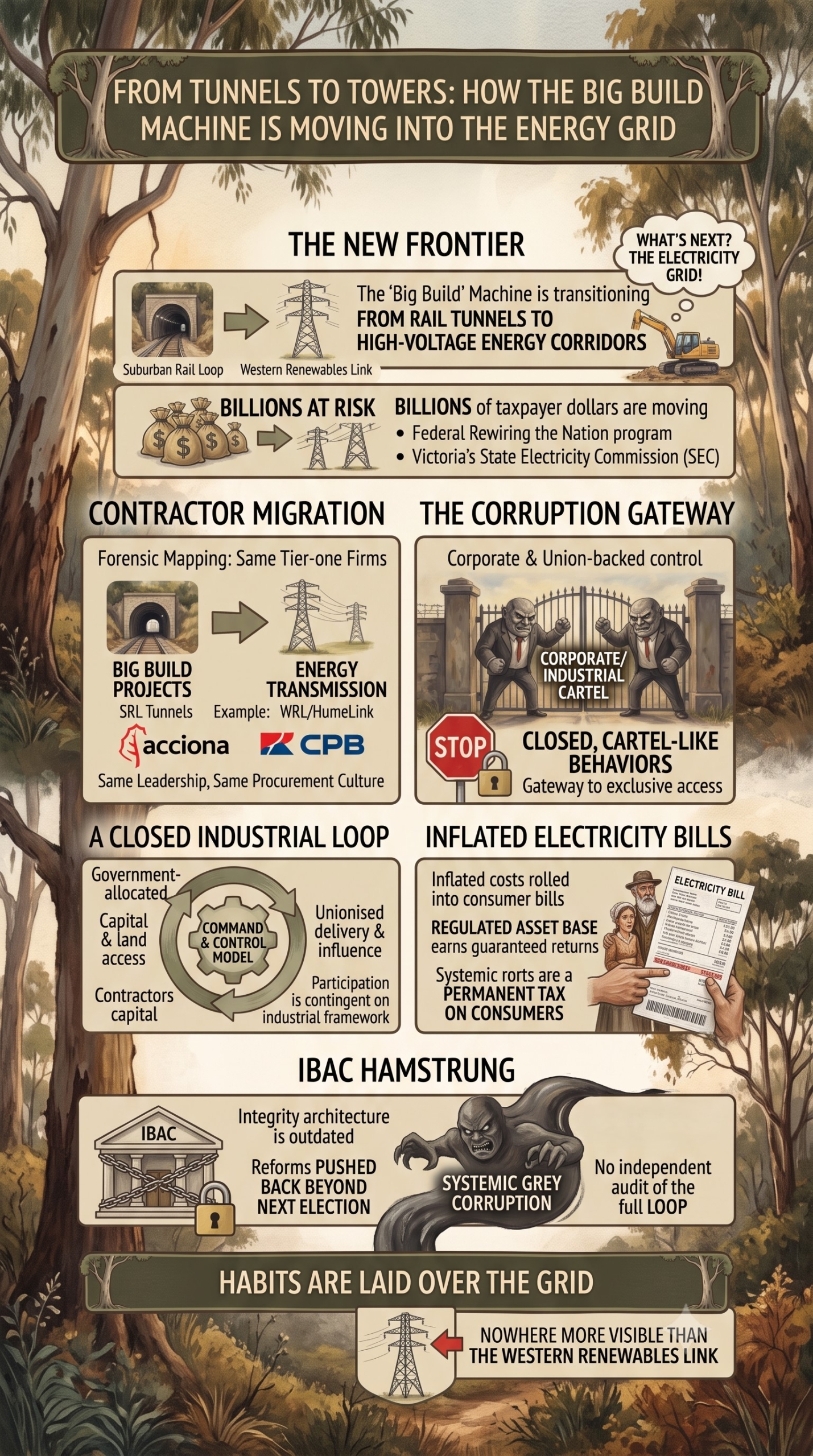
FROM TUNNELS TO TOWERS: HOW THE BIG BUILD MACHINE IS MOVING INTO THE ENERGY GRID
The next frontier for this machine is not another tunnel or toll road. It is the electricity grid.
Under the federal Rewiring the Nation program and Victoria’s revived State Electricity Commission (SEC), billions of taxpayer dollars are now being steered into high‑voltage transmission corridors and Renewable Energy Zones across the state. On its surface, this is a story of climate action and energy security. Look closer at the overlaps in companies, contracts and industrial arrangements, and it begins to look like a migration of the Big Build’s corruption risks into the very infrastructure that will power Victoria for the next 80 years
A forensic mapping of contractors shows the same tier‑one firms that built the West Gate Tunnel, North East Link and Suburban Rail Loop now at the centre of major transmission builds. Acciona, for example, is a key partner in the Suburban Connect consortium building the SRL East tunnels, and simultaneously leads the Acciona Genus Joint Venture appointed by AusNet to construct the Western Renewables Link (WRL) in western Victoria. CPB Contractors, which worked on the West Gate Tunnel and North East Link, now holds major contracts on Transgrid’s HumeLink transmission corridor in New South Wales, alongside joint venture partner UGL.
These are not isolated coincidences. The same corporate leadership teams, industrial relations managers and procurement cultures are operating across rail tunnels and energy corridors. The Business Council of Australia has warned that control over enterprise agreements and project access is now a powerful “corruption gateway” in this environment. When the same players dominate multiple sectors, and when entry is controlled through union‑backed EBAs and PLAs, the risk is not just high prices – it is systemic exclusion of independent operators and the entrenchment of closed, cartel‑like behaviours.
At the policy level, the structure of the energy transition increases this vulnerability. Renewable Energy Zones (REZs) in Victoria – declared in regions like the South‑West, Central Highlands, Gippsland and the Western corridor – concentrate dozens of wind, solar and battery projects into tightly managed geographic hubs. Under Renewable Energy Transformation Agreements, the state and Commonwealth underwrite large volumes of generation and storage, and can preference bids that come wrapped in union‑endorsed enterprise agreements.
The result, as one internal analysis puts it, is a “closed industrial loop”: government allocates capital and land access; unionised contractors deliver the projects; industrial organisations consolidate membership and influence; and political capital flows back into the executive that designed the system. This is not a neutral market; it is a command‑and‑control model where participation is contingent on aligning with the dominant industrial framework.
Labour shortages amplify the leverage of that framework. The Electrical Trades Union (ETU) projects a national shortfall of tens of thousands of qualified electricians by 2030, rising further by mid‑century. In such a tight market, unions can demand template EBAs that embed high-cost conditions: compulsory double-time overtime, expanded paid rostered days off, minimum daily engagement regardless of hours worked, and layered site allowances that push real hourly rates close to double the national award.
In a competitive market, the ultimate payer for those conditions might be the developer or shareholder. In regulated transmission, the mechanism is different. Capital costs are rolled into the Regulated Asset Base of monopoly networks and earn guaranteed, inflation‑linked returns that are passed directly onto consumer electricity bills. When those capital costs are inflated by a corruption premium, the effect is to convert systemic rorts into a permanent tax on every household and business.
Meanwhile, Victoria’s integrity architecture has not been upgraded to match this new wave of risk. IBAC remains constrained, and promised reforms to expand its remit into systemic grey corruption have been pushed back beyond the next state election. There is no independent body with clear jurisdiction to audit the full political–industrial loop now embedded in transmission procurement.
The Big Build did not just overrun budgets; it created habits, relationships and incentives. Those patterns are now being laid over the lattice of the state’s future energy grid. Nowhere is this more visible than along one project: the Western Renewables Link.
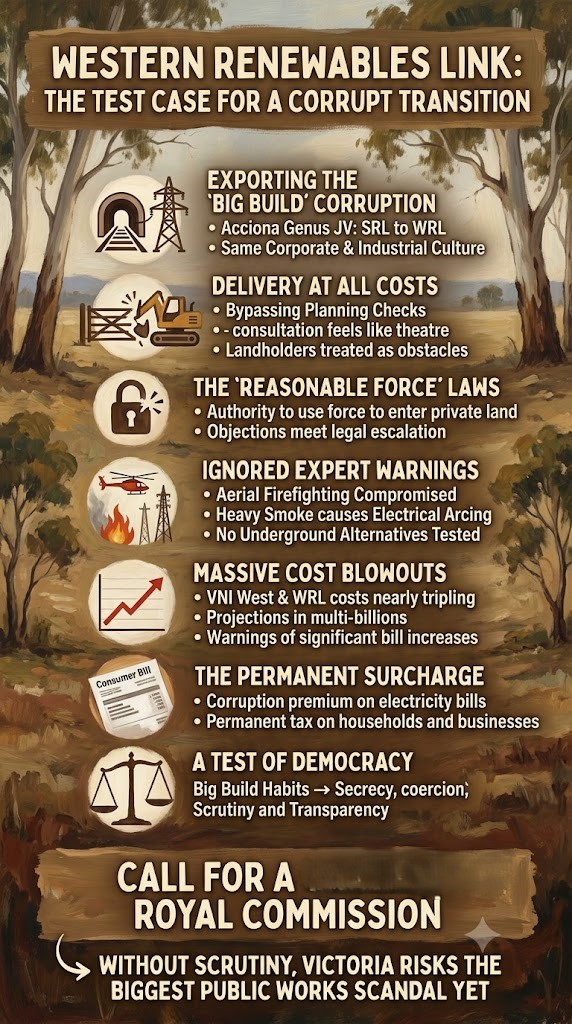
WESTERN RENEWABLES LINK: THE TEST CASE FOR A CORRUPT TRANSITION
For many Victorians, the Western Renewables Link is a line on a map. For farmers, CFA volunteers and regional communities from Melton through the Central Highlands and into western Victoria, it is something more concrete: 80‑metre steel towers cutting through productive farmland and fire‑prone country, backed by laws that allow officials to break farm gates and compulsory purchase land.
AGJV – the Acciona Genus Joint Venture – holds the approximate billion‑dollar construction contract for WRL. The same corporate machine is simultaneously delivering key packages of the Suburban Rail Loop. The industrial agreements, subcontractor networks and corporate cultures that operated on those urban sites are now being exported into rural landscapes, with regional communities as the unwilling host.
The legal and regulatory tools being deployed mirror the “delivery at all costs” mentality of the Big Build. Through ministerial orders under the National Electricity (Victoria) Act, the state has given VicGrid and AEMO sweeping powers to fast‑track WRL and related projects, bypassing standard planning checks. Landholders report consultation that feels like theatre: critical environmental, agricultural and bushfire risk assessments are withheld or delayed; alternatives such as undergrounding are dismissed on cost grounds without transparent comparison; and objections are met not with negotiation but with legal escalation.
The National Electricity Victoria Amendment (VicGrid Stage 2 Reform) Bill 2025 went further, granting Transmission Company Victoria and VicGrid officers authority to use “reasonable force” to open gates, cut locks and enter private land for surveys and works. Farmers who physically resist face fines in the tens of thousands of dollars, even after a politically‑driven reduction following public backlash. Our Stop Labor’s Towers campaign backed by the Western Victorian Community Alliance has documented repeated instances where regional families feel less like community members and more like obstacles to be cleared.
At the same time, expert warnings about safety and cost are echoing the ignored alarms of the Big Build. CFA brigades and local fire experts argue that tall steel towers and dense overhead lines will severely compromise aerial firefighting, expanding “no‑go” zones for water‑bombing aircraft during extreme fire days. Heavy smoke is known to cause electrical arcing and line trips, forcing ground crews to withdraw from areas where towers and lines dominate the landscape. Despite this, there has been no comprehensive, independent testing of underground alternatives along the corridor, and no transparent cost‑benefit comparison that includes fire risk and long‑term land use.
Economically, WRL and its partner interconnector VNI West have already massively blown past their initial cost estimates. National modelling shows the cost of planned transmission investment nearly tripling in real terms across the grid; in Victoria, projections for VNI West alone have risen from hundreds of millions into the multi‑billion range within a few years. The Director of the Victorian Energy Policy Centre has warned that these blowouts could increase standard household power bills by hundreds of dollars a year, and drive large‑user bills to two or three times current levels.
Once again, the pattern is familiar. Warnings from independent analysts are met with official assurances that cost pressures are purely global – inflation, materials, supply chains – while the proven corruption premium from CFMEU‑linked practices and non‑competitive procurement is left out of the explanation. Calls for a Royal Commission into Victoria’s construction sector and its union ties have been rejected or delayed. Integrity reforms for IBAC have been pushed into the political long grass.
What WRL exposes, more starkly than any briefing note, is the human geography of this governance failure. The same political–industrial loop that hollowed out the Big Build is now being stretched across paddocks, ridgelines and firegrounds. The corruption premium is no longer just a line in a report; it is a permanent surcharge on electricity bills, secured against the land titles and safety of regional communities.
For our communities, WRL is not simply another piece of infrastructure. It is a test of whether Victoria will allow the habits of the Big Build – secrecy, coercion, industrial capture and fiscal recklessness – to become the template for the entire energy transition.
If that template stands, the corruption premium exposed in tunnels and rail lines will be written into the backbone of the state’s power system for decades. The alternative is clear but politically uncomfortable: a coercive, joint state‑federal Royal Commission with the power to interrogate not just the past conduct of the Big Build, but the present and future of projects like the Western Renewables Link. Without that level of scrutiny, Victoria risks turning its energy transition into the biggest public works scandal yet.
STOP THE MACHINE: WHY THIS GOVERNMENT MUST GO
By mid‑2026 the pattern is no longer in doubt. A government that built its reputation on the “Big Build” has presided over a construction sector riddled with coercive union power, criminal infiltration and a 15‑billion‑dollar corruption premium baked into public works. The same political–industrial machine is now being rolled out across the energy grid, from the Western Renewables Link to VNI West and beyond. At every step, when faced with hard evidence of abuse, this government has chosen to protect the machine rather than the public.
This is not simply mismanagement. It is a deliberate model of rule. Ministers attack whistleblowers and integrity experts instead of confronting the findings. Critical sections of forensic reports are redacted. Independent business cases are buried. Integrity reforms are pushed safely beyond the next election. Laws are written to let officials break farm gates while families who resist are threatened with crippling fines. The message to Victorians is unmistakable: the project comes first, your rights come last.
The cost of this arrogance is being carried by the people least able to afford it. Every inflated EBA, every ghost shift and every non‑competitive contract is ultimately capitalised into state debt and power bills. Regional communities lose safe farmland and firegrounds. Households inherit a grid loaded with unnecessary, overpriced infrastructure that will be paid for, with interest, over decades. The corruption premium is no longer abstract—it is written into mortgages, rents, food prices and electricity charges.
A government that will not police its own system cannot be trusted to rebuild it. That is why this must now be treated as a political emergency, not a technical problem. Victorians are entitled to demand two things: a joint state–federal Royal Commission with full powers to tear open the project–union–contractor nexus, and the removal of the government that allowed it to flourish. Until that happens, every new announcement on infrastructure or “renewable transition” should be read for what it is: another turn of a machine that has already taken too much and will not stop on its own.