Stop Labors Towers Newsletter – August 16, 2026
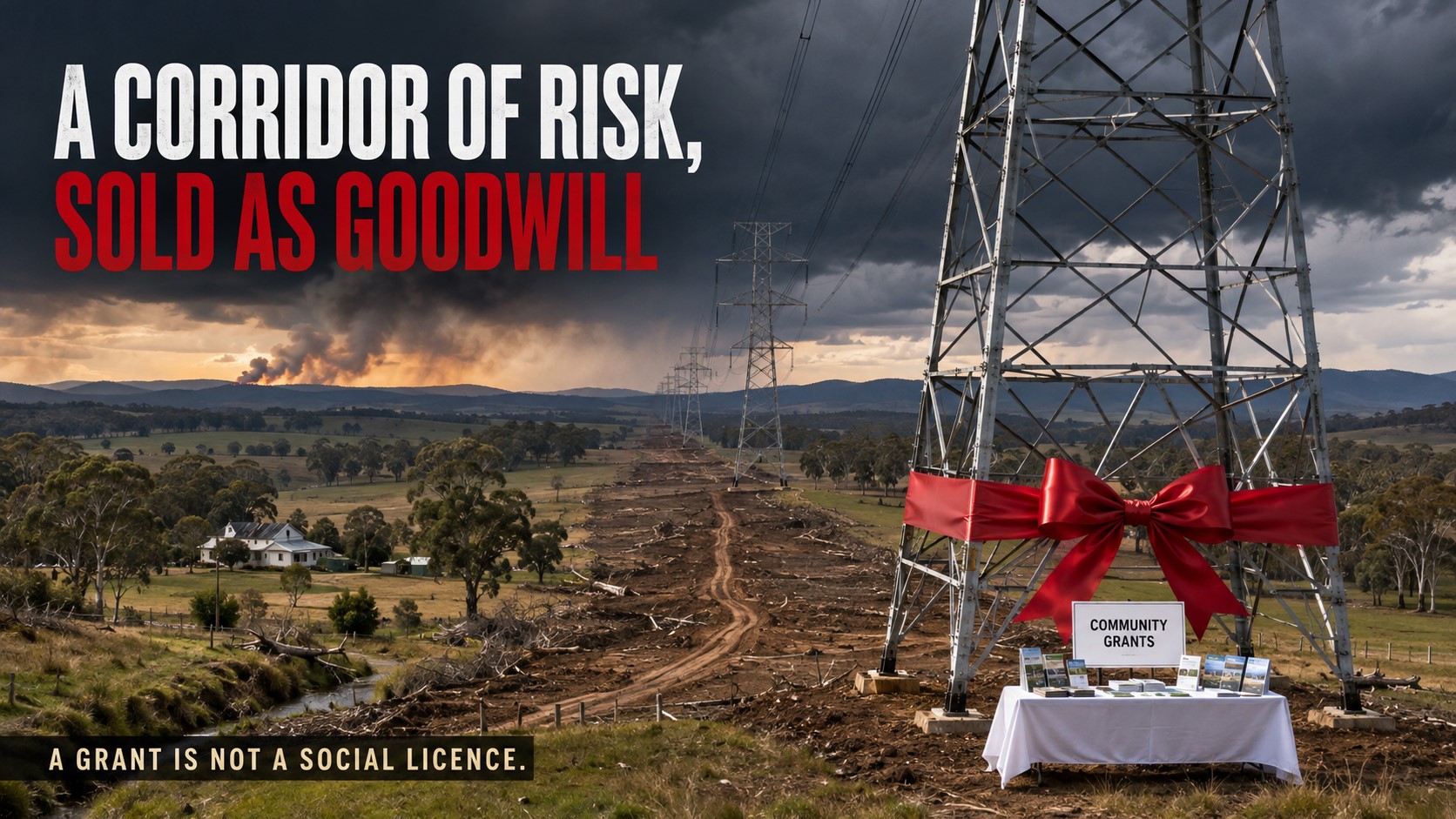
A CORRIDOR OF RISK, SOLD AS GOODWILL
The Western Renewables Link is being marketed across Western Victoria with grant money, “Meet the Builder” events and carefully polished language about opportunity.
But beneath the brochures, sponsorship announcements and contractor briefings lies the reality: a proposed 190-kilometre industrial transmission corridor across farmland, habitat and bushfire-prone country – driven through communities that will bear the risk while others collect the benefit.
This is not goodwill. It is an attempt to make a destructive project appear inevitable.
The formula is painfully clear. Offer community groups grants. Invite local businesses to tender for work. Promise a “lasting legacy”. Then hope the region becomes too financially entangled, too divided, or too exhausted to keep resisting.
But Western Victoria should not be fooled.
A few thousand dollars for a community garden does not offset the permanent fragmentation of productive farming land. Solar panels on a hall do not compensate a family whose property is overshadowed by massive transmission infrastructure. A cheque for a volunteer organisation does not remove the fear, uncertainty and disruption imposed on people expected to live with the live threatening risks this project will leave for decades.
The WRL is not merely a planning proposal. It is a permanent industrial intrusion into one of Victoria’s most productive and environmentally significant rural landscapes.
It threatens to carve up farms that have been built, improved and handed down over generations. It risks disrupting grazing, cropping, machinery access, stock movement, biosecurity and the everyday operation of family businesses that cannot simply relocate when a government map redraws their future.
It threatens habitat already under immense pressure from land clearing, invasive species, drought and climate extremes. It places infrastructure through country where biodiversity is not an abstract planning term, but the living fabric of the landscape: native vegetation, birds, animals, waterways, shelter belts and ecological connections that cannot be recreated with a token planting program after the damage is done.
And then there is fire.
Western Victoria knows fire. Communities do not need bureaucrats and project consultants to explain what happens when dry grass, high winds, heat and infrastructure collide. Every new access track, cleared corridor, construction zone and permanent asset must be examined through the unforgiving reality of fire behaviour – not through a glossy risk register drafted in an office far from the properties that will face the consequences.
The question is not whether the project can produce a document saying risk has been “managed”. Every major project can produce documents. The real question is whether the remaining risk is acceptable to the people asked to live with it.
The answer is clear: it is not.
The WRL’s cost has already risen dramatically from its original estimate. That should alarm every Victorian. When projects blow out before construction, communities are entitled to ask what else has been underestimated: environmental impacts, compensation costs, construction disruption, bushfire exposure, long-term maintenance and the economic damage to farming districts.
Yet instead of pausing for a full independent reassessment, the project machine is moving ahead with supplier briefings and grants programs.
The message is unmistakable: prepare to profit from it, because we intend to build it.
That is precisely why local businesses must think carefully before attaching their name to the WRL. No business should be condemned for seeking work or trying to keep staff employed. But no business can claim to be neutral once it accepts money, contracts or commercial advantage from a project that threatens their farms, safety and future.
The companies that sign up may earn revenue in the short term. But they will also be making a public choice about the kind of region they want Western Victoria to become: one where communities are consulted after the route is chosen, where private property is treated as a corridor, and where the damage is carried locally while decisions are made elsewhere.
The same applies to the grants program. Community groups along the proposed WRL route know exactly what is at stake: productive farmland, bushfire safety, habitat, family livelihoods and the integrity of their towns.
They must not allow themselves to become complicit in a project that threatens those very things. Project grants are not harmless acts of generosity when they are offered alongside a campaign to secure acceptance for a destructive industrial corridor. They are an attempt to purchase legitimacy, soften opposition and create the appearance of local consent.
Community organisations must not be susceptible to such inducements. No grant, sponsorship or promised benefit can justify lending their name, reputation or silence to a project that may cause permanent damage to the region. Accepting this money without publicly opposing the WRL risks making those organisations part of the machinery used to force it through. But the project proponents and the government must not be allowed to confuse need with consent.
A grant is not a social licence.
A sponsorship is not community approval.
A contractor briefing is not local support.
Western Victoria does not need to be bought off, managed or divided. It needs a government prepared to listen, to properly test alternatives and to recognise that the energy transition cannot be built on the forced sacrifice of rural communities.
The WRL MUST be stopped. Its route, cost, alternatives, environmental effects, agricultural impacts and bushfire risks should be subjected to independent scrutiny.
Compulsory acquisition should be ruled out. And no further approvals should be rushed through before Victorians have their say at the election.
This region has been asked to accept the unacceptable for too long.
VICTORIA’S FIRE SYSTEM IS ALREADY UNDER STRAIN
The Victorian Parliament’s Inquiry into the 2026 Summer Bushfires delivered a blunt conclusion: the state’s bushfire system contains systemic shortcomings.
More than 440,000 hectares burned. Four hundred and fifty-one homes were destroyed. Around 150,000 hectares of agricultural land were affected. More than 45,000 livestock died. Thousands of kilometres of fencing and tens of thousands of tonnes of fodder were lost. One person died.
These are not just disaster statistics. They are a measure of system failure: insufficient preparedness, constrained firefighting capability, ageing equipment, weaknesses in fuel management, gaps in communication and a recovery system that placed excessive burdens on people who had already lost homes, stock, fences and livelihoods.
The inquiry made 93 findings and 80 recommendations. It pointed to a 26% fall in CFA volunteer numbers over the past decade and continued reliance on hundreds of ageing, single-cab tankers, including many that leave firefighters exposed to the weather while responding to dangerous fires.
In other words, Victoria is asking regional communities to face longer, hotter and more destructive fire seasons with fewer volunteers, ageing assets, inconsistent emergency information and a system that the Parliament itself has found needs major repair.
That is the starting point for every major infrastructure decision in bushfire country.
The WRL Risk Equation
The Western Renewables Link must not be considered as though it exists in isolation.
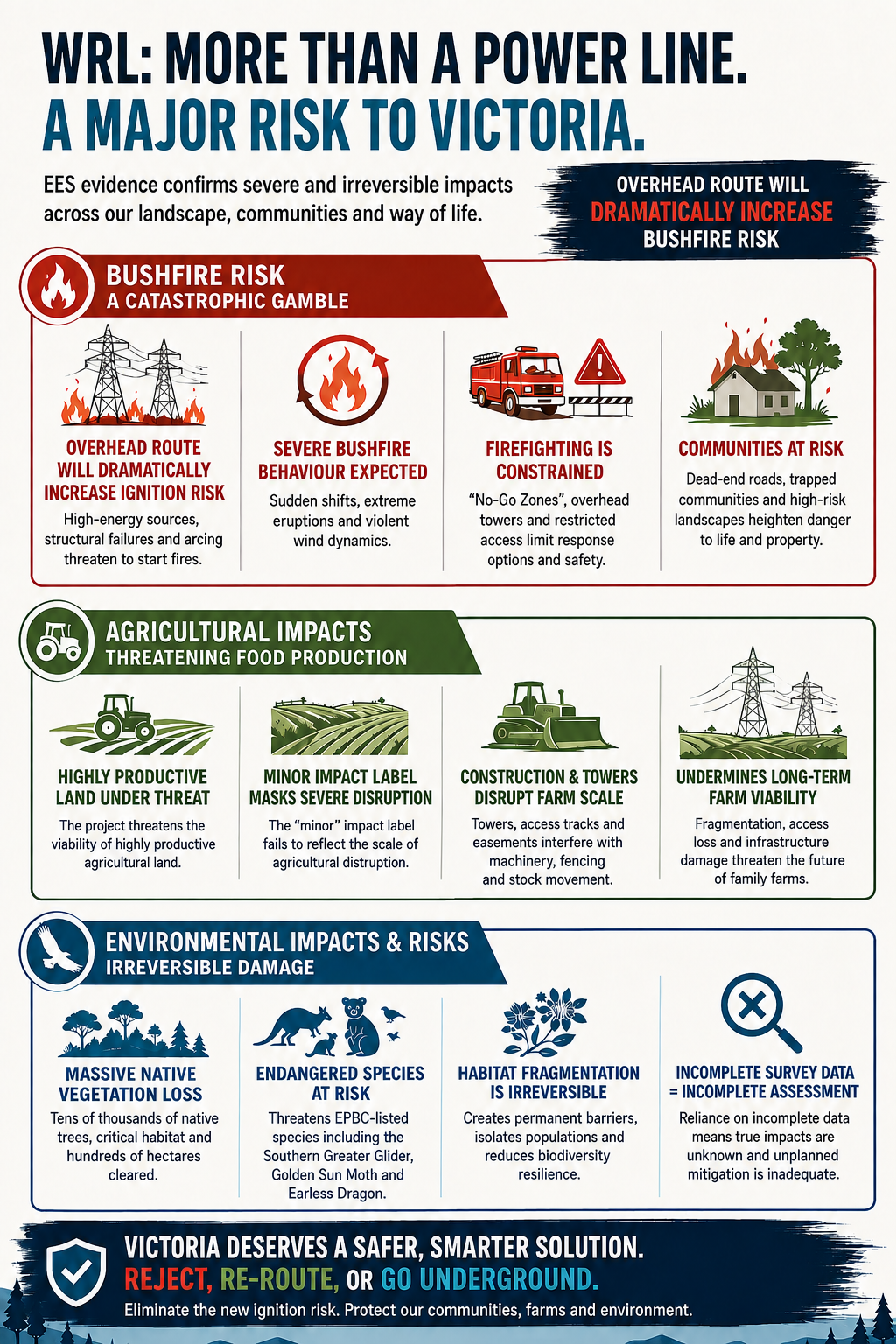
A major overhead transmission corridor is not merely a collection of towers and wires. It is permanent infrastructure across agricultural land and fire-prone landscapes. It requires access tracks, work zones, construction activity, vegetation management, maintenance access, heavy equipment and ongoing operational activity.
Each component introduces exposure. Certainty of an ignition event. In a severe fire environment, the risk calculation cannot stop at “is this asset compliant?” It must ask: “what happens if the system fails, and what is the consequence if it fails on the worst possible day?”
That is the question government must answer.
The consequences are not limited to the infrastructure itself. They include:
-
People unable to defend or evacuate safely.
-
Emergency services stretched across multiple fire fronts.
-
Farms cut off by damaged roads, smoke or fire.
-
Livestock trapped behind inaccessible paddocks and damaged fences.
-
Communications and electricity systems disrupted precisely when communities need them most.
-
Habitat, shelter belts, waterways and productive agricultural land destroyed.
-
Volunteers and local brigades forced to carry a risk created by a project they did not ask for.
The recent inquiry shows that those emergency resources cannot simply be assumed to be available at unlimited scale. They are finite. They are already under pressure.
A Risk That Cannot Be Waved Away
The WRL may be presented as part of the energy transition. But an energy transition that increases unmanaged risk in already vulnerable regions is not resilient infrastructure – it is an infrastructure failure waiting to happen.
This is the core issue: government proposes to add permanent overhead electricity infrastructure to bushfire-prone country while its own Parliament has just documented serious weaknesses in the state’s ability to prevent, fight and recover from major fires.
That does not prove that the WRL will cause a fire. It does demonstrate why the threshold for approval must be extraordinarily high.
If Victoria cannot adequately resource its fire services, replace ageing frontline assets, retain volunteers, manage fuel, maintain roads and deliver coherent emergency communication during a major event, it cannot credibly tell regional communities to accept additional industrial infrastructure risk on the promise that it has all been “managed”.
A risk register is not a fire truck.
A project assurance process is not a tanker brigade.
The Required Standard
Before any WRL approval proceeds, the government should be required to demonstrate – publicly and independently – that:
-
The full bushfire consequences of the proposed alignment have been assessed under extreme fire-weather conditions.
-
Alternatives, including use of existing corridors, different routes, lower-risk technologies and undergrounding where feasible, have been properly tested.
-
The project will not impose additional unresourced burdens on CFA brigades, farmers, councils or emergency-management systems.
-
Fire access, evacuation, communications, water supply, livestock management and post-fire recovery have been planned with affected communities – not simply assumed in a consultant’s report.
-
The state has the people, equipment and capability necessary to manage the compound risk created by major fire weather and new transmission infrastructure.
The summer of 2026 showed the real cost of underestimating fire risk.
To proceed with the WRL without meeting this standard would not be innovation. It would be negligence disguised as progress.
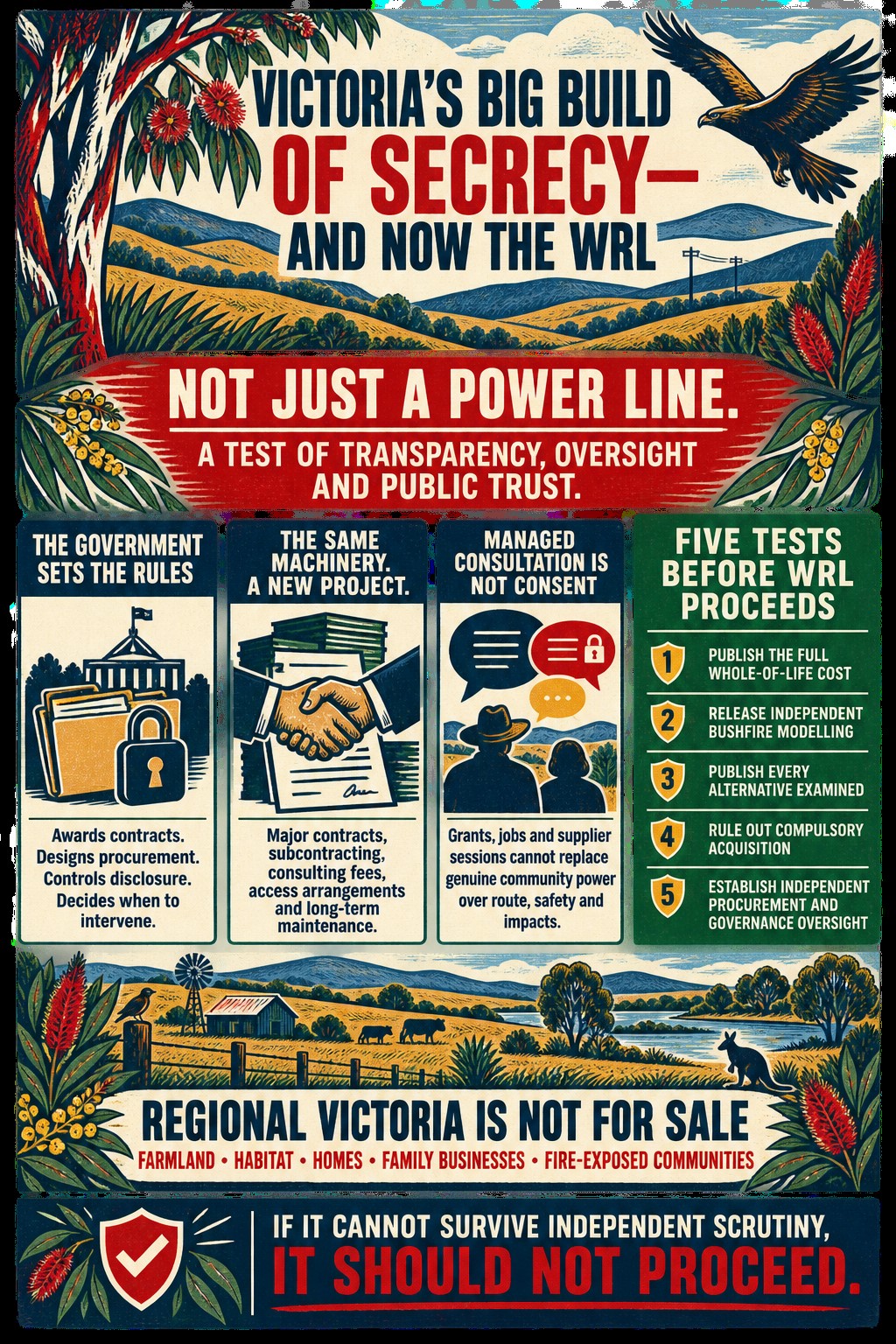
VICTORIA’S BIG BUILD – AND NOW THE WRL
Let us stop pretending this is merely about energy.
The Western Renewables Link is not just a transmission line. It is the next test of a Victorian Labor Government that has spent years presiding over an infrastructure culture defined by secrecy, cost blowouts, political protection and an alarming closeness to powerful industrial interests.
Labor ministers may say they were shocked by revelations of alleged criminality and corruption linked to parts of Victoria’s construction sector. They may insist that the problems were isolated, that they knew nothing, that reforms are now underway.
But Victorians are entitled to ask: how much did this government fail to see – and how much did it choose not to see?
You do not get a culture of secrecy, intimidation and entrenched influence overnight. It thrives where oversight is weak, where whistleblowers are ignored, where ministers avoid hard questions and where billions of taxpayer dollars are pushed through increasingly opaque systems.
That is the Victorian Labor Government’s responsibility.
Not because every minister, public servant, union member or construction worker is corrupt. They are not.
But because it is government that sets the rules, awards the contracts, designs the procurement systems, controls disclosure and decides whether to intervene when warning signs emerge.
The Same Machinery, A New Project
Now Labor wants regional Victoria to trust it with another multi-billion-dollar infrastructure program.
The WRL will create major contracts, subcontracting opportunities, construction work, consulting fees, access arrangements and long-term maintenance activity. It will pull more public money into the very infrastructure ecosystem that Victorians have every reason to examine with suspicion.
It is the old formula: secure the route, prepare the contracts, recruit the local suppliers, offer enough money to soften community resistance and keep moving until the project becomes politically impossible to stop.
That is not community engagement. It is political containment.
The Government Must Carry the Burden
The government cannot demand that farmers, local businesses and our community trust the WRL process while refusing to meet a higher standard of transparency itself.
It must publish the full costs not selective headlines and optimistic estimates, but the whole-of-life bill for construction, compensation, vegetation management, emergency planning, maintenance and risk mitigation.
It must release independent bushfire modelling and demonstrate how the project would perform under catastrophic fire-weather conditions.
It must publish every alternative examined: undergrounding, existing easements, alternative alignments, decentralised energy options and lower-impact technologies.
It must rule out compulsory acquisition before asking communities to engage in good faith.
And it must establish an independent procurement and governance process with real power to investigate conflicts, disclose labour arrangements, monitor contracting and expose any improper influence.
Anything less is asking Victorians to trust a government that has not earned trust.
Regional Victoria Is Not for Sale
The WRL is not an empty line on a map.
It is farmland. It is habitat. It is homes and family businesses. It is a landscape exposed to fire. It is communities that will remain after ministers have moved portfolios and contractors have moved to the next project.
Victorian Labor has a choice.
It can confront the failures of its infrastructure culture – open the books, strengthen oversight, respect communities and redesign the project around safety and consent.
Or it can keep doing what it has done for years: manage the headlines, defend the process, reward the insiders and tell regional Victorians that opposition is simply the price of progress.
The government says the WRL is essential.
Then it should be able to survive independent scrutiny.
If it cannot, it should not proceed.