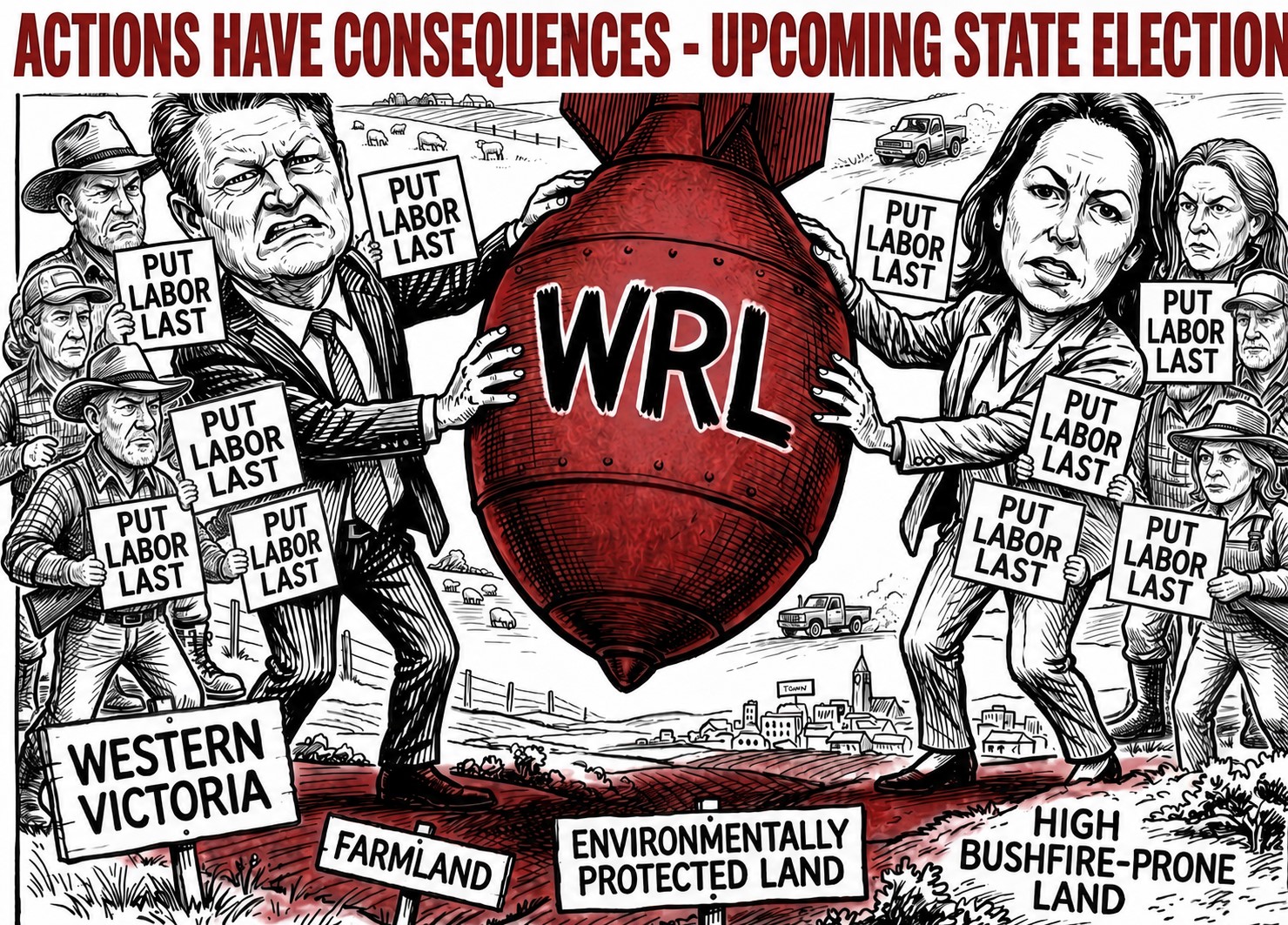
Stop Labors Towers Newsletter – August 29, 2026
HOLD THE LINE
A Chronicle of Country, Community and the Western Renewables Link
An archive newsletter from Stop Labor’s Towers
“The landscape has a memory, and so do its people.”
There are landscapes that look empty only to those passing through.
Western Victoria is not empty. It is worked country: paddocks held together by judgement, weather and long memory; creeks that remember drought; old trees that keep their hollows through hard summers; roads travelled before dawn by farmers, volunteers, contractors and children on buses. It is country shaped by labour and care. It is the kitchen table after a day in the paddock. It is the CFA shed when the wind turns. It is the neighbour who arrives before being asked.
For years, the Western Renewables Link has come toward this country, our country first as a line on a map, then as letters, maps, surveys, meetings, notices, hearings and deadlines. Before a tower has been built, the project has entered homes and futures. It has altered plans to retire, sell, borrow, plant, expand, protect habitat or simply get through the season without another piece of official correspondence arriving in the mailbox.
This archive is not a technical assessment of a transmission proposal. Nor is it a claim that regional people oppose change, renewable energy or the need for reliable power. It is a record of a community asking a more difficult question:who decides how change is made, who bears its risks, and what happens when the people who will live with the outcome say the plan is wrong – dead wrong?
Across this years Western Victorian Community Alliance’s Stop Labor’s Towers newsletters, the answers came in many forms: a farmer speaking at an inquiry; a volunteer firefighter describing what smoke and live lines mean on a fireground; a family holding their line; a landcare voice defending a habitat corridor; a local group questioning whether a grant can ever equal genuine consent. Taken together, they describe a community that became organised, informed and determined not to be treated as a corridor on somebody else’s map.
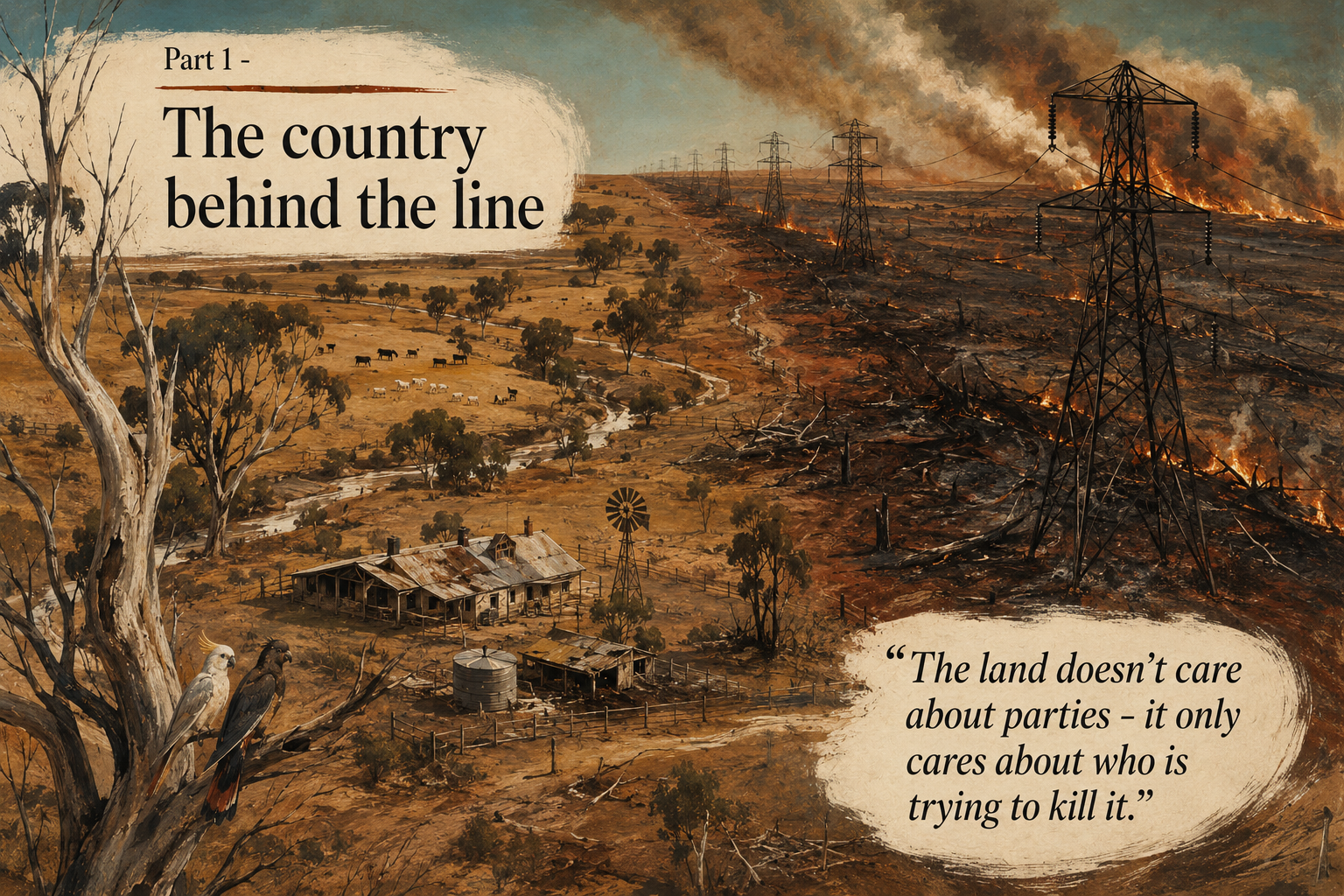
Part 1 – The Country Behind The Line
The proposed Western Renewables Link has been described in official terms as infrastructure: a 190-kilometre transmission corridor intended to carry electricity from Bulgana toward Melbourne’s north-west. But our community, along the route have never experienced it as an abstraction. To us, it is a proposal with a physical address.
It runs through working farms where access, irrigation, stock movement, machinery, biosecurity and shelter belts are not planning considerations but daily realities. It crosses country where remnants of native vegetation and old hollow-bearing trees are not merely environmental values listed in a report; they are part of the living fabric of a place. And it passes through landscapes where fire is not an occasional risk category. It is a permanent fact of life.
That is why the campaign’s language has so often returned to place. The argument was never simply that towers would be visible, or that an easement would inconvenience one landholder. The argument was that the landscape is already carrying many roles: food production, biodiversity, habitat, homes, local economies, recreation, heritage and emergency access. To impose a large new industrial corridor is to change the relationships that make rural life work.
Our campaign repeatedly challenged the assumption that regional land is vacant, available or somehow less valuable because it lies beyond metropolitan view. A paddock can be productive without looking dramatic. A line of trees can shelter stock, retain soil, hold birds and connect habitat. A rough track can be the only way a tanker reaches a property when the air is brown and the wind has begun to roar.
“The land doesn’t care about parties – it only cares about who is trying to kill it.”
That line, published in May 2026, captured the campaign’s central instinct. Political labels mattered less than the enduring question of whether the people proposing the project understood the country they were asking to carry it.
The answer, all community members felt, was no. The project had been conceived from above: a route, a technology and an economic rationale settled before landholders, local communities and the full environmental realities of the corridor had been properly heard. The Environmental Effects Statement process became, for many, an opportunity to put the ground truth back into a process they believed had begun with a predetermined answer.
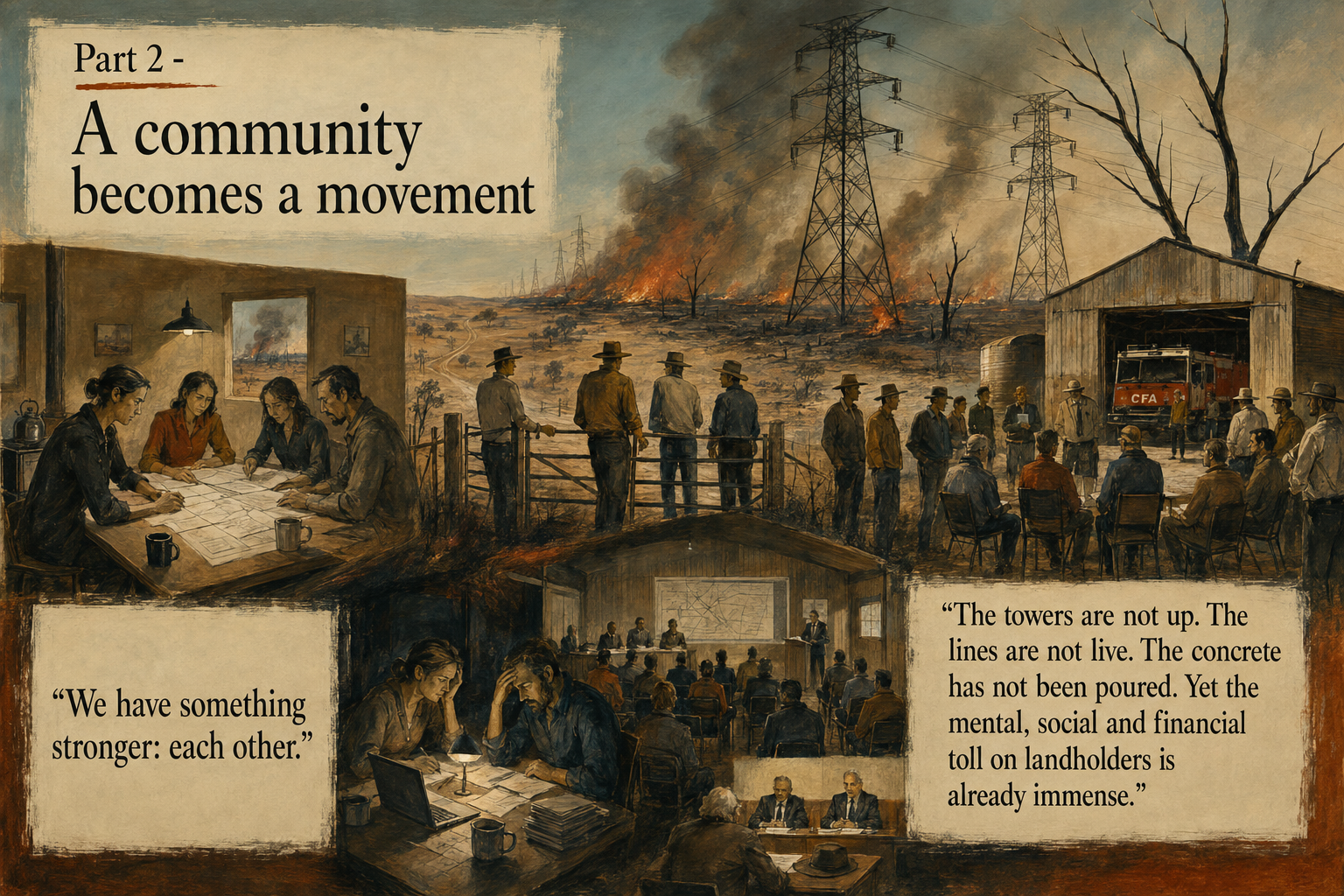
Part 2 – A Community Becomes a Movement
This newsletter and our campaign tells the story of our community that did not begin as a campaign machine. It formed because people who knew their country felt compelled to learn the language of planning, engineering, bushfire doctrine, legislation and public advocacy.
The movement gathered around kitchen tables, farm gates, local halls, council chambers, CFA sheds and screens late at night. Landholders compared maps. Families sought advice. Volunteers and local organisations shared information. People who had never made a formal submission found themselves reading thousands of pages of material, attending hearings, preparing evidence and speaking publicly about matters they had once expected governments and agencies to manage responsibly.
The scale of participation was itself a recurring story. This newsletters recorded thousands of supporters across the region, hundreds of written and verbal submissions, and hearing sessions devoted to individual landholders, farming families, rural businesses, community groups and fire brigade representatives. The community’s point was plain: this was not a narrow objection from a handful of affected properties. It was a broad regional response rooted in different kinds of knowledge.
There were the practical witnesses: farmers explaining the impacts of easements on irrigation, cropping, aerial spraying, fencing, stock movement and long-term business decisions. There were environmental voices speaking to grasslands, waterways, habitat links and the loss of old trees that cannot be recreated in a grant-funded planting scheme. There were local fire voices who understood the operational consequences of restricted access, dense smoke and live high-voltage infrastructure.
There were also people speaking about less visible losses: sleep, certainty, trust and the ability to plan a life.
“The towers are not up. The lines are not live. The concrete has not been poured. Yet the mental, social and financial toll on landholders is already immense.”
The archive shows how a proposal can create harm before construction begins. People reported postponing decisions about investment, retirement, property sales and succession. They spoke of years spent waiting for information, challenging assumptions and wondering whether their homes or livelihoods would become subject to a decision they could not meaningfully influence.
This campaign’s strength comes from this shared experience. It did not require everyone to agree on every detail. It required only recognition that the project’s consequences were real, the process was not trusted, and silence would make it easier for decisions to be made without them.
“We have something stronger: each other.”
That phrase became a practical proposition. Share the newsletter. Forward it. Attend a meeting. Support a neighbour. Learn the documents. Speak at a hearing. Write to a minister. The community’s communications are not just a vehicle for opinion; they are an organising tool that made people less isolated and better informed.
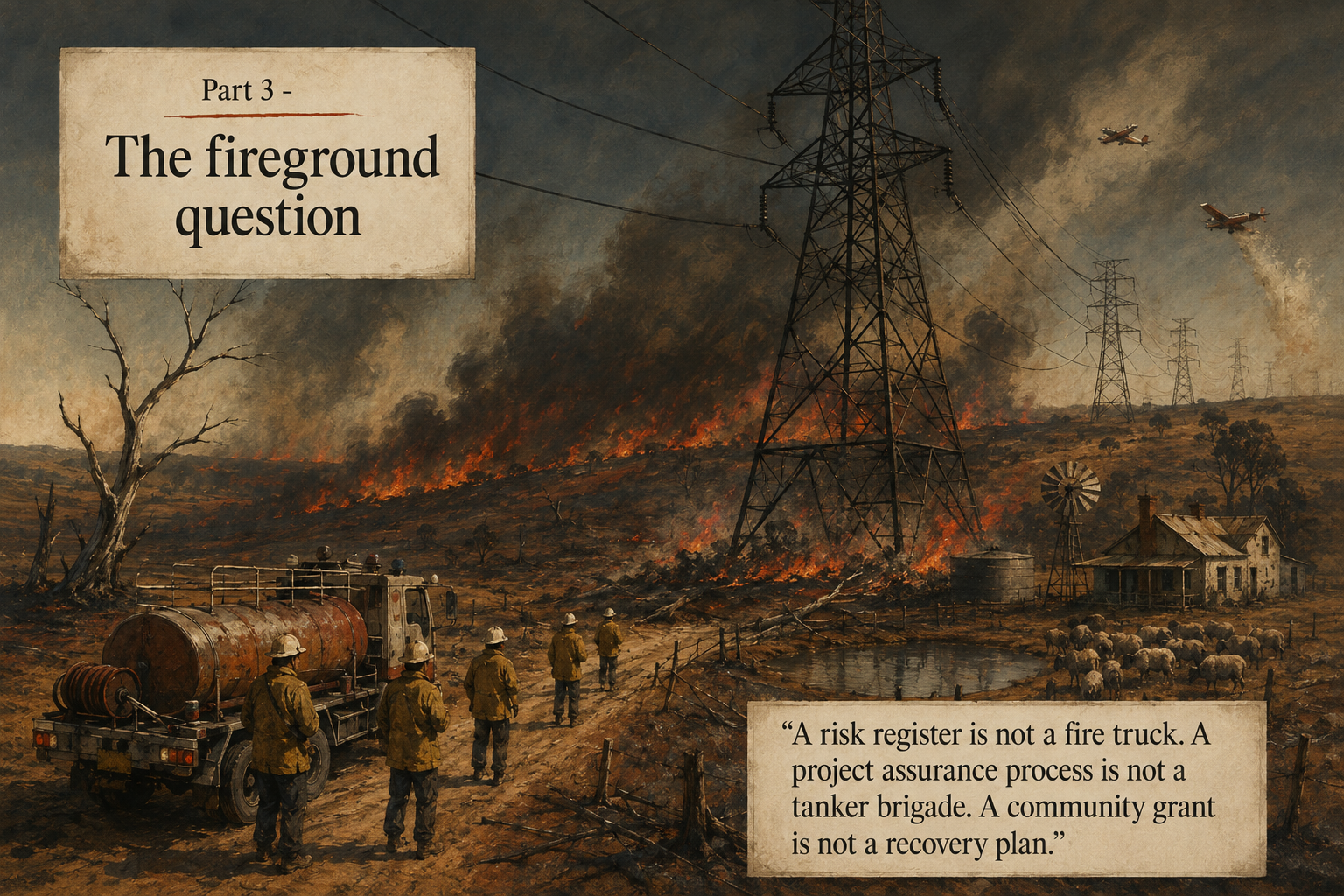
Part 3 – The Fireground Question
If one concern ran through this campaigns archive with particular urgency, it was bushfire.
Western Victoria’s communities understand that the worst fire days do not leave much room for comforting assumptions. Dry grass, heavy fuel loads, extreme heat, erratic winds, steep country, limited access and volunteer crews can combine into conditions in which every decision becomes consequential. It’s one of the world’s most vulnerable bushfire regions. In that setting, this campaign asked whether a major overhead transmission corridor should be placed across country already exposed to catastrophic fire risk.
These newsletters drew heavily on the lived experience of firefighters and landholders, alongside references to CFA procedures and broader fire inquiries. Their concern was not only that the proposed line would inevitably cause a bushfire. It was that the consequences of failure, or of operating around live overhead infrastructure during a major fire, demanded a much higher standard of design and scrutiny than had been applied.
Community voices repeatedly raised questions about smoke-related arcing and flashovers, stand-off requirements, access in easements, the restrictions faced by ground crews, and limits on aerial firefighting near tall towers and high-voltage lines. These were not rhetorical flourishes to the people making them. They were questions about whether a tanker could reach a paddock, whether an aircraft could work a fire edge, whether a crew could safely attack a blaze, and whether a family could defend or evacuate when the conditions were at their worst.
“A risk register is not a fire truck. A project assurance process is not a tanker brigade. A community grant is not a recovery plan.”
That is the distinction these newsletters pressed again and again. A project can generate studies, procedures and mitigation plans. But, the community argued, documents do not create additional volunteers, replace ageing appliances, clear a blocked access route or reduce the pressure on a fire service already stretched by larger and more frequent events.
The 2026 fire season brought fresh gravity to this concern. Newsletter coverage referred to parliamentary inquiry findings on the scale of losses, the pressures on the state’s bushfire system, declining volunteer numbers, ageing equipment and continuing shortcomings in preparedness and recovery. The archive’s argument was not that all risk can be eliminated. It was that governments must not add new, permanent infrastructure risk to a vulnerable landscape without publicly demonstrating why safer alternatives are not feasible.
These newsletters pointed to undergrounding, different alignments, lower-risk technologies and use of existing corridors as options requiring genuine, transparent examination. The repeated question was not “why build nothing?” It was: why choose the version that imposes the greatest burden on the communities and environment least able to carry it?
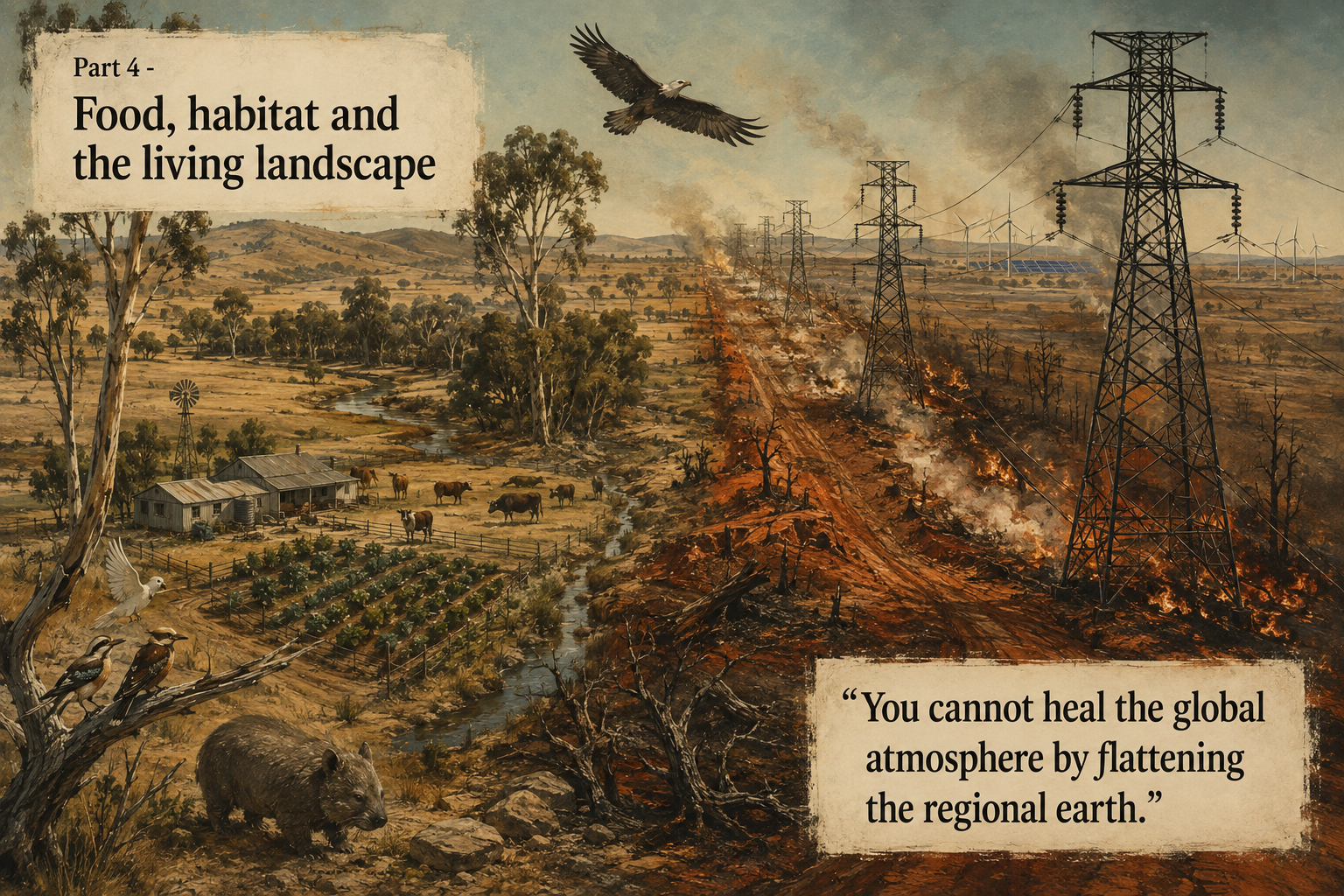
Part 4 – Food, Habitat and the Living Landscape
The campaign also refused the false choice between climate action and environmental protection.
We argued that a transition undertaken without care for agricultural land, habitat and local ecology was not a transition worthy of the name. The campaign challenged the idea that regional landscapes should be treated as a blank field between energy generation and urban demand. We described working land as a food-producing system, a home for wildlife, a store of knowledge and an inheritance held in trust.
This was not romanticism. It was an insistence on consequences.
Farm businesses depend on the practical integrity of land: paddock shape, access, machinery movement, water systems, reliable operations and the ability to adapt across seasons. Environmental systems depend on connections too: old trees, grasslands, gullies, waterways, shelter belts and corridors that allow species to persist through changing conditions.
Our campaign objected to a planning culture that, in our campaign’s view, too often considered these impacts as matters to be mitigated after the route had effectively been selected. Community submissions argued for better baseline information, more on-ground surveying and an honest comparison of alternatives before irreversible decisions were made.
“You cannot heal the global atmosphere by flattening the regional earth.”
You cannot heal the global atmosphere by flattening the regional earth means climate action must not become an excuse for avoidable local damage. We support the transition to cleaner energy, but it must protect the landscapes, ecosystems, farms, water and communities on which that transition depends.
Renewable infrastructure should be necessary, properly costed, carefully located, built with the least harm possible and developed with the genuine consent and participation of the people who will live with it.
This is one of the campaigns’ strongest and most enduring propositions. Our campaign rejects being called anti-renewable simply for questioning the route, technology, cost and governance of a particular project. Its position is that an energy transition should respect the things it claims to protect: biodiversity, productive soil, water, rural livelihoods and the communities that steward them.
The argument extended beyond one corridor. These newsletters concerned that if the Western Renewables Link proceeded in a form regarded as damaging and coercive, it would become a template for how future energy infrastructure is built across Australia: decisions made early, costs externalised locally, alternatives dismissed, and community engagement offered after the most important choices have already been made.
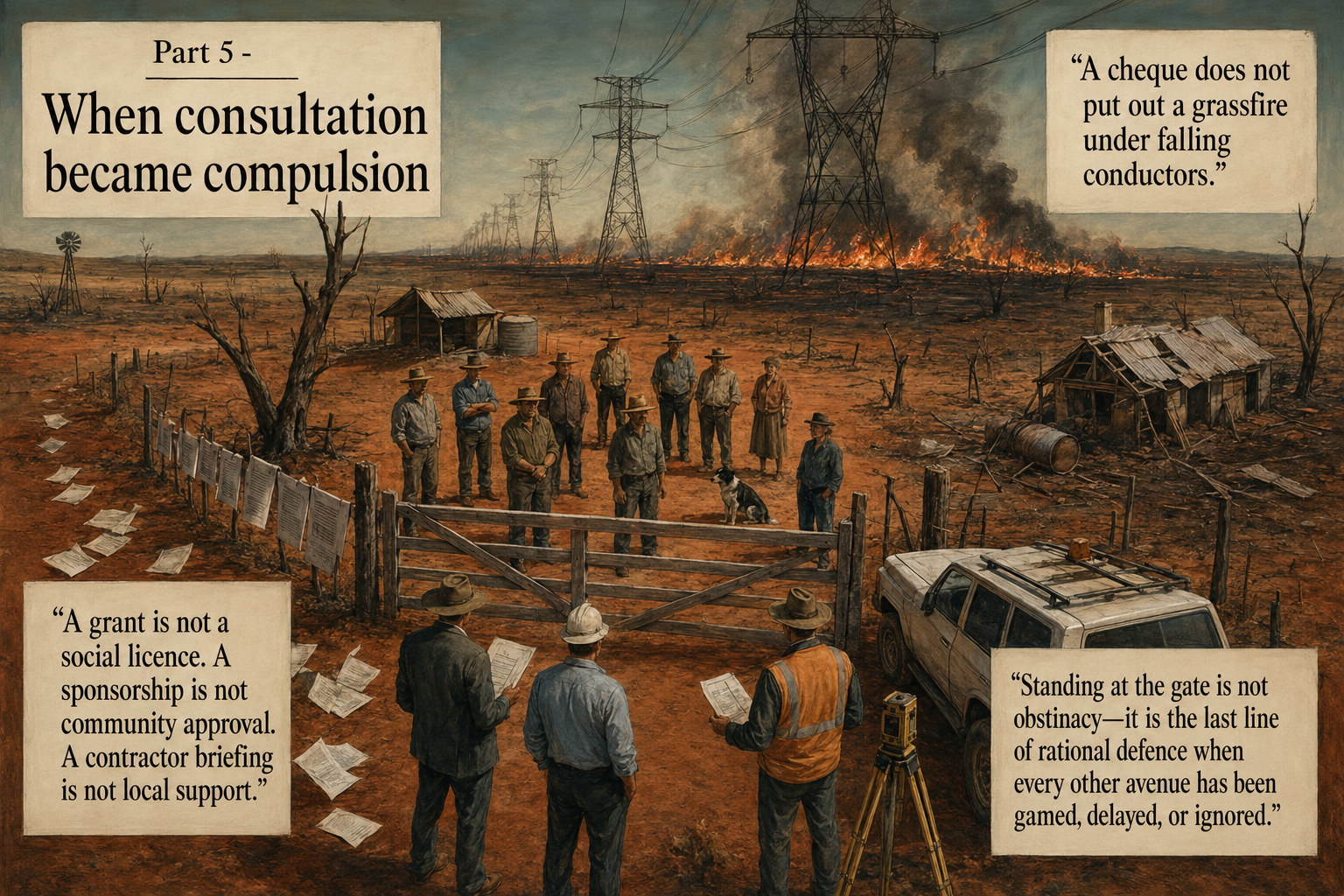
Part 5 – When Consultation Became Complulsion
No theme reveals the campaign’s loss of trust more clearly than land access.
In these newsletters, the story of access was told as a sequence: consultation becoming notification; notification becoming direction; direction becoming enforcement. Landholders facing notices, fines or the possibility of forced entry did not experience the process as partnership. They experienced it as evidence that the state had decided compliance was more important than consent.
Community members gathered at farm gates. These gatherings were presented as acts of solidarity rather than aggression: neighbours and supporters showing that one landholder would not be left alone to face the pressure of an infrastructure process backed by new legal powers.
“A cheque does not put out a grassfire under falling conductors.”
“Standing at the gate is not obstinacy – it is the last line of rational defence when every other avenue has been gamed, delayed, or ignored.”
The language was forceful because the stakes felt personal. For many, the prospect of compulsory acquisition or forced access transformed the issue from a planning dispute into a democratic one. The campaign argued that consultation cannot be credible if its ultimate form is a notice that says the state can proceed regardless.
This is why the newsletters repeatedly called for a reset: no compulsory acquisition before full scrutiny; proper appeal rights; genuine negotiation; alternatives openly assessed; and decisions paced according to evidence rather than political or commercial momentum.
The community is not asking to veto every change. It is asking that consent not be treated as a public-relations exercise – something to be simulated through workshops, brochures, sponsorships and grants while the major decisions remained closed.
“A grant is not a social licence. A sponsorship is not community approval. A contractor briefing is not local support.”
That is perhaps the campaigns clearest warning. Communities know the difference between benefit and buy-in. A local grant may support worthy work. A contract may create employment. But neither changes the duty to consider whether the project itself is safe, fair, necessary and accepted by the people expected to live with it.
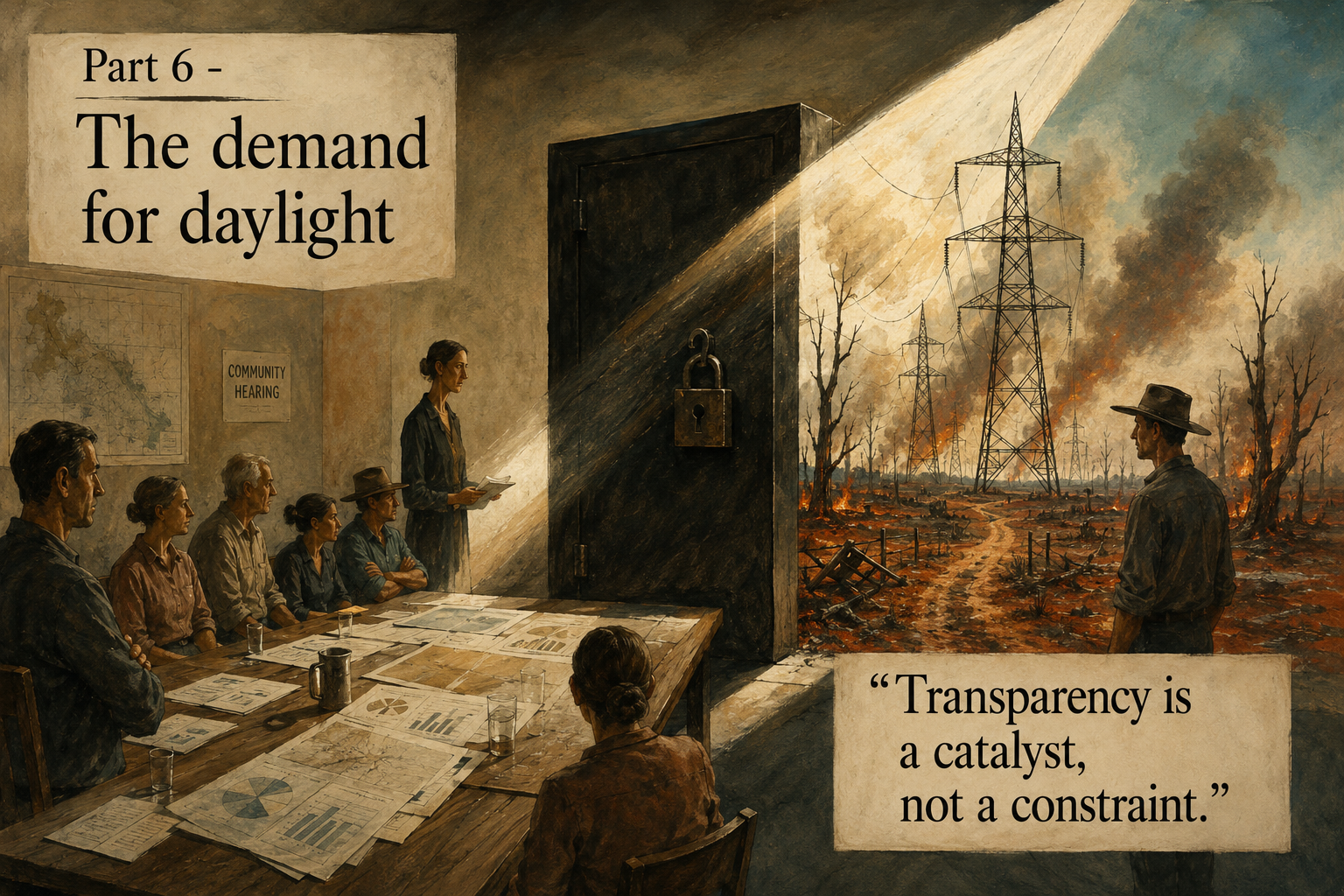
Part 6 – The Demand for Daylight
The Environmental Effects Statement hearings were a defining chapter in the campaign. They placed ten’s of thousands of pages of material, expert views, local knowledge and personal testimony onto the record. For the community, the hearings were proof that regional voices were neither uninformed nor easily dismissed.
But the conclusion of hearings created another frustration. The Inquiry and Advisory Committee report went to the Minister for Planning, while the public record and hearing materials were no longer readily available. This newsletters documented a persistent demand for the report to be released before any final ministerial decision.
“Transparency is a catalyst, not a constraint.”
The campaign’s case was straightforward: if a project is said to have undergone an independent, evidence-based process, the public should be able to see the findings before the final decision is made. A report about a project with long-term implications for farms, fire safety, biodiversity, local amenity and public expenditure should not be withheld until after the moment when communities might respond meaningfully to it.
The call for release became more than a procedural request. It represented a deeper question about the relationship between the state and its community. Are communities entitled to see evidence that will shape their futures? Or are they expected to accept that decisions will be made for them, then explained later?
The newsletters connected this issue to wider concerns about cost, governance and public trust. We challenged escalating estimates, questioned the handling of alternatives and raised concerns about the way major infrastructure is procured and overseen. These are substantial claims and should always be tested against primary evidence and independent reporting. But the archive is clear about the political feeling behind them: community members believed they had been asked to trust systems that had not earned their trust.
In the campaign’s own words, transparency was not the obstacle to a transition. The absence of it was.
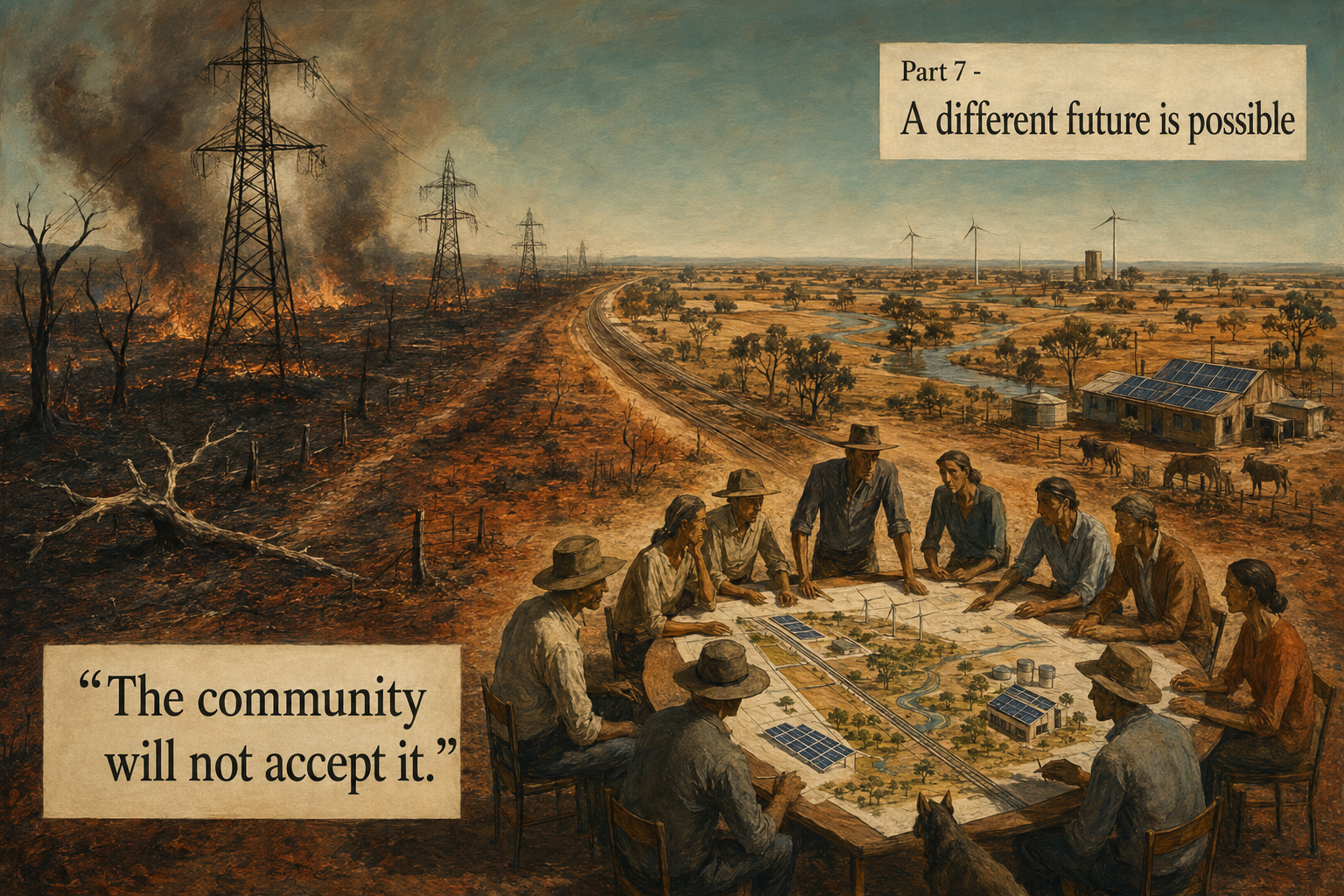
Part 7 – A Different Future is Possible
The most important fact in this year’s newsletter archive is not simply that people resisted. It is that they articulated an alternative.
Across these newsletters, the community did not argue that Victoria should abandon its energy future. It argued that the future should not be imposed through a single, overhead, greenfield corridor without proper testing of different routes, existing easements, undergrounding where feasible, decentralised options, storage and lower-impact technologies.
The campaign called for early planning with communities rather than late consultation with them. It called for full and independent cost comparisons that include not only construction figures, but agriculture, ecology, fire safety, insurance, access, compensation, maintenance and long-term public risk. It called for a transition designed around genuine social licence rather than coerced acceptance.
These are principles that travel beyond the Western Renewables Link.
A durable energy system must be technically sound. But it must also be legitimate. It must explain its choices, hear inconvenient evidence, protect the people who host it and recognise that land is not merely a route between supply and demand. It is home, livelihood, ecosystem and memory.
“The community will not accept it.”
Those words were not a rejection of the future. They were an insistence that there are better ways to reach it.
Conclusion – Hold the Line
This year’s (so far) archive records a period of pressure and uncertainty, but it also records resilience.
It records people who became advocates because they had to. People who spoke in formal hearings, stood with neighbours at gates, sifted documents, attended meetings, shared newsletters, wrote letters, sought expert advice and kept going when exhaustion might have been easier.
It records the power of a community refusing to be reduced to a demographic, an easement or an obstacle in a project plan.
The Western Renewables Link remains, in the pages of these newsletters, a highly contested proposition. The campaign’s demands have remained consistent: stop the project in its current form; release the evidence; test alternatives openly; protect country, farms and habitats; account honestly for bushfire risk; restore trust and rights; and do not confuse coercion, compensation or public relations with consent.
The final word belongs not to a corporation, a minister or a consultant, but to the communities that have carried this issue for six plus years.
The land remembers.
So do its people.
And we are still here.
Hold the line.
Source note
This retrospective is based on the Stop Labor’s Towers newsletters and associated community material published from February to August 2026. It presents the campaign’s perspectives, concerns and stated claims.