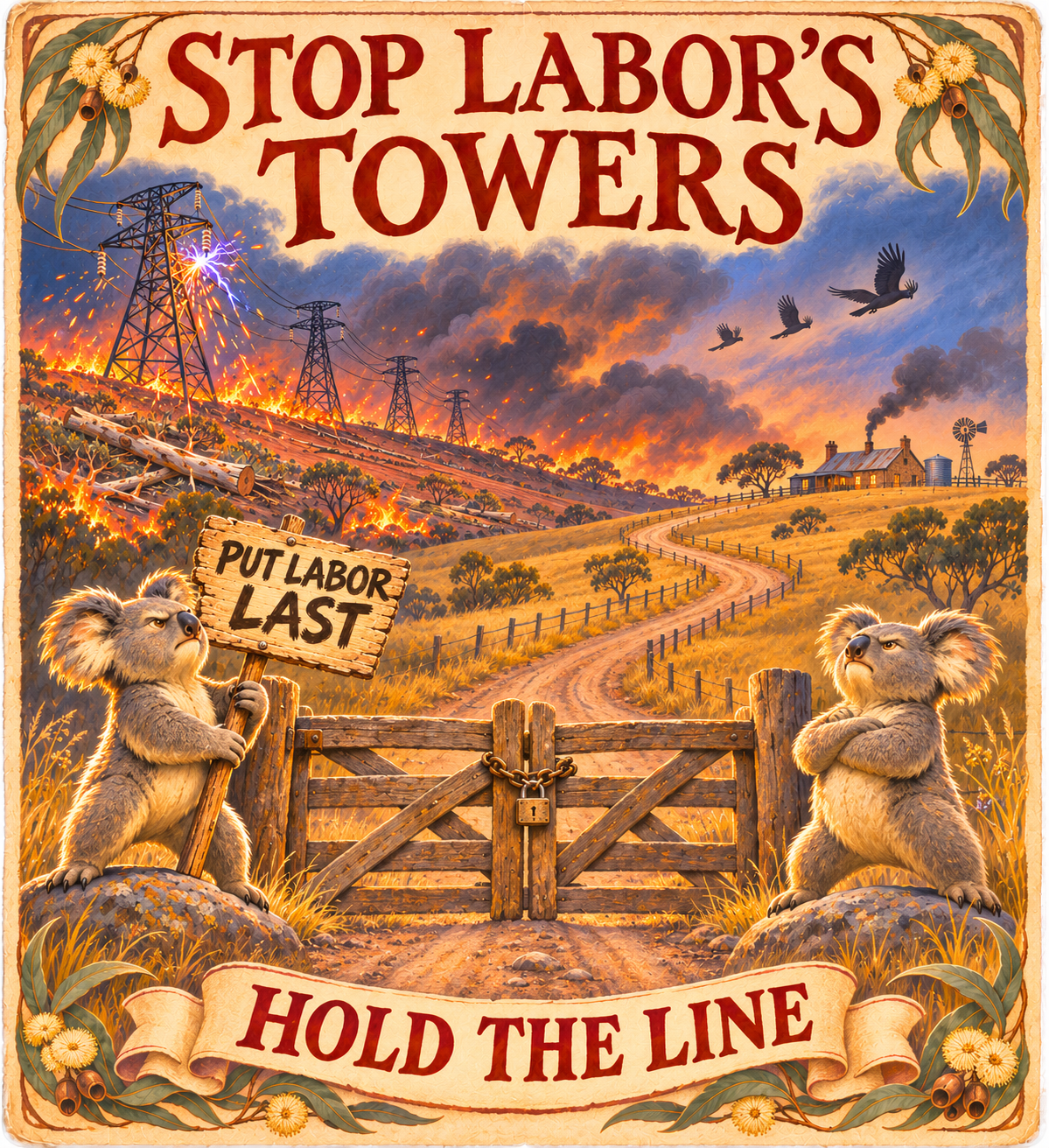
Stop Labors Towers Newsletter – November 14, 2026
___________________________________________
IN THIS ISSUE
YOU HOLD THE POWER
- 14 days until the State Election.
- Countdown to the Election: Every Number Matters
- Why the WRL will not survive a Coalition government
- Stop Labor’s Towers: come and see us at the Bacchus Marsh Strawberry & Cherry Festival!
- New signs available
- We condemn violence. So why do we accept it when it comes disguised as government policy?
- Blood Money: the moral cost of AusNet’s community sponsorships
- The locked gate at Myrniong is an election issue
___________________________________________
14 DAYS UNTIL THE STATE ELECTION.
THE WRL IS NOT INEVITABLE.
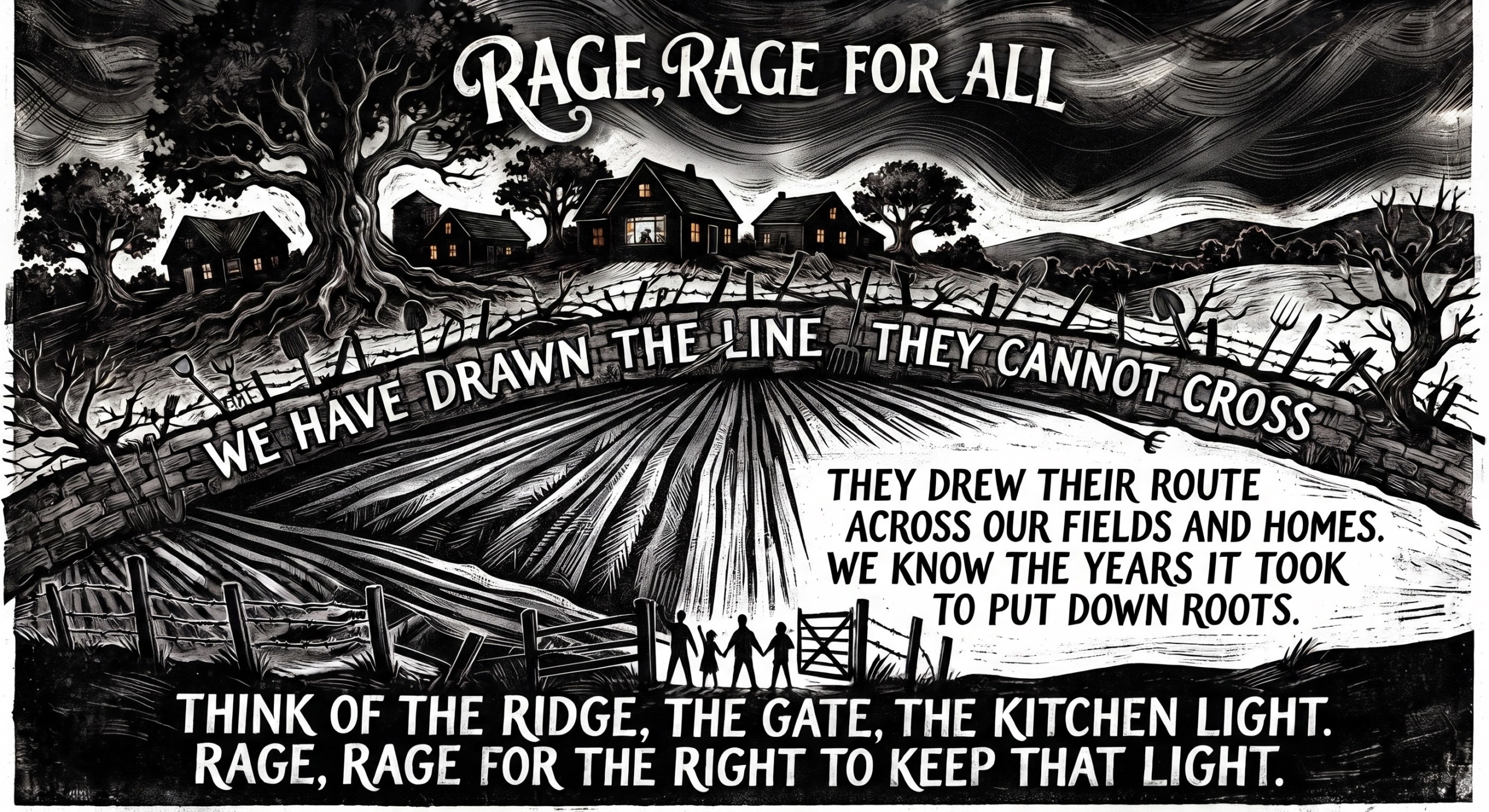
We have drawn the line they cannot cross.
It runs through every home they ask us to forsake.
Rage, rage for all they ask us to call loss.
We know which gullies fill when creeks run high,
Which gate to leave unlatched on days of fire.
We have drawn the line they cannot cross.
They drew their route across our fields and homes.
We know the years it took to put down roots.
Rage, rage for every home that stands along the route.
And when they come to town to ask for votes,
Ask where they stand. Let the whole hall hear.
We have drawn the line they cannot cross.
Bring all the anger of those waiting years,
And all the love that made you stay and fight.
Rage, rage for the homes that keep their windows bright.
Then take their answers with you when you vote.
Think of the ridge, the gate, the kitchen light.
We have drawn the line they cannot cross.
Rage, rage for the right to keep that light.
Thanks to Dylan Thomas
___________________________________________
COUNTDOWN TO THE ELECTION: EVERY NUMBER MATTERS
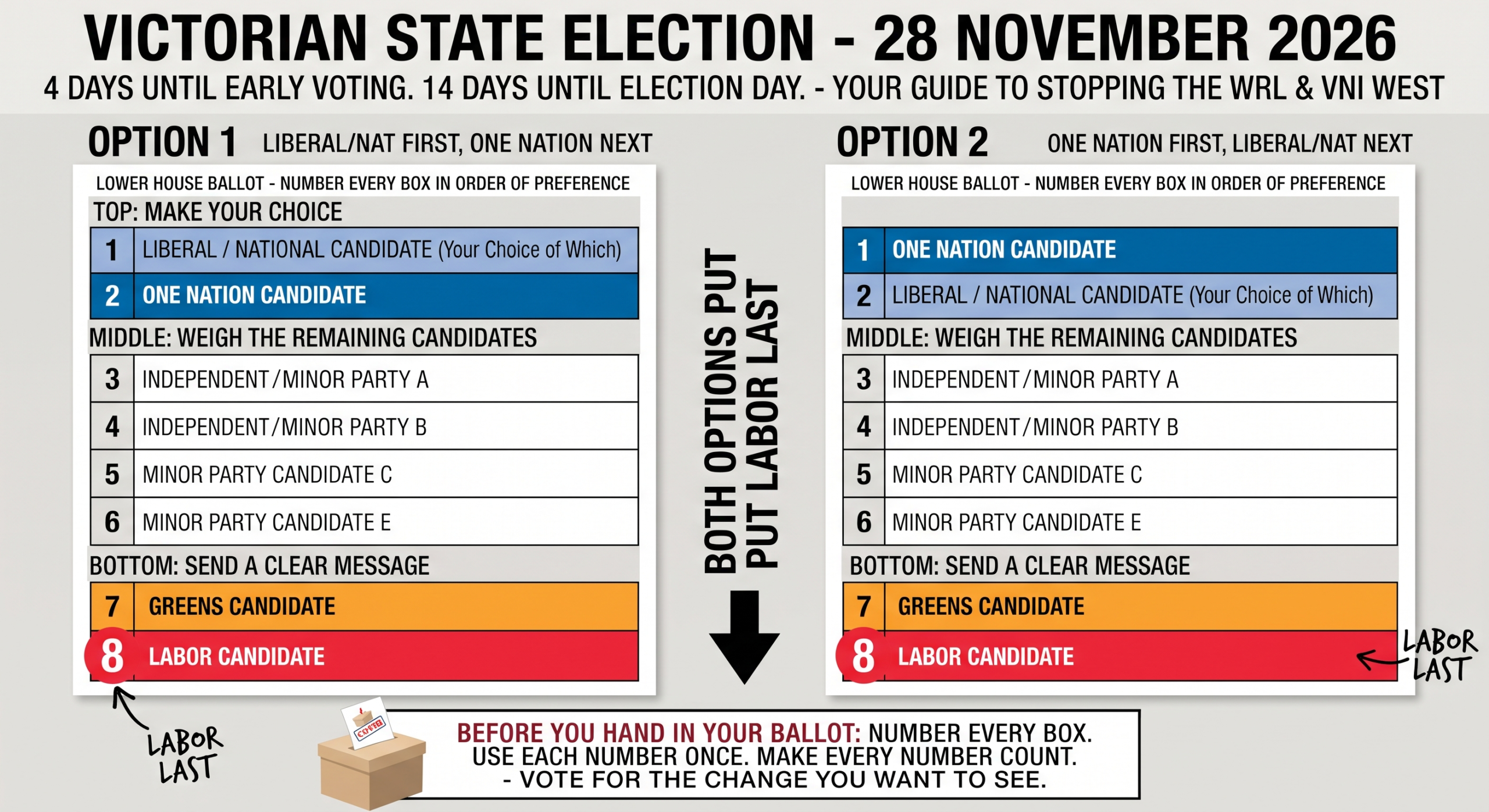
This election, our message is simple: stop the WRL. Stop VNI West. And make every number on your ballot paper count.
Because voting is not just about who you put first. It is about the choices you make all the way down.
On your Lower House ballot, you must number every box in order of preference. If no candidate has a majority, the candidate with the fewest votes is eliminated. If that is your candidate, your vote moves to your next preferred candidate still in the count.
That process continues until a candidate has a majority.
Think about what that means: your first choice matters, but your later preferences can help decide the result.
You control those preferences. Not a party. Not a how-to-vote card. You.
IMPORTANT: The candidates and their order on the ballot paper will vary between electorates. Number the box beside each candidate according to the voting guidelines below, rather than their position on the ballot paper.
At the top: make your choice
To advance our campaign against the WRL and VNI West, we encourage you to put the Liberal or National candidate or the One Nation candidate at the top of your ballot, where they are standing.
Which comes first? That is your decision.
If you put the Liberal or National candidate first, put One Nation next. If you put One Nation first, put the Liberal or National candidate next.
In the middle of the ballot: weigh the remaining candidates
Then rank the remaining independents and minor-party candidates in your order of your preference. Independents and minor parties may mean well, but they cannot form a government. They don’t have a seat at the cabinet table to stop harmful policies. Don’t waste your primary leverage.
At the bottom: send a clear message
Our recommendation is clear: Greens second-last. Labor last.
Not somewhere near the bottom. Last.
Even if you choose a different candidate at the top, we urge you to put Labor last.
Before you hand in your ballot
Number every box. Use each number once. Do not skip or repeat numbers. These instructions apply to the Lower House ballot.
We have raised our concerns. We have asked to be heard. Now we have another opportunity to make our position unmistakable.
Make your choice. Take care with every preference. And vote for the change you want to see.
_______________________________________________________________________
WHY THE WESTERN RENEWABLES LINK WILL NOT SURVIVE A COALITION GOVERNMENT
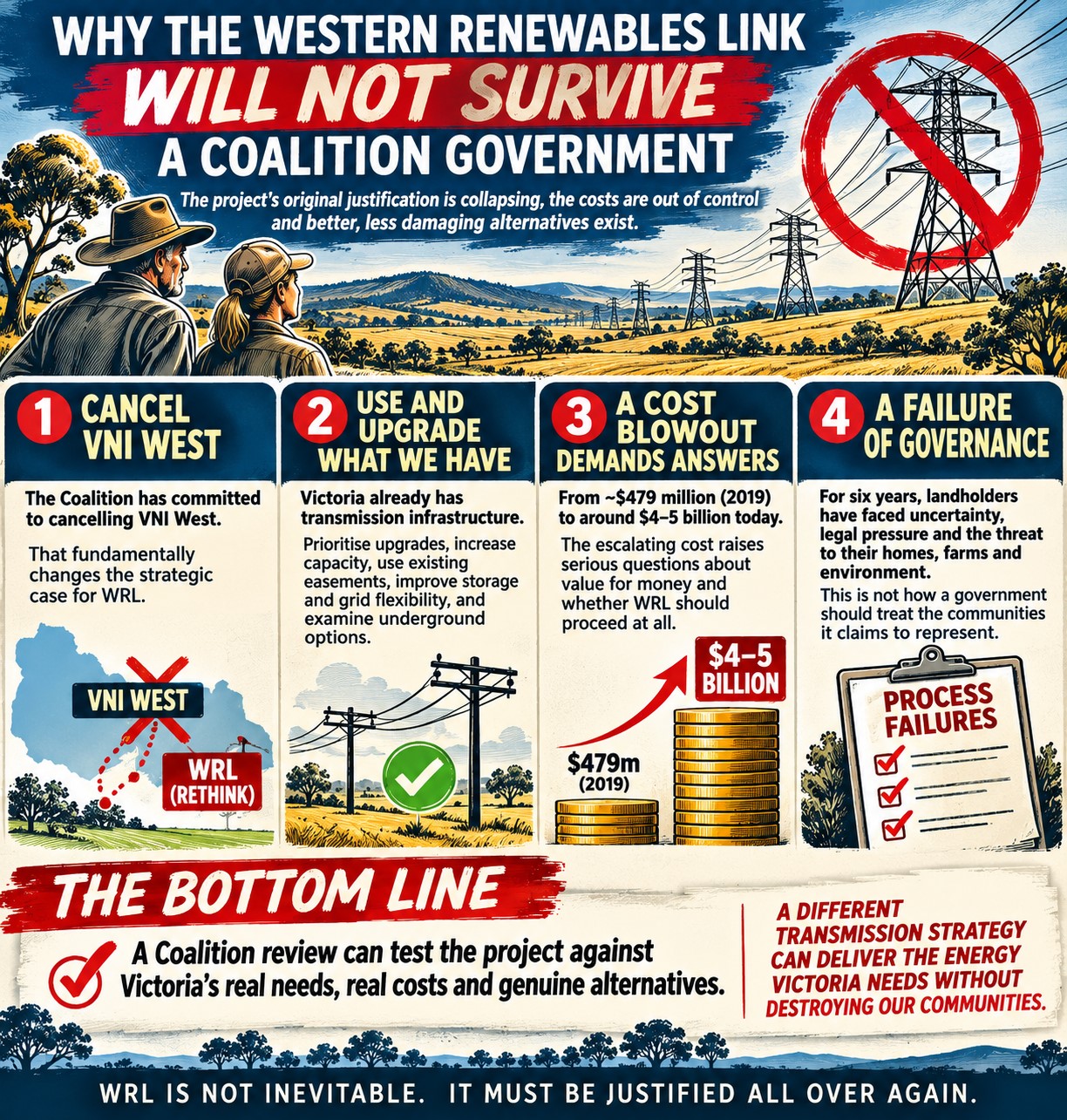
The political commitment is clear. The economic justification is increasingly questionable. The alternatives deserve proper examination. And the communities of Western Victoria have spent six years exposing why this project should never have proceeded in its present form.
There is a fundamental difference between stopping a project for political reasons and stopping a project because its original justification no longer stands up to scrutiny.
For the Western Renewables Link (WRL), those two arguments are now converging.
The Victorian Liberal–National Coalition has committed to cancelling VNI West and halting WRL pending a comprehensive review. That is not speculation. It is a publicly reported election commitment.
We believe that a genuine, independent examination of WRL, without the assumption that Labor’s preferred design must proceed, will demonstrate that the project in its current form is neither necessary nor justified.
And there are compelling reasons for that conclusion.
- Cancel VNI West and the central justification for WRL changes fundamentally
WRL and VNI West were conceived as interconnected elements of a much larger transmission strategy. Together, they would establish a high-voltage pathway through Western Victoria, connecting renewable generation areas with Melbourne and the interstate electricity network.
The Coalition has committed to cancelling VNI West. That decision fundamentally changes the strategic assumptions upon which WRL was developed.
Why should Victoria proceed with a 190-kilometre, 500-kilovolt transmission corridor, involving an extensive new easement through productive farmland, private properties and environmentally sensitive landscapes, when a major component of the network it was designed to support will no longer proceed?
A project designed for one transmission strategy cannot simply be declared indispensable after that strategy has been fundamentally changed.
That is why the Coalition’s commitment matters so greatly. It creates the opportunity to examine the project against Victoria’s actual future electricity requirements, rather than defend decisions made under an increasingly contested set of assumptions.
- Victoria already has transmission infrastructure. Why was upgrading it not given greater priority?
For years, Western Victorian communities have argued that electricity transmission should be modernised intelligently, rather than automatically expanded through enormous new overhead corridors.
The alternatives include upgrading existing transmission infrastructure, increasing the capacity of established lines, using existing easements wherever practicable, improving storage and grid flexibility, and examining underground transmission in sensitive locations.
These are not fanciful ideas.
The Victorian Government’s own 2025 Victorian Transmission Plan explicitly recognises the value of prioritising upgrades along existing lines where possible, including reducing impacts on landholders and communities and limiting costs to electricity consumers.
The plan does not establish that those alternatives can replace WRL outright. That requires fresh, independent modelling.
But it exposes the question that should have been answered before the government committed to such an intrusive project:
Why should families, farmers and communities surrender their land, amenity and security before the least damaging, technically credible alternatives have been independently tested?
A Coalition review has the opportunity to examine options previously advanced by community experts, including the Bartlett–Mountain Plan B approach, existing-corridor upgrades, the AEMO B3 concept and underground solutions such as the Syncline Community Cable.
A different transmission strategy could deliver the electricity Victoria needs without reproducing the destructive footprint of Labor’s current WRL proposal.
- The cost of WRL has become an economic scandal demanding answers
The financial case for WRL is becoming harder to defend.
Originally estimated at approximately $479 million in 2019, the project has since been associated with dramatically higher figures.
In March 2026, Brookfield, whose infrastructure interests include AusNet, described WRL as an approximately $4 billion project in a filing with the United States Securities and Exchange Commission.
Yet the Victorian Government had provided Parliament with a construction estimate of $1.53 billion and identified a construction contract worth approximately $1.6 billion.
These figures do not necessarily measure identical project costs, but the difference demands a detailed public explanation.
Some estimates and concerns raised by opponents now approach $5 billion. This is not a minor accounting issue. It goes directly to whether Victorian electricity consumers are being asked to finance an increasingly expensive transmission solution when less intrusive and potentially less costly alternatives may exist.
The fundamental question is no longer simply whether WRL can be built. It is whether it should be built at all.
The Coalition has committed to reviewing that question. A rigorous review should examine not only construction expenditure, but also financing, network charges, compensation, bushfire exposure, environmental damage and the broader economic losses imposed upon affected communities.
The enormous cost of proceeding must be compared with the genuine cost of doing things differently.
- Labor’s treatment of landholders has exposed a profound failure of governance
Our communities have been forced to defend their homes, farms, livelihoods and environment against a project they believe has never been adequately justified.
The proposed corridor would introduce massive transmission towers through landscapes already exposed to serious bushfire hazards, threaten agricultural operations, fragment habitats and impose lasting restrictions on privately owned land.
In some cases, the proposed infrastructure would approach dangerously close to homes. In others, it would compromise property use, emergency access and the security of families who have lived on their land for generations.
And how did Labor respond to this resistance?
Rather than resolve the underlying concerns, its government introduced legislation expanding land-access powers and creating additional enforcement mechanisms to facilitate transmission development.
The message received by many landholders was unmistakable: the project would proceed, whether they agreed with it or not.
That is a profound failure of public trust.
A government should have to prove the necessity of taking people’s land, not require ordinary citizens to spend their savings and years of their lives proving why it should not.
A different government can restore that balance. It can review the decisions, reassess the alternatives and insist that engineering necessity, public safety, affordability and property rights take precedence over political convenience.
- Victoria’s Corruption Royal Commission: WRL Must Face Scrutiny
Victoria’s Royal Commission into major infrastructure construction is examining serious allegations of corruption, misconduct and improper influence, including evidence concerning the CFMEU’s access to government ministers and major projects.
The Western Renewables Link must not escape independent scrutiny.
Here is a project with dramatically escalating costs, a contested economic justification, far-reaching consequences for communities and extraordinary legislative intervention to facilitate its development.
Who drove these decisions? Who benefited? Why were alternatives rejected? And whose interests were ultimately served?
These questions demand answers, supported by examination of government records, commercial arrangements and the decisions behind WRL’s approval.
A Coalition government would inherit a project requiring comprehensive scrutiny of its justification, governance and financial commitments.
No protected interests. No unanswered questions. No assumption that Labor’s decisions were justified simply because Labor made them.
- A new government has no obligation to defend Labor’s decisions
Perhaps the strongest reason for believing that WRL will not proceed in its present form is that a Coalition government would be free to question the assumptions that have sustained it.
The project has received some planning approvals, including a planning scheme amendment gazetted on 30 September 2026, although further approvals and consents remain necessary.
But approvals already granted do not, by themselves, require a new government to continue with every element of the existing proposal.
The Coalition’s review could establish a different network development strategy, reassess the need for the present route, examine available alternatives and determine the implications of stopping or substantially redesigning the project.
And critically, the cancellation of VNI West would require the strategic case for WRL to be reconsidered within an altered transmission network.
A responsible government should examine the costs and benefits of proceeding from this point forward, not defend past decisions simply because reversing them would be politically uncomfortable.
The Conclusion: Why WRL’s Future Must Be Reconsidered
The case for reconsidering WRL rests on six compelling arguments:
- The commited cancellation of VNI West,
- Credible transmission alternatives,
- Escalating costs,
- Unacceptable impacts on communities and the environment,
- Serious governance/corruption questions now with the Royal Commision
- and the opportunity for a fundamentally independent review.
Together, they challenge the necessity, affordability and justification of WRL in its current form.
The Coalition’s commitment to halt and review WRL, alongside cancelling VNI West, creates the opportunity to test its justification afresh.
The principle is simple: if the need cannot be demonstrated, the cost cannot be justified and less damaging alternatives exist, WRL should not proceed in its current form.
The Western Renewables Link is not inevitable. Its future must be determined by evidence, necessity and the public interest, not the political decisions of the past.
________________________________________________________________________
STOP LABOR’S TOWERS: COME AND SEE US AT THE BACCHUS MARSH STRAWBERRY & CHERRY FESTIVAL!
As we race toward the final stretch before the 28 November election, the fight against the Western Renewable Link (WRL) is more critical than ever.
This weekend, Saturday 14 November and Sunday 15 November, the Western Victoria Community Alliance (WVCA) will be hosting a community information stall at the Bacchus Marsh Strawberry and Cherry Festival from 9:00 am to 5:00 pm.
Come on down to check out our stall – complete with banners, infographics, informative flyers, and new corflutes. Most importantly, come and have a chat with us! We want to talk with community members about why the upcoming election is our chance to make our votes count, how to ensure we put Labor last, and what candidates are doing to commit to cancelling the WRL.
Whether you want to learn more about the campaign, pick up some merchandise, we’d love to see you there. Stop by, say hello, and let’s stand together to protect our community!
________________________________________________________________________
NEW SIGNS AVAILABLE – ORDER HERE OR AVAILABLE AT BACCHUS MARSH STRAWBERRY & CHERRY FESTIVAL
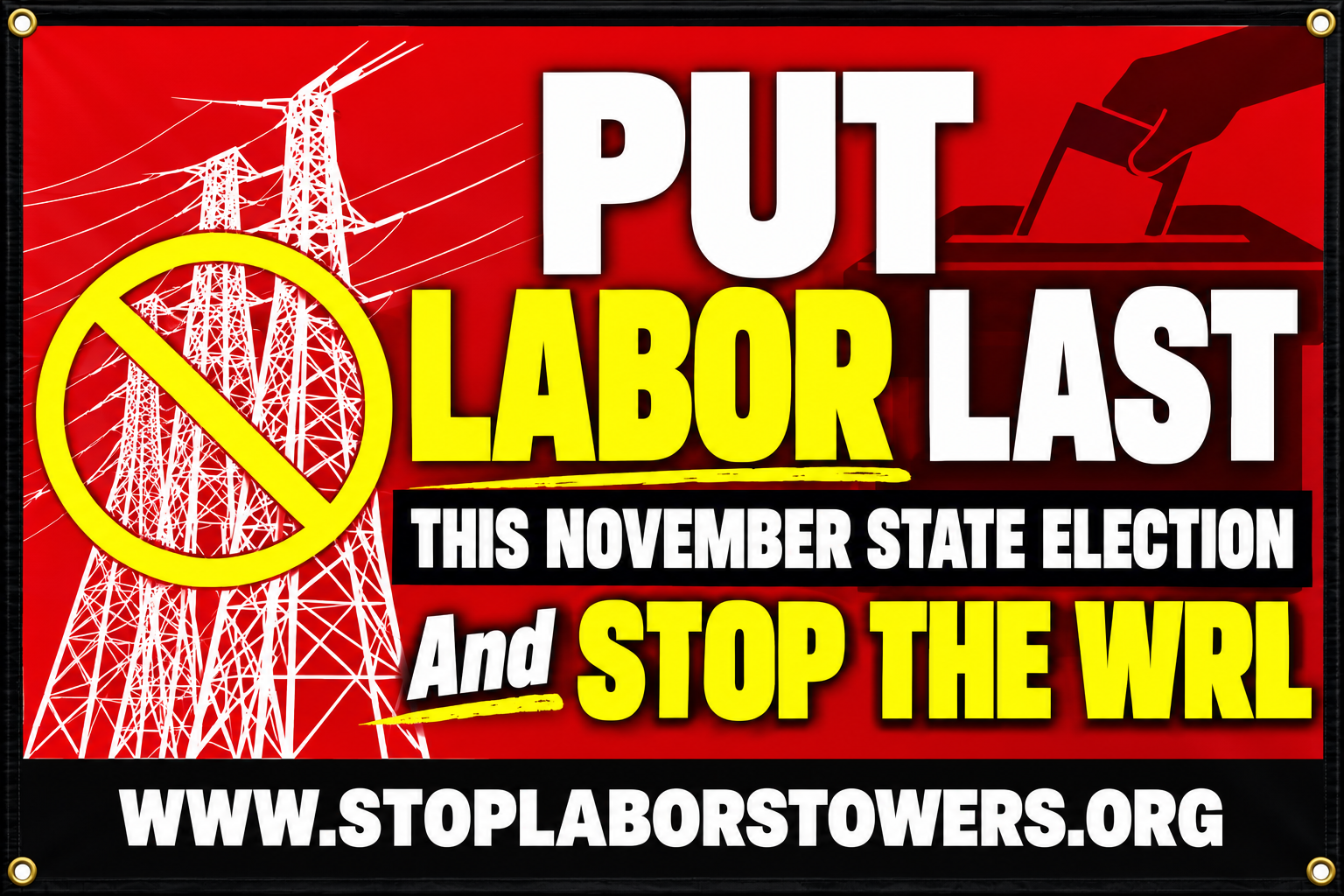
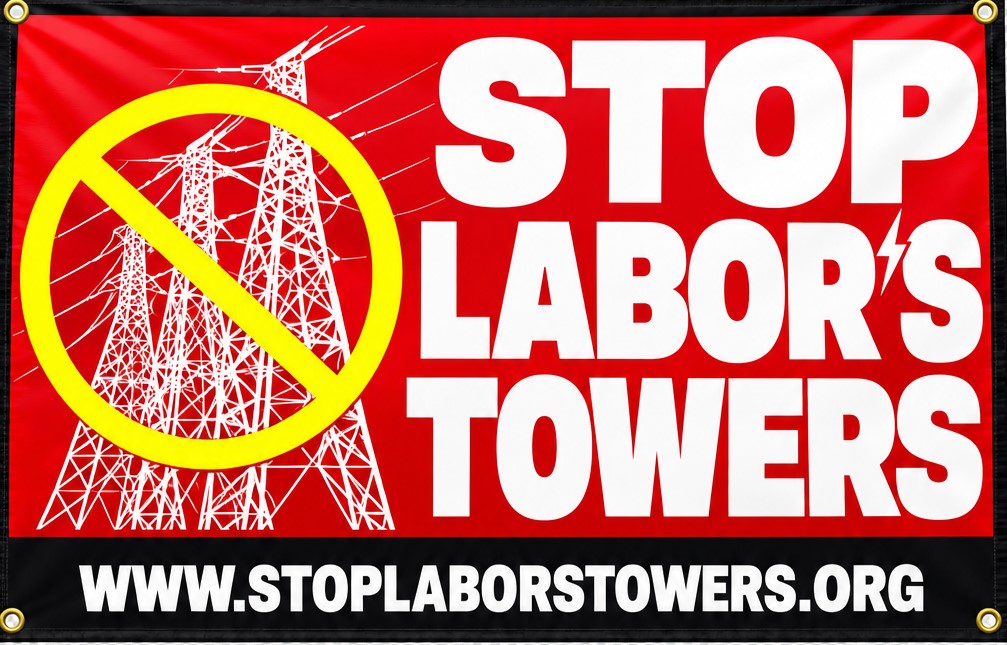
GET YOUR ELECTION SIGNS
The November State Election is approaching, and now is the time to make our message impossible to ignore!
We need our signs on fences, farm gates, front lawns and properties right across the region.
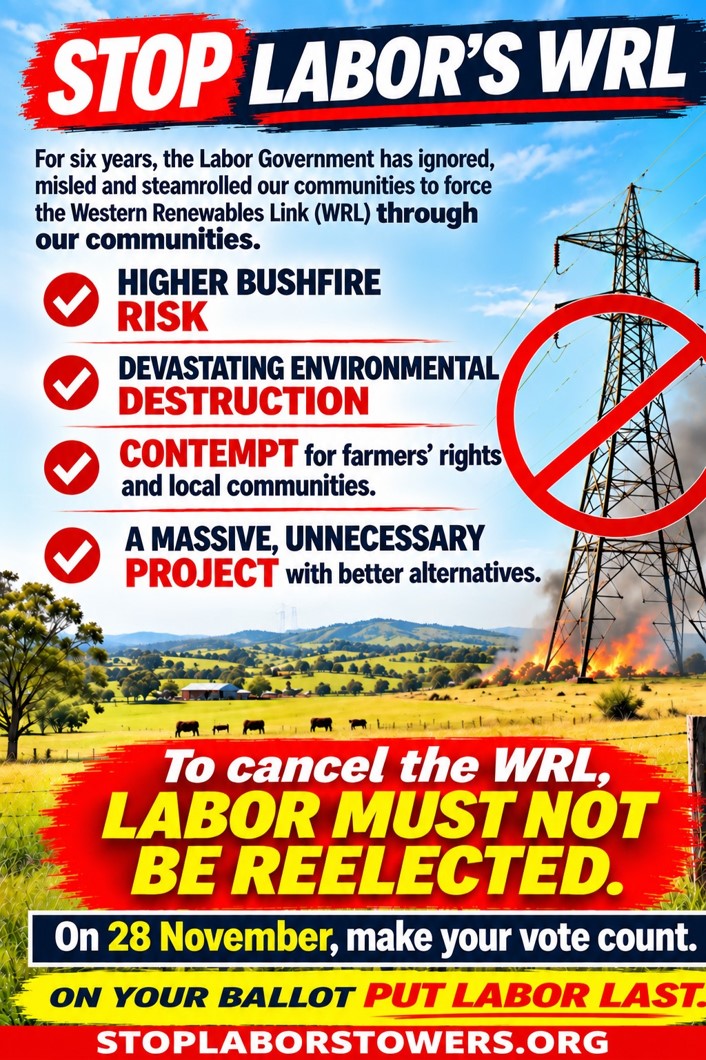
Let every passing motorist know where our communities stand. PUT LABOR LAST AND STOP THE WRL!
LIMITED SUPPLY – ORDER TO SECURE YOUR SIGNS!
We have two designs of our bold, high-impact election signs available for collection in Ballan.
🪧 SIGN DETAILS:
- Size: 600 mm x 900 mm
- Material: Durable Corflute with eyelets, ready for mounting
- Two designs available
- PRICE: JUST $10 EACH (to cover production costs)
✉️ ORDER NOW – DON’T MISS OUT!
Email info@stoplaborstowers.org
EVERY SIGN COUNTS. EVERY FENCE COUNTS. EVERY VOTE COUNTS.
The more signs we get out across our communities, the harder our message will be to ignore.
Stand up for our farms, our homes and our communities.
PUT LABOR LAST. STOP THE WRL. HOLD THE LINE!
_______________________________________________________________________
WE CONDEMN VIOLENCE. SO WHY DO WE ACCEPT IT WHEN IT COMES DISGUISED AS GOVERNMENT POLICY?
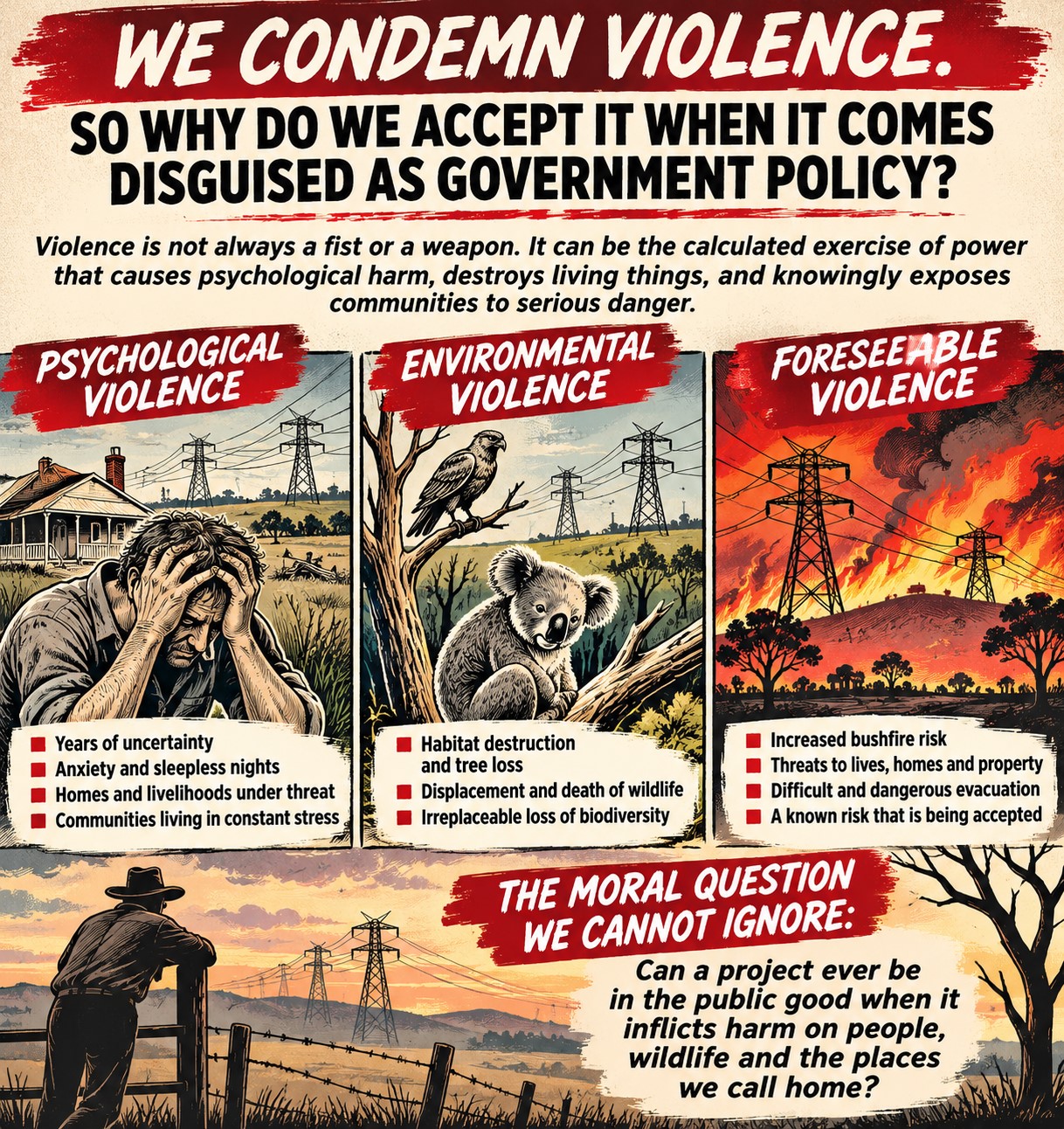
Violence is not always delivered by a fist, a weapon or an act of aggression.
Sometimes it arrives through the calculated exercise of power, the destruction of a living environment, or the deliberate acceptance of risks that others will be forced to endure.
Let us begin with something that should unite every decent person: we categorically oppose violence in all its forms. We reject intimidation, threats, physical aggression and the deliberate infliction of suffering. Our campaign against the Western Renewables Link has always been, and must remain, peaceful.
But that commitment raises a profoundly uncomfortable question.
Why do we recognise violence when an individual inflicts harm, yet struggle to recognise it when powerful institutions impose suffering on entire communities?
The World Health Organization defines violence to include the intentional use of physical force or power, threatened or actual, that results in, or is likely to result in, physical injury, psychological harm or deprivation.
That definition challenges us to look beyond the obvious.
1.PSYCHOLOGICAL VIOLENCE: WHEN HOME BECOMES A PLACE OF FEAR
Imagine spending your life building a home, raising a family, caring for your land and investing everything in a future you believed was secure.
Then imagine being told that your property may be fundamentally altered, your livelihood compromised, your landscape transformed and your ability to remain in the place you love placed under permanent uncertainty.
Imagine living with that knowledge. The sleepless nights. The anxiety. The financial uncertainty. The strain on relationships. The exhausting struggle to defend what was never supposed to be under threat.
When institutional power places people under prolonged psychological pressure, to the point where leaving their homes becomes the only future they can contemplate, we must confront the possibility that this represents a form of structural violence.
No physical assault is required for psychological suffering to be real. And the fact that suffering is produced through a legally authorised process does not automatically make it morally acceptable.
- PHYSICAL VIOLENCE: THE DESTRUCTION OF LIVING CREATURES
Now consider the animals that have no voice in this process.
The koalas, gliders, kangaroos, echidnas, wombats and countless birds that depend on the remaining habitats of western Victoria.
When trees are felled, nesting sites destroyed, wildlife displaced and animals injured or killed, the consequences are not abstract environmental impacts.
They are physical harm inflicted upon living creatures.
We have developed an extraordinary bureaucratic vocabulary to describe this destruction. Vegetation clearance. Habitat offsets. Fauna management. Acceptable residual impacts.
But changing the language does not change what happens to an animal whose home is destroyed. A habitat offset cannot resurrect a dead animal. A spreadsheet cannot replace a centuries-old tree. An environmental management plan cannot guarantee that a displaced species will survive.
If we condemn cruelty towards animals when it is committed by individuals, why should we become morally indifferent when comparable suffering occurs in the name of infrastructure?
- FORESEEABLE VIOLENCE: WHEN DANGER IS KNOWINGLY IMPOSED
Perhaps the most disturbing question concerns bushfire.
Western Victoria already lives with the reality of catastrophic fire danger. Families understand the consequences of extreme weather, restricted access, vulnerable roads and the terrifying speed with which a bushfire can overwhelm a landscape.
Now consider the proposal to introduce a massive overhead electricity transmission corridor through parts of that environment.
Communities and expert witnesses have raised concerns about ignition hazards, emergency access, evacuation, aerial firefighting and the cumulative consequences of infrastructure in high-risk landscapes.
The precise level of additional risk remains contested, and approval authorities have concluded that risks can be managed with conditions.
But the moral question cannot be avoided. What happens when decision-makers knowingly proceed with a project despite unresolved risks and impacts that carry catastrophic consequences?
When foreseeable risks to human life are discounted or inadequately addressed, the moral responsibility for those decisions does not disappear behind a regulatory approval.
A bushfire does not respect an environmental effects statement. Flames do not stop at an easement boundary. And a family trapped on a dead-end road cannot escape through a risk assessment.
THE MORAL QUESTION WE CANNOT IGNORE
We are told that projects like the Western Renewables Link are necessary for the public good. But the public good cannot be measured solely in megawatts, investment returns and construction schedules.
It must also be measured in human dignity, psychological wellbeing, the survival of wildlife, the protection of homes and the fundamental right of communities to live in reasonable safety.
The Victorian Government’s environmental assessment has determined that the project can proceed with conditions. Many of us profoundly disagree with the weight given to the human, environmental and bushfire consequences.
That disagreement is not a rejection of progress.
It is a rejection of the idea that progress justifies imposing avoidable suffering on those with the least power to resist it.
We categorically oppose violence.
We oppose it when it is physical. We oppose it when it is psychological. We oppose it when it is inflicted upon the natural world. And we oppose the knowing imposition of unacceptable danger upon communities.
Because violence does not become harmless when it is authorised. Suffering does not become insignificant when it is calculated. And destruction does not become morally defensible simply because somebody calls it progress.
As Victoria approaches its state election, these are questions of public responsibility that every political leader must be prepared to answer.
The measure of a society is not simply what it builds. It is what it refuses to destroy in the process.
_______________________________________________________________________
BLOOD MONEY: THE MORAL COST OF AUSNET’S COMMUNITY SPONSORSHIPS
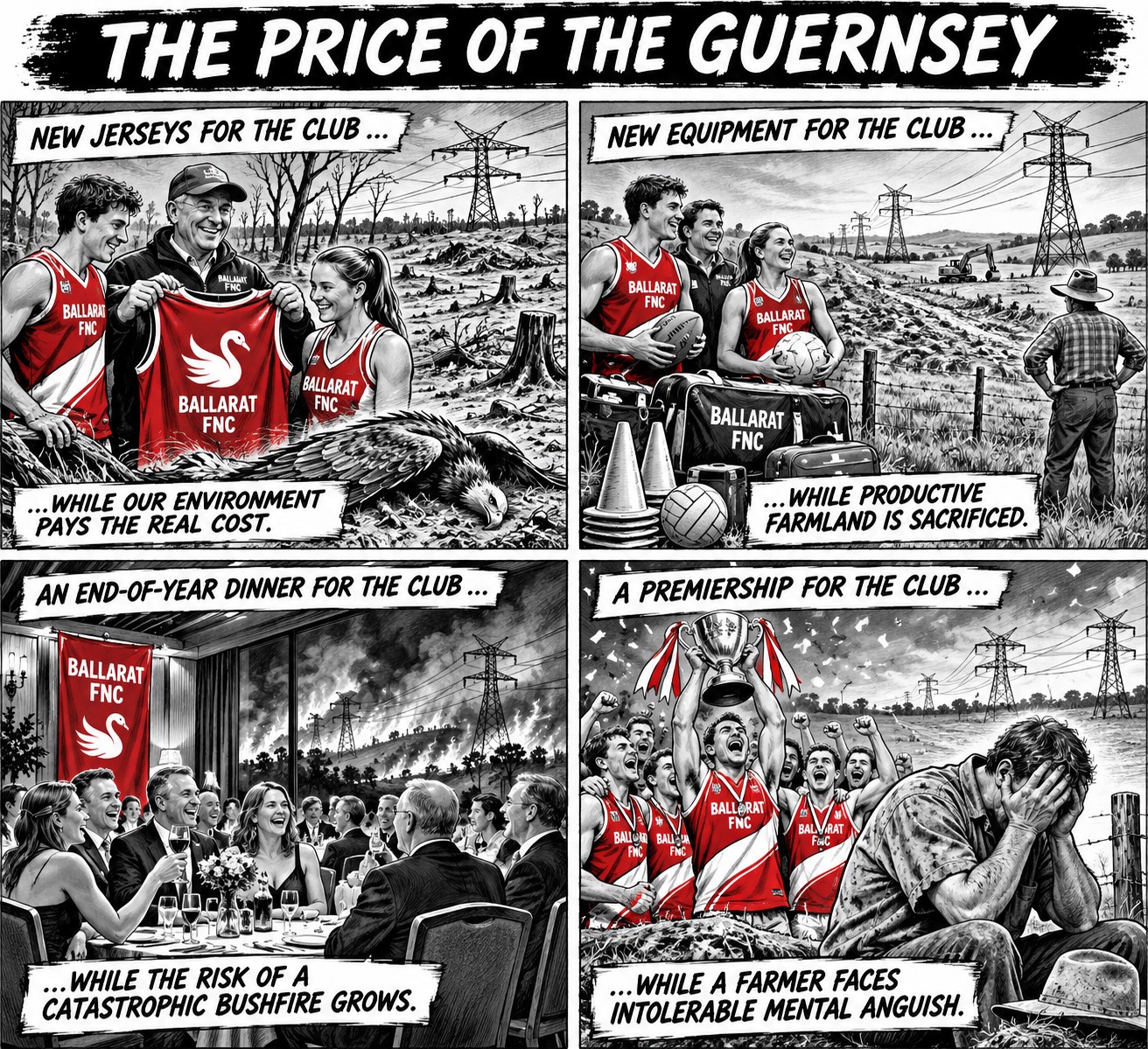
AusNet’s Western Renewables Link Community Benefit Sharing Program raises serious ethical questions, not only for the company offering the money, but also for the organisations choosing to accept it.
Ballarat Football Netball Club has been identified as a recipient of WRL sponsorship potentially worth $45,000 over three years.
The club is entitled to seek funding. But entitlement does not remove responsibility.
When money comes from a project that threatens neighbouring communities, accepting it demands more than a grateful handshake. It demands moral scrutiny.
The Western Renewables Link threatens three foundations of life in Western Victoria: our natural environment, our agricultural livelihoods and, perhaps most devastatingly, the psychological wellbeing of those forced to live with its consequences.
Families face uncertainty over their homes. Farmers confront restrictions on land worked for generations. Communities face catastrophic environmental damage, permanent landscape destruction and serious risk of heightened bushfire safety.
Behind these impacts lies a human cost that cannot be measured in dollars.
Sleepless nights. Anxiety. Financial insecurity. Families living for years under the threat of losing the homes, livelihoods and security they have spent their lives building.
And against this backdrop, AusNet offers money for community wellbeing.
The contradiction is staggering.
A sporting club exists to strengthen community health, resilience and belonging. What responsibility does it have when its sponsor is responsible for a project that other members of the wider community believe is destroying those very things?
Accepting sponsorship does not establish that a club supports WRL. But it does create an ethical obligation to understand where the money comes from, acknowledge the harm alleged by affected communities and explain why accepting it is consistent with the organisation’s values.
The responsibility cannot rest with AusNet alone.
Community organisations must ask themselves whether a sponsorship cheque is worth the reputational and moral consequences of accepting money tied to such a deeply destructive project.
We regard these payments as blood money, not because their recipients have been proven to have committed wrongdoing, but because the benefits offered stand in such stark contrast to the suffering and losses feared by affected landholders.
Our position is simple.
You cannot measure community wellbeing by the size of a sponsorship cheque while ignoring the human suffering, agricultural damage and environmental destruction associated with the project funding it.
AusNet must answer for the consequences of WRL. Organisations accepting its money must answer for their own decisions.
Community responsibility does not end when the cheque clears.
___________________________________________
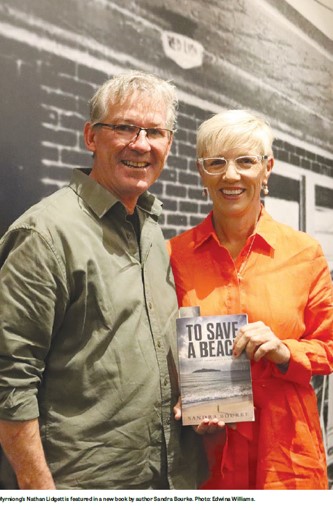
Below is the full transcription of the newspaper article from The Moorabool News 13 November 2026 .
The locked gate at Myrniong is an election issue
Dear Editor,
On the morning of 27 August 2024, two AusNet workers pulled up at a locked farm gate at Myrniong with their body cameras running. One carried a folder. The other carried bolt cutters.
Nathan Lidgett, a fifth-generation farmer, stood at the gate for his neighbour.
“You’ve got no consent,” he told them.
They cut the lock anyway. The padlock dropped into the wet grass, and the two men walked onto the property.
AusNet wants around 454 steel towers, each up to 80m high, in a cleared strip up to 100m wide, running 190km across 222 private properties, most of them farms. This is the Western Renewables Link.
Nathan and his neighbours did everything Victorians are told to do. Three hundred people packed the Myrniong Recreation Reserve.
Farmers drove their tractors through Ballarat and around Parliament House. The district raised more than $850,000 at farm gates and took the Energy Minister, Lily D’Ambrosio, to the Supreme Court.
While the case was running, she issued orders removing the economic test they were challenging. They lost and were ordered to pay her costs.
In April 2023, the Andrews Labor government made the Planning Minister the sole judge of projects like this one, with no appeal to the Victorian Civil and Administrative Tribunal.
In 2025, the Allan Labor government passed a law letting a magistrate authorise reasonable force to open a farm gate.
Nathan holds an eight-page submission AusNet itself sent to the market operator in March 2020. In it, AusNet warned against concentrating so much power on the single corridor between Ballarat and Sydenham.
The towers are going through that corridor anyway. AusNet’s owner, the Canadian asset manager Brookfield, earns a regulated return on every kilometre, paid through Victorian power bills.
Now the gate at Myrniong is an election issue.
On 15 September, Planning Minister Sonya Kilkenny approved the project’s environment effects statement. The same day, Premier Ben Carroll ordered an independent review of the $1.5b project’s cost and promised no compulsory acquisition while it runs.
The Coalition will halt the Western Renewables Link pending a review.
One Nation will cancel it.
Nathan’s story is chapter 15 of my book, To Save a Beach: The Story of Reckless Renewables. My husband Bruce and I drove more than 5,000km along the National Electricity Market, from Queensland through NSW and Victoria out to South Australia.
Every family we met lodged submissions, wrote letters and rallied. Labor ignored them. Nathan was met at his own gate with bolt cutters.
Nobody asked western Victoria before. On 28 November, it gets a say.
Sandra Bourke
Author, To Save A Beach: The Story of Reckless Renewables
________________________________________________________________________
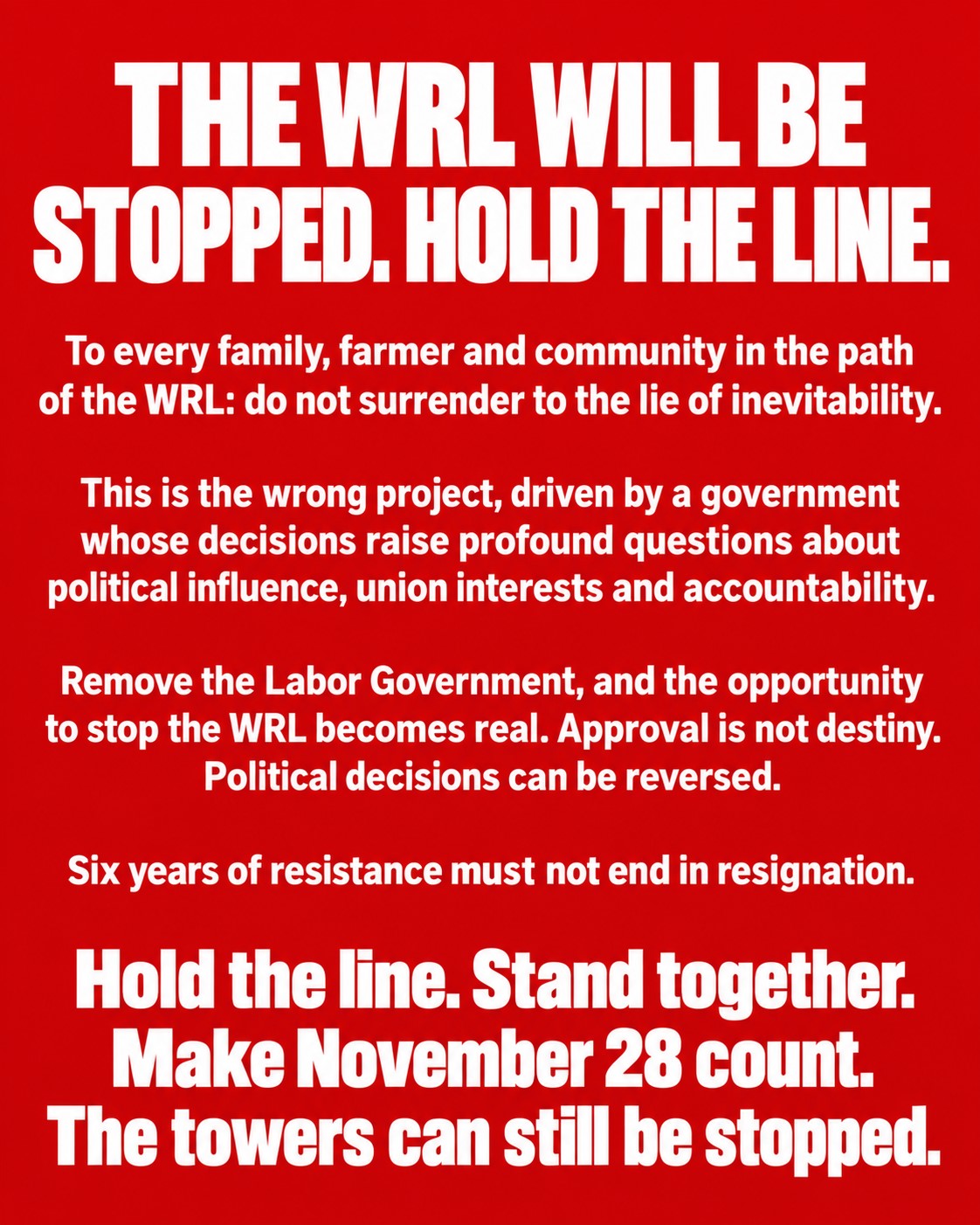
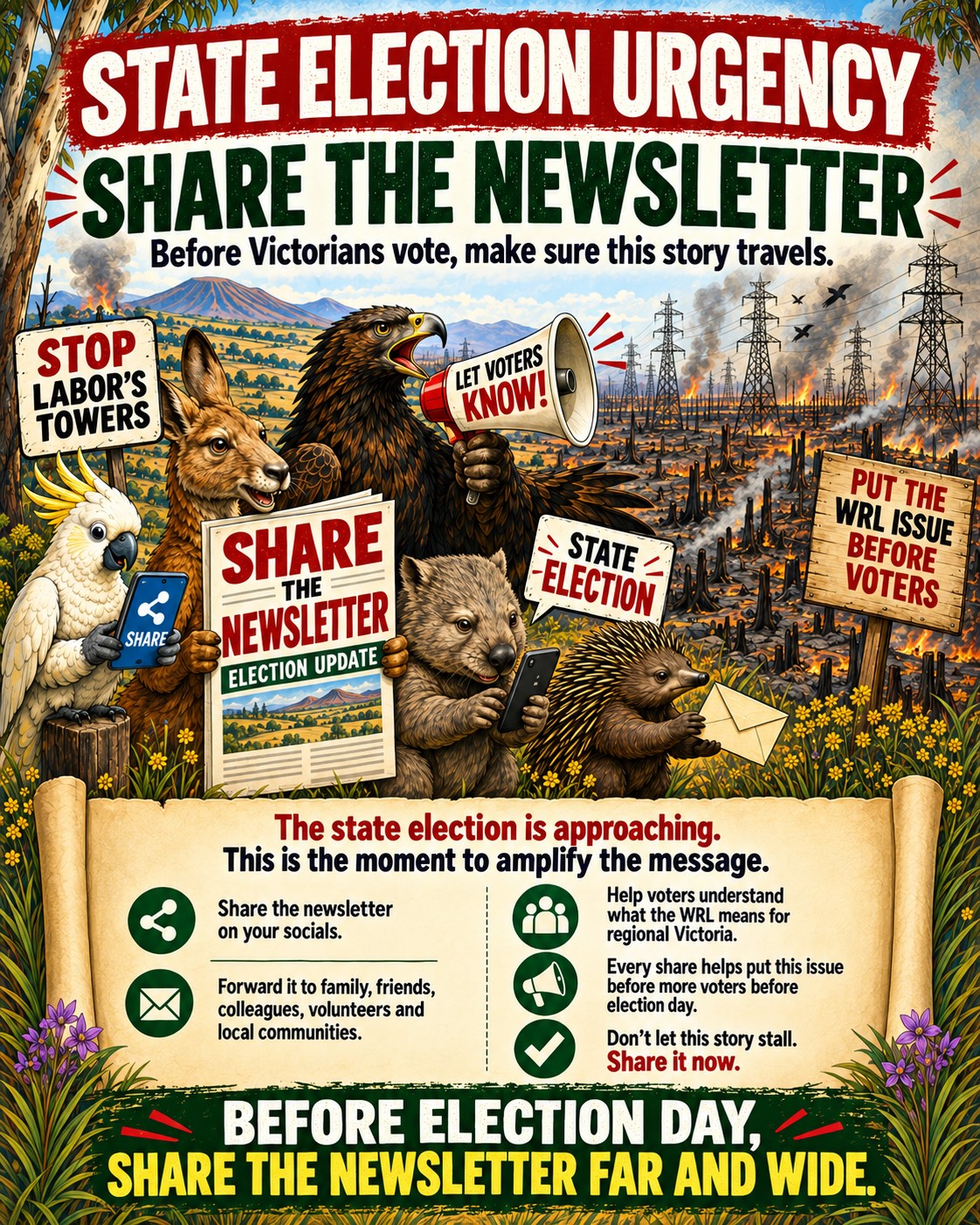
SHARE THIS NEWSLETTER – THE WRL WILL BE STOPPED. THIS FIGHT IS FAR FROM OVER!
________________________________________________________________________