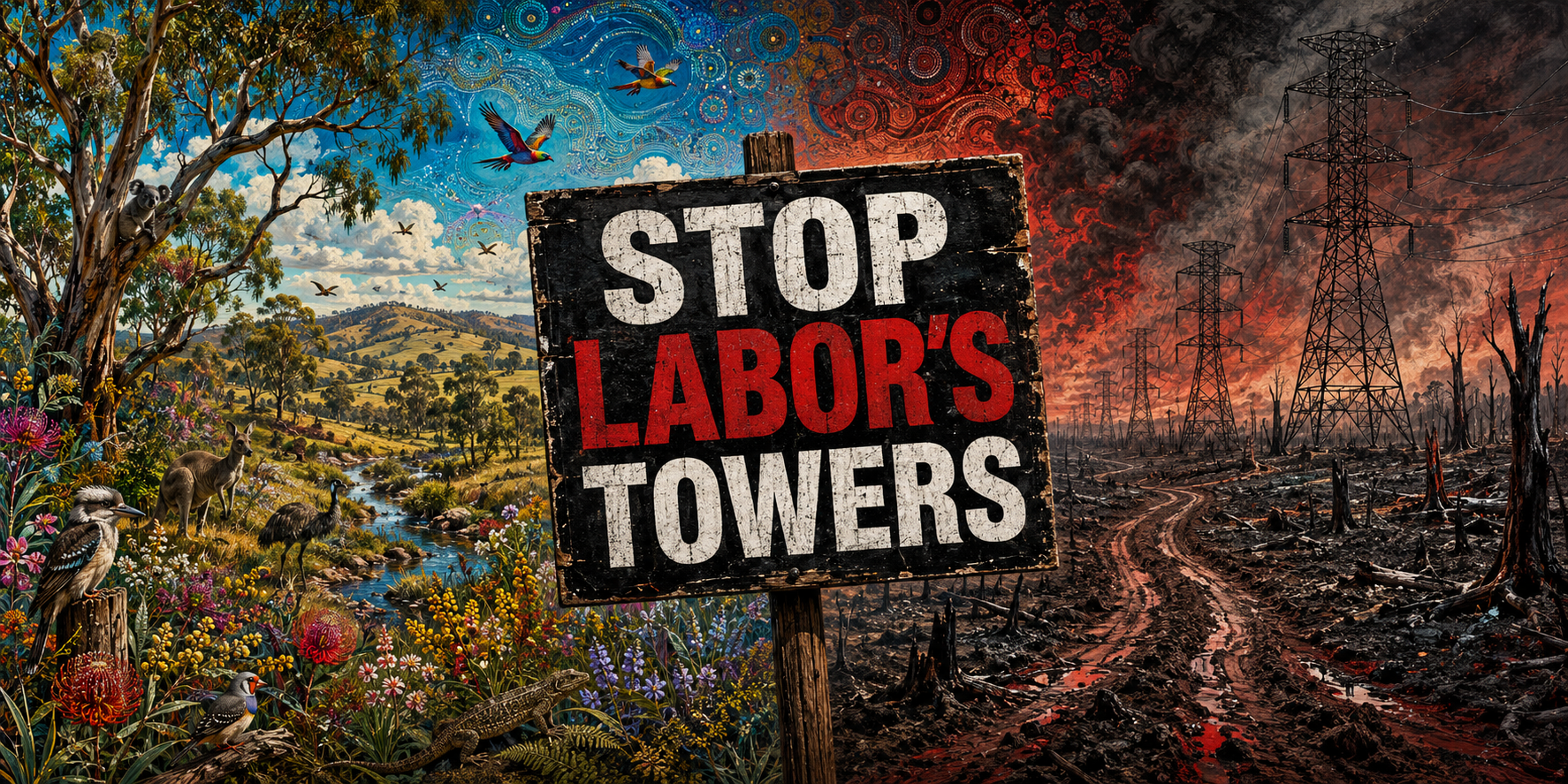
Stop Labors Towers Newsletter – August 8, 2026
THE WRL IS HEADING FOR THE CLIFF – VICTORIA MUST PULL THE BRAKES NOW
Jess Wilson Is on the Right Track. Now Stop the Western Renewables Link for Good.
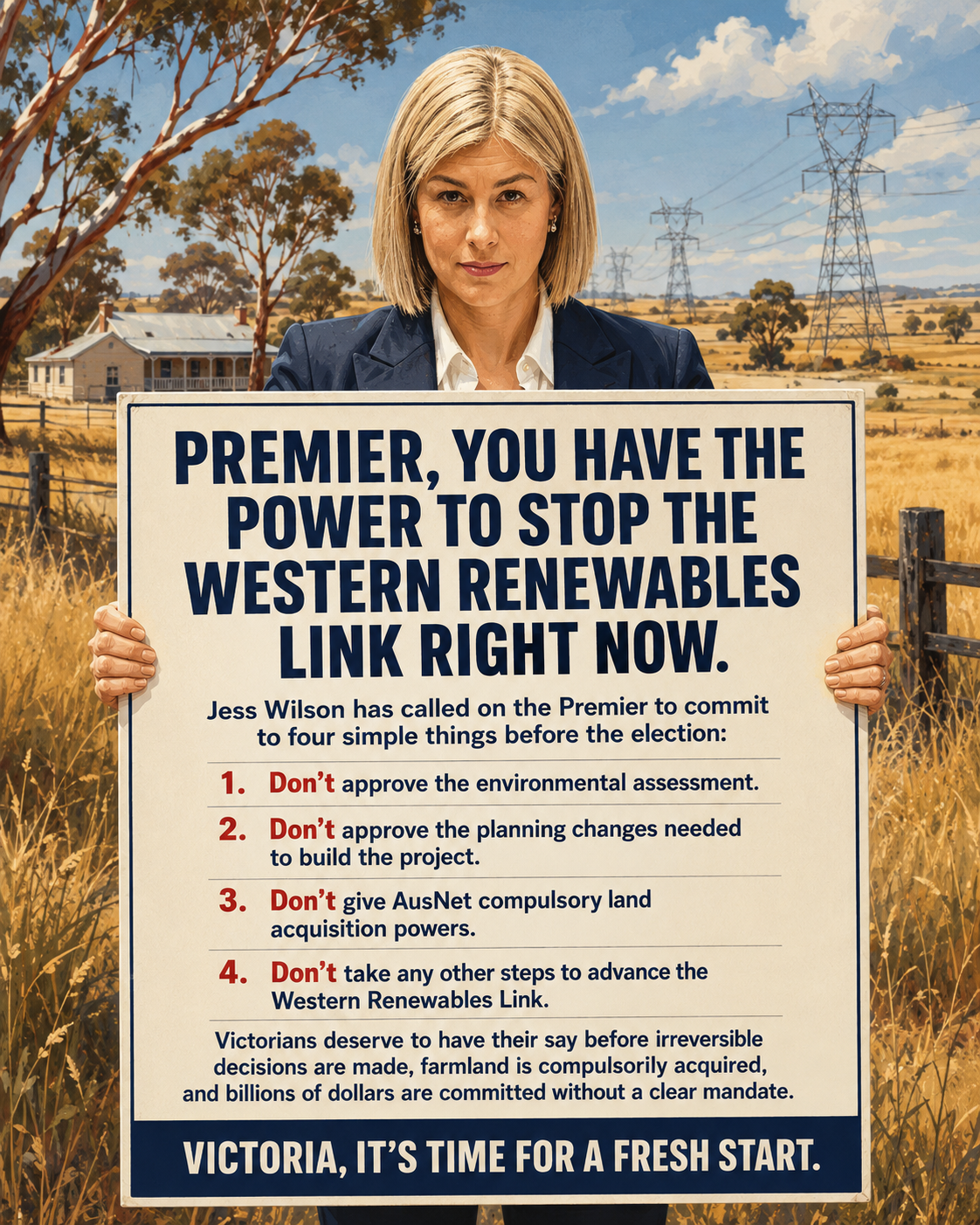
Jess Wilson and the Liberals are finally moving in the right direction. Demanding that the government stop rushing Western Renewables Link approvals before the election is an important step – but a step is not a journey.
A train that slows down before the cliff is still heading for the cliff.
The Liberal Party should understand this: a promise to pause the WRL, or send it off for another review, will not be enough. Not after years of uncertainty and pressure on landholders. Not when this 190-kilometre transmission corridor is proposed through private farmland, with the potential for compulsory acquisition hanging over farming families.
This is not a trivial matter of costs, though the blowout from $479 million to an estimated $3 billion plus should alarm every Victorian. And yes, the burden ultimately passed onto household electricity bills matters. But money is only one measure of damage.
The greater devastation is on the ground: pushing a major transmission corridor through some of the highest bushfire-prone country in the world, decimating habitat, threatening environmental values and placing further pressure on the landscapes that support productive family farming. These are not abstract lines on a planning map.
They are living ecosystems, working farms and regional communities already confronting drought, fire and rising costs that will carry the consequences long after ministers, consultants and project executives have moved on.
A project of this scale must confront its bushfire exposure honestly: not merely the risk to towers and wires themselves, but the risk created when access tracks, construction activity and permanent infrastructure are imposed across vulnerable country. It must also account for the cumulative loss of agricultural land, the distructon of farming operations and the irreversible damage done when generational farms are treated as empty space between a power source and a city.
So yes: halt the approvals. Stop the pre-election rush. Stop trying to bind the hands of whoever Victorians elect in November.
But then go further. Commit to a complete overhaul of the WRL: an independent assessment of alternatives, genuine community consent, transparent costs, rigorous bushfire and environmental scrutiny, protection for productive farmland, and a presumption against compulsory acquisition.
You are on the right track, Jess Wilson. Now build a bigger train – and drive it straight through the political machinery that has kept this destructive project rolling for far too long.
Victorians do not need another carefully worded review designed to make the WRL more palatable. They need leadership prepared to stop it, rethink it and put communities, country and long-term safety before bureaucratic momentum.
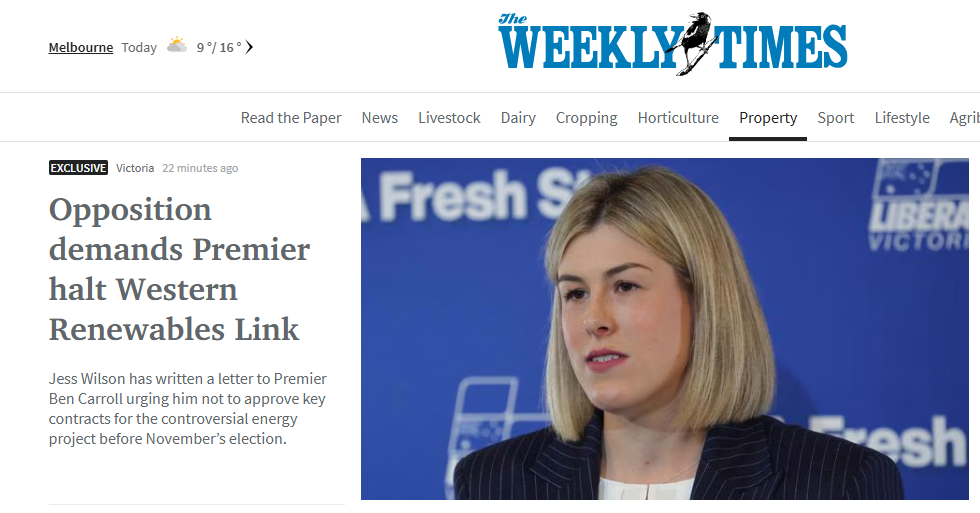

Extract From Herald Sun / Weekly Times Article
Victorian Opposition leader Jess Wilson is urging Premier Ben Carroll not to sign new contracts related to the controversial Western Renewables Link before November’s election.
In a letter seen by The Weekly Times, Ms Wilson wrote to Premier Carroll: “With the Victorian election approaching, your government should not attempt to rush through decisions that would bind an incoming government, expose taxpayers and electricity consumers to substantial liabilities and permit compulsory acquisition across private farmland.”
The Western Renewables Link is a proposed 190km transmission line that will see infrastructure pass through farmland and will carry renewable energy from Bulgana in western Victoria to Melbourne’s north west.
The letter provides a list of regulatory approvals still remaining before the project can proceed, with Ms Wilson asking Mr Carroll not to proceed with them before the pre-election caretaker period.
“These decisions should not be made in the final months of a government’s term, particularly where they could deliberately limit the choices available to a government elected in November,” she wrote.
“Having visited and listened to many residents and landholders who will be impacted, it is clear WRL has not secured the social licence required for a project of this scale.
“WRL will have profound consequences for affected farmers, regional communities, energy consumers and the state’s finances.”
The Coalition has reaffirmed it will halt the WRL if elected for a “rigorous review”.
Former treasurer Jaclyn Symes has taken on the energy portfolio from retiring MP Lily D’Ambrosio, and Ms Wilson said the change was an opportunity to “(give) communities affected by WRL a real say”.
“We would welcome your confirmation that no such approvals will be made before the caretaker period begins,” the letter concludes.
INTEGRITY IS NOT A CAMPAIGN SLOGAN
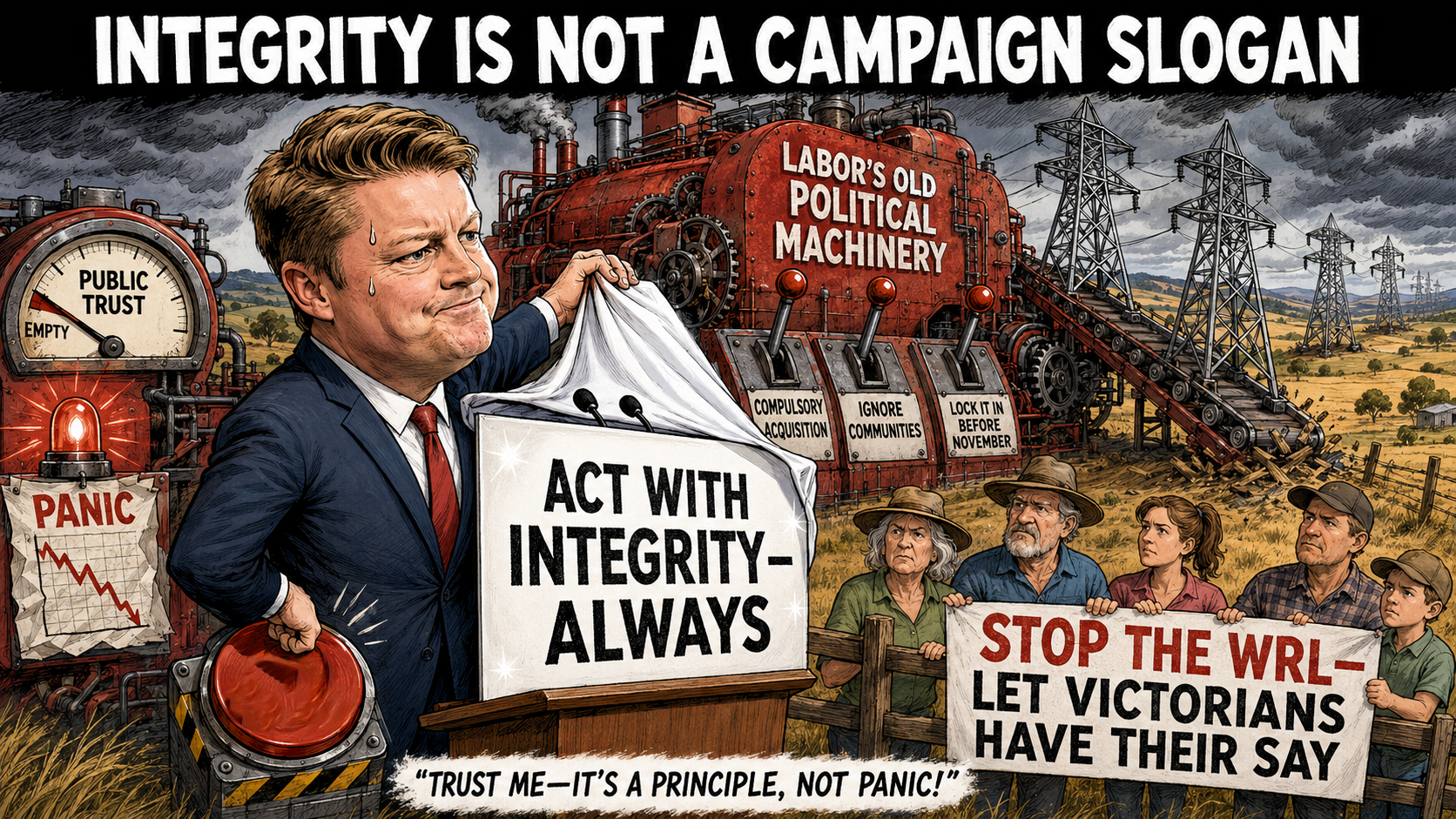
Oh, so Victorian Labor has suddenly discovered integrity – because it knows it may lose if it does not?
After years of refusing to confront the culture around it, after scandal, waste, secrecy and decisions made over the heads of communities, Ben Carroll now wants Victorians to believe his government will “act with integrity always”. Convenient timing.
Is this new commitment to integrity driven by principle? Or by panic – by the rise of One Nation, collapsing public trust, and the real prospect that Labor will be punished in November?
Carroll may come from Labor’s Right, but he does not govern alone. The Socialist Left still holds enormous influence inside Victorian Labor, just as it does federally. These are the factions that have driven an agenda of spending without restraint, ideological division, ever-expanding government and climate policy pursued with little regard for cost, consent or consequence.
And nowhere is that more obvious than the Western Renewables Link.
The WRL is the perfect test of Carroll’s promise. For years, communities and landholders have been expected to accept a massive transmission line across farmland, the prospect of compulsory acquisition, environmental distruction and unmanaglable bushfire risks – all while the cost keeps climbing and consultation is treated as a box to tick.
Now Carroll has a choice.
Will he stop the approvals before the election, as Jess Wilson has demanded? Will he commit to a genuinely independent overhaul of the WRL – one that tests alternatives, protects productive farmland, confronts bushfire risk and gives communities a real say?
Or will he allow Labor’s old political machinery to keep rolling: rush the approvals, silence objections, bind the hands of the next government and call it “progress”?
Integrity is not a press release. It is not a slogan dusted off when the polls turn ugly. It means saying no to powerful interests, no to ideological projects that have lost touch with the people they affect, and no to a planning process that treats regional Victoria as a sacrifice zone.
Ben Carroll says his government will act with integrity. The WRL is his first real test.
Victorians should judge him not by what he promises now – but by whether he stops this project before it does irreversible damage.
KILKENNY MUST GO – A PATTERN THAT DEMANDS ACCOUNTABILITY
Planning Minister Sonya Kilkenny should be removed from the planning portfolio unless she can provide a full and credible account of why she approved activity-centre boundaries near her Hampton investment property without first delegating the decision.
By her own admission, this was an “oversight”. But this is not a minor administrative error. Victoria’s Ministerial Code of Conduct requires ministers to disclose and manage actual, potential and perceived conflicts of interest. Where such a conflict may arise, delegation is a clear safeguard – not an optional afterthought.
The public deserves to know why that safeguard was not used. It is not enough to say that her property was outside the boundary or that no direct financial benefit was received. Planning decisions can transform neighbourhoods, change land values and affect the rights of residents for generations. The relevant test is whether the public can have confidence that private interests played no role – and that the decision was beyond reasonable perception of influence.
This controversy does not stand alone. It comes after a planning tenure marked by increasing centralisation of power, diminished local participation and decisions that have repeatedly inflamed community concern.
Under the Development Facilitation Program, Ms Kilkenny has used ministerial powers to bypass councils and accelerate major developments. In 2025, the government directly approved 11 major residential projects, including a 17-storey Greensborough tower opposed by the local council; those powers can waive requirements concerning height, setbacks and garden space, while ministerial decisions are not appealable to VCAT.
In Kew, Boroondara Council has commenced Supreme Court action seeking to overturn Ms Kilkenny’s fast-tracked approval of an 18-storey, $520 million redevelopment at the former Leo’s supermarket site. The council alleges the decision was legally unreasonable and involved legal errors. These are allegations to be tested by the court – but the fact that a council has been forced to litigate against the Planning Minister speaks volumes about the breakdown in trust.
There have also been longstanding concerns over the administration of major planning decisions. Reporting in 2023 identified a backlog of major projects – worth billions of dollars- waiting on ministerial decisions, and noted that Ms Kilkenny imposed then reversed interim height limits on a development proposal within months.
Meanwhile, community groups across Victoria have united in opposition to the government’s activity-centre agenda, arguing that it concentrates decision-making in Spring Street and sidelines councils and residents. The government maintains it consulted and adjusted plans following feedback. But consultation is not meaningful if communities are left without effective notice, review or appeal rights once decisions are made.
The Premier should not dismiss the Hampton conflict as a one-off oversight. It is the latest warning sign in a portfolio where extraordinary power has been centralised, transparency has too often been inadequate, and communities have been treated as obstacles rather than partners.
Ben Carroll now faces a straightforward test. He can insist on full disclosure, independent scrutiny and genuine accountability – or he can allow the Planning Minister to remain in office while public confidence in Victoria’s planning system continues to erode.
For the sake of integrity, and for the communities whose homes, streets and futures are shaped by these decisions, Sonya Kilkenny should be removed from the planning portfolio.