Stop Labors Towers Newsletter – July 11, 2026
THE MISSING CONVERSATION
The Path We Were Never Asked To Choose
Australians are told, again and again, that the transition to renewable energy is both inevitable and unquestionably good. Under the Victorian Labor Government, that message has hardened into dogma: the only acceptable path is the one they have chosen, and any challenge to it is treated as obstruction, not legitimate concern. The problem is no longer just how fast we move to renewables. It is whether we are being driven down a reckless, transmission‑heavy path that was never honestly put to the people in the first place.
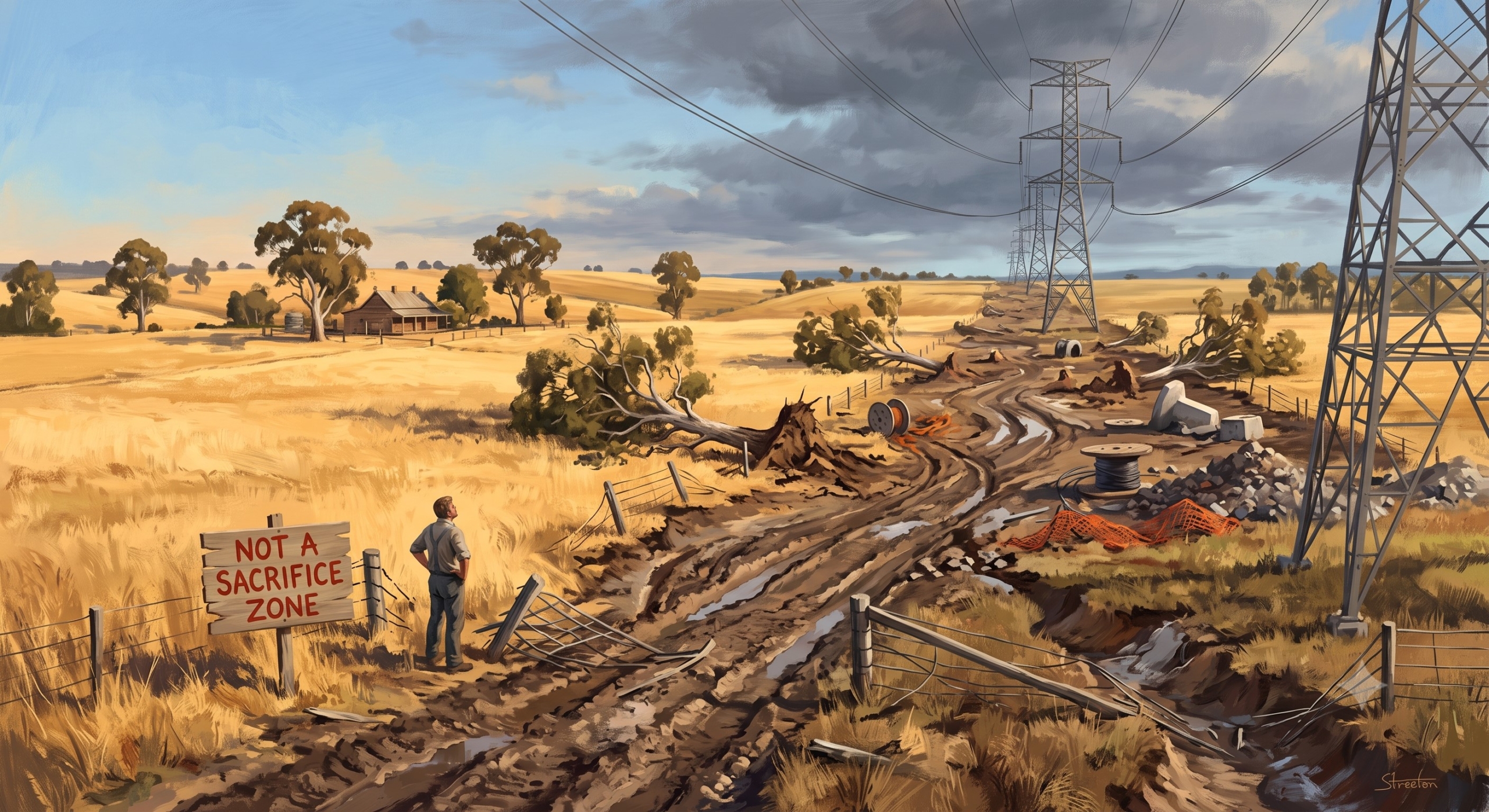
This is not simply about wind turbines and solar panels. Labor’s plan demands an industrial takeover of the countryside: thousands of kilometres of high‑voltage transmission lines across productive farmland, bushfire‑prone country and regional townships, locked in by permanent easements that strip families of control over their own land. Projects like the Western Renewables Link are only the beginning. Under the current model, the grid will be rebuilt not around communities, but over the top of them.
The Andrews‑Allan Labor Governments have treated this as a technical detail – something best left to planners, consultants and aligned corporates – while they sell a simple headline: “Net Zero”. But the real questions are political and moral. Who decided that the only way to decarbonise was to carve new steel corridors through private property instead of upgrading existing routes or investing in generation and storage closer to demand? Who decided that regional Victoria would carry the greatest physical and economic burden because it has the least political clout?
Every major infrastructure project should be judged by the same basic tests: What will it cost? Who pays? Who benefits? Who bears the risk and the loss? Under Labor’s current approach, those questions are either unanswered or answered behind closed doors. Transmission costs are blowing out by billions.Those billions do not vanish; they are converted into regulated assets that earn guaranteed returns and are pushed onto every household and business through higher power bills. Landholders face compulsory acquisition and “reasonable force” powers to open gates. CFA brigades face more steel in their firegrounds and less room for aircraft to operate on catastrophic days.
What is most alarming is the contempt built into the process. Consultation has become a performance. Regional communities are told what is “necessary”, given a chance to “provide feedback”, and then watch as the original plan proceeds regardless. Undergrounding options are dismissed on cost without transparent, independent comparison. Existing corridors are brushed aside. The cumulative impacts on agriculture, biodiversity, tourism, property values and regional investment are treated as unfortunate side‑effects, not central factors.
This is not good government. It is a state government using climate policy as cover for a massive expansion of centralised control over land, infrastructure and revenue streams. It is a government that expects regional Australians to accept that if similar lines were proposed through Melbourne’s eastern suburbs, Sydney’s North Shore or around Parliament House in Canberra, the scrutiny would be far more intense and the bar for community consent far higher.
Questioning this path is not “anti‑renewables”. It is pro‑democracy and pro‑accountability. It is asking:
- Why has Labor locked itself into the most intrusive, transmission‑heavy version of the transition instead of genuinely testing alternatives?
- Why are regional grid‑scale projects being fast‑tracked with special legal powers, while basic transparency and independent assessment lag years behind?
- Why are Victorians being sold the benefits of Net Zero without a frank accounting of the long‑term costs and risks of the chosen route?
The energy transition will define Australia for generations. Under the current Victorian Labor Government, it is being defined by secrecy, coercion and a presumption that those outside the metropolitan bubble will simply absorb whatever is imposed upon them. That path must be stopped and replaced, not with inaction, but with a fundamentally different model: one that starts with communities, tests every option on merit, and refuses to treat regional Australia as a sacrifice zone for the sake of political slogans.
The question has never been whether Australia should invest in its energy future. The question is whether we allow one government, pursuing one narrow, transmission‑dominated vision, to hard‑wire that future into our landscapes and our bills without honest consent. Under Labor’s current course, the answer must be no.
NET ZERO AT ANY COST: HOW LABOR TURNED CLIMATE POLICY INTO A WEAPON AGAINST REGIONAL AUSTRALIA
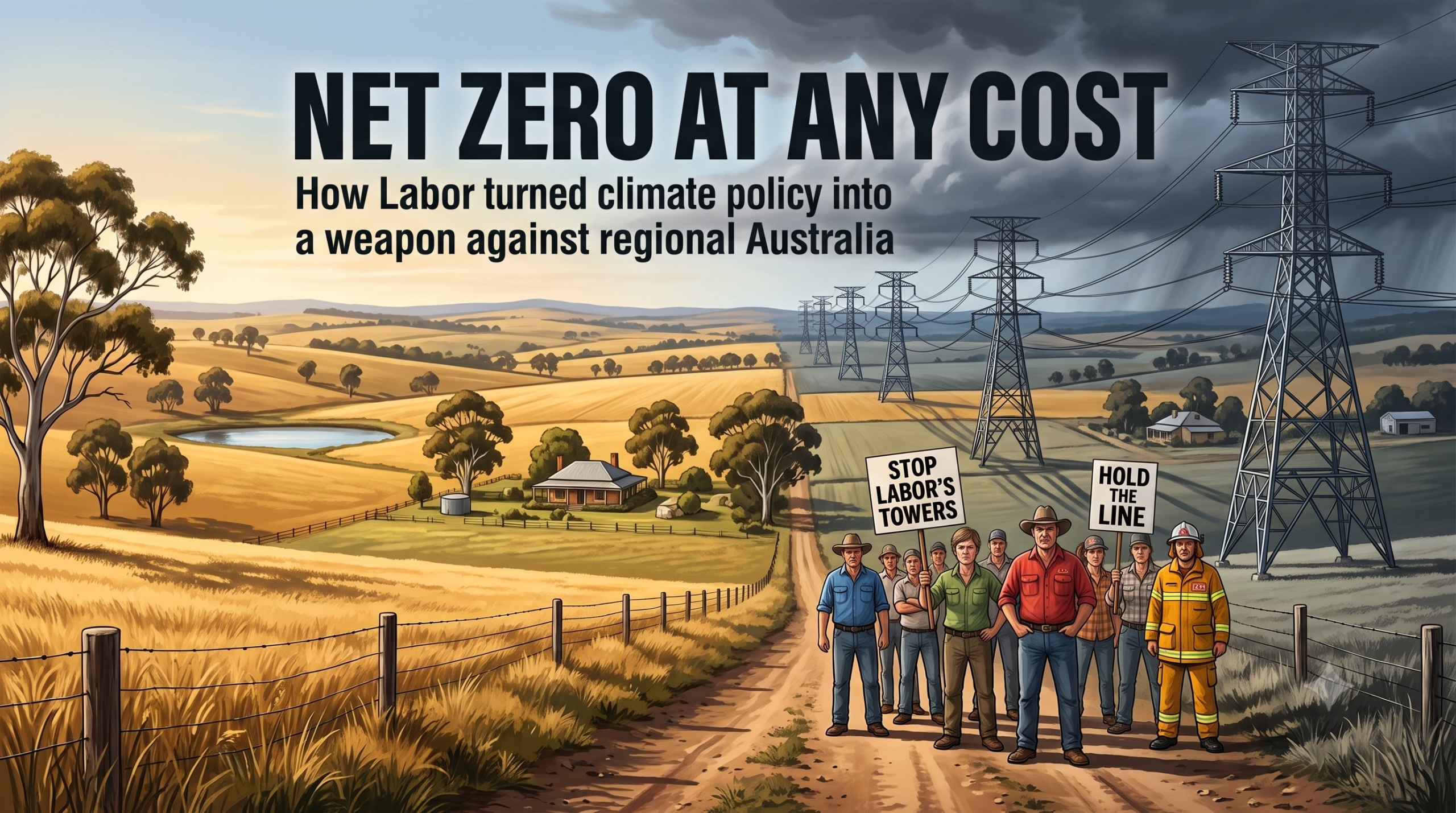
Net Zero, as it is being pursued by Labor at both state and federal level, has stopped being a climate policy and turned into an ideology – and a deeply self‑serving one. It is driven not by sober, evidence‑based planning, but by a kind of righteous zealotry that treats any question about cost, safety, fairness or alternatives as heresy rather than legitimate concern. In Victoria, that fanaticism now has a physical form: high‑voltage transmission corridors like the Western Renewables Link, driven through some of the state’s most productive farmland and fire‑prone country, over the top of the people who live and work there.
This is the most dangerous policy project in Australia today, not because decarbonisation itself is wrong, but because of how brutally and blindly it is being executed. To feed a political storyline about “world‑leading climate ambition”, governments are prepared to carve up landscapes, hollow out regional economies, undermine food production, and escalate bushfire risk – all while loading ordinary Australians with a multi‑trillion‑dollar bill. No other issue comes close on the combination of sheer cost and long‑term impact. Every other fight – over tax, over culture, over day‑to‑day politics – pales beside a program that is literally rewiring the nation’s economy, landscapes and firegrounds without honest consent from the people who will bear the consequences.
The real obscenity is the moral posture that surrounds it. Ministers and their advisers wrap themselves in the language of “justice” and “future generations” while they sign off on projects that dump risk onto farmers, volunteers and regional communities, and funnel benefits to offshore capital and metropolitan consumers. They lecture the very people they are dispossessing, insisting that resistance is backward, selfish or “anti‑renewables”, instead of recognising it for what it is: communities fighting for their safety, their livelihoods and their right to be heard.
This Net Zero at all costs agenda is ripping apart Australia’s environment, agriculture and regional social fabric in the name of saving them. It must be stopped – not to abandon climate action, but to reclaim it from the ideologues and careerists who have turned it into a vehicle for their own power and vanity. Until that happens, we are not on a path to a fair, orderly transition; we are on a collision course, with regional Australia strapped to the front of the train.
TWO TRANSITIONS. ONE CHOICE
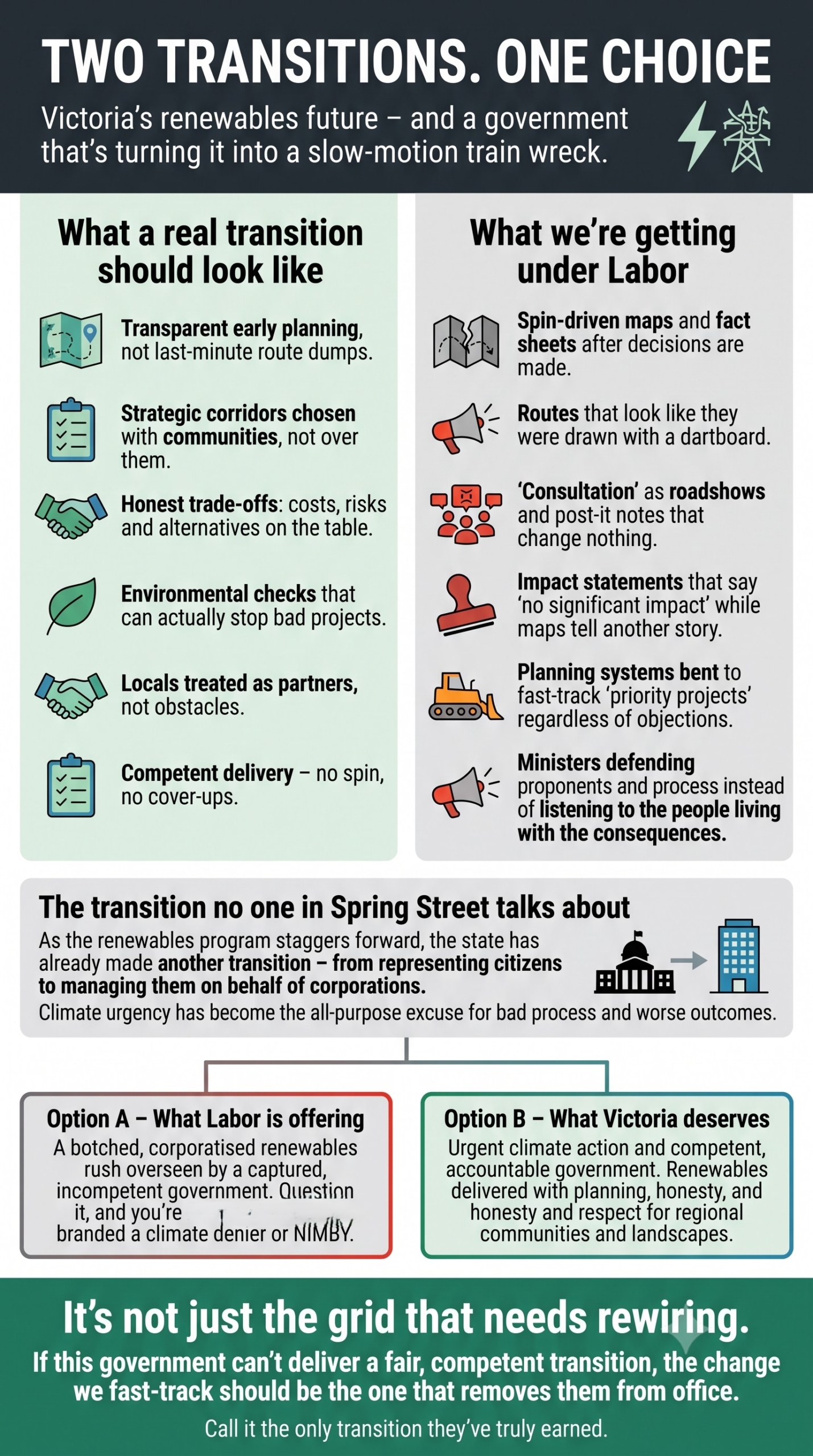
There’s a line ministers love to trot out about Victoria’s “world‑leading renewables transition”. You hear it in the press conferences, see it in the glossy brochures, feel it seeping through every consultation “fact sheet”. If you didn’t know better, you’d assume the whole thing was being run with Scandinavian efficiency and Swiss neutrality.
Then you look at the reality: a rollout so bungled and mishandled it’s turning one of the most important tasks of our time into a slow‑motion train wreck. The problem isn’t the destination – it’s the clowns driving the bus.
A transition run on spin, not competence
On paper, the renewables build‑out is meant to be orderly: strategic corridors, careful site selection, robust environmental assessment, genuine community partnership. In practice, we get route maps seemingly drawn with a dartboard, “consultation” that starts after the decisions are locked in, and impact statements that read like someone copy‑pasted “we’ll manage that” into every box.
Projects are drip‑fed to the public via leaks and rumours; key documents arrive in doorstop‑sized piles nobody can realistically digest in the time allowed; and whenever anyone dares to ask why this is all such a shambles, they’re met with the same tired incantation: “We can’t let the perfect be the enemy of the good.”
Except this isn’t imperfect. It’s incompetent.
Capture in green clothing
It would be bad enough if this were just bureaucratic chaos, but there’s a more corrosive layer underneath. The government that once styled itself as the people’s party has quietly rebranded as the Projects and Proponents Party.
Follow the money and the meetings and you find ministers and senior officials welded to corporate developers, infrastructure funds and network monopolies. The same handful of consultants bob up on every major proposal. Legal and PR firms write the script; government reads its lines. Communities and landholders are invited in later to “share their views” – after the finale’s been filmed.
And because all of this is wrapped in the language of climate virtue, any criticism is treated as heresy. Object to being steamrolled and you’re cast as anti‑science, anti‑climate, or – the latest favourite – “standing in the way of progress”. It’s a handy trick: put a green logo on the bulldozer and hope no one looks too closely at whose orders it’s following.
The renewable transition as case study in how not to govern
What we’re watching is how you take a necessary transition and, through a mix of arrogance and ineptitude, turn it into a civics lesson in how to lose the room.
Instead of:
- Transparent, early planning anchored in real constraints, we get last‑minute route drops and shrugged explanations about “least‑cost options”.
- Honest assessment of trade‑offs, we get glossy “no significant impact” language paired with maps that magically skirt the ugliest realities.
- Serious engagement with locals as partners, we get travelling roadshows, post‑it note workshops and “feedback considered” form letters that change precisely nothing.
This isn’t just bad manners; it’s structurally stupid. You don’t build durable public support for decarbonisation by treating the people who host the infrastructure as collateral damage. You certainly don’t do it by behaving exactly like the fossil‑fuel operators you claimed to be replacing.
The other transition Victoria needs
Which brings us to the transition nobody in Spring Street wants to talk about: the transition of power that isn’t about electrons at all.
While the renewables program staggers forward, the state government has undergone its own, much smoother transition – from representing citizens to managing them on behalf of corporations. You can see it in:
- Planning systems bent to fast‑track “priority projects” regardless of local objections.
- Environmental checks treated as hurdles to clear, not thresholds that might actually stop a bad idea.
- A reflexive instinct to defend proponents and processes instead of listening to the people living with the consequences.
This is not a bug in the system; it is now the system. Climate urgency has become the all‑purpose excuse. The message is simple: “We made a mess, but you must accept it because the planet is burning.” It’s emotional blackmail wearing a lanyard.
So yes, Victoria absolutely needs a transition. But it’s not just the grid that needs rewiring. We need a swift, unapologetic transition away from a government that has proved itself incapable of delivering complex change without collateral social and environmental carnage – and apparently uninterested in learning.
Two transitions, one choice
Here’s the choice that’s quietly being presented to Victorians:
- Accept a botched, corporatised renewables rush overseen by a captured, incompetent government; or
- Be branded as climate deniers, NIMBYs or worse.
That is a false choice.
We can demand both urgent climate action and competent, accountable government.
We can insist on renewables delivered with planning, honesty and respect for the communities and landscapes they transform. And we can be very clear that if this government can’t manage that, the transition we’ll be fast‑tracking is not another transmission line, but the one that removes them from office.
Call it the only transition they’ve truly earned.
CFA GAGGED, COMMUNITIES EXPOSED: HOW LABOR’S CULTURE OF CONCEALMENT IS NOW A DIRECT BUSHFIRE RISK
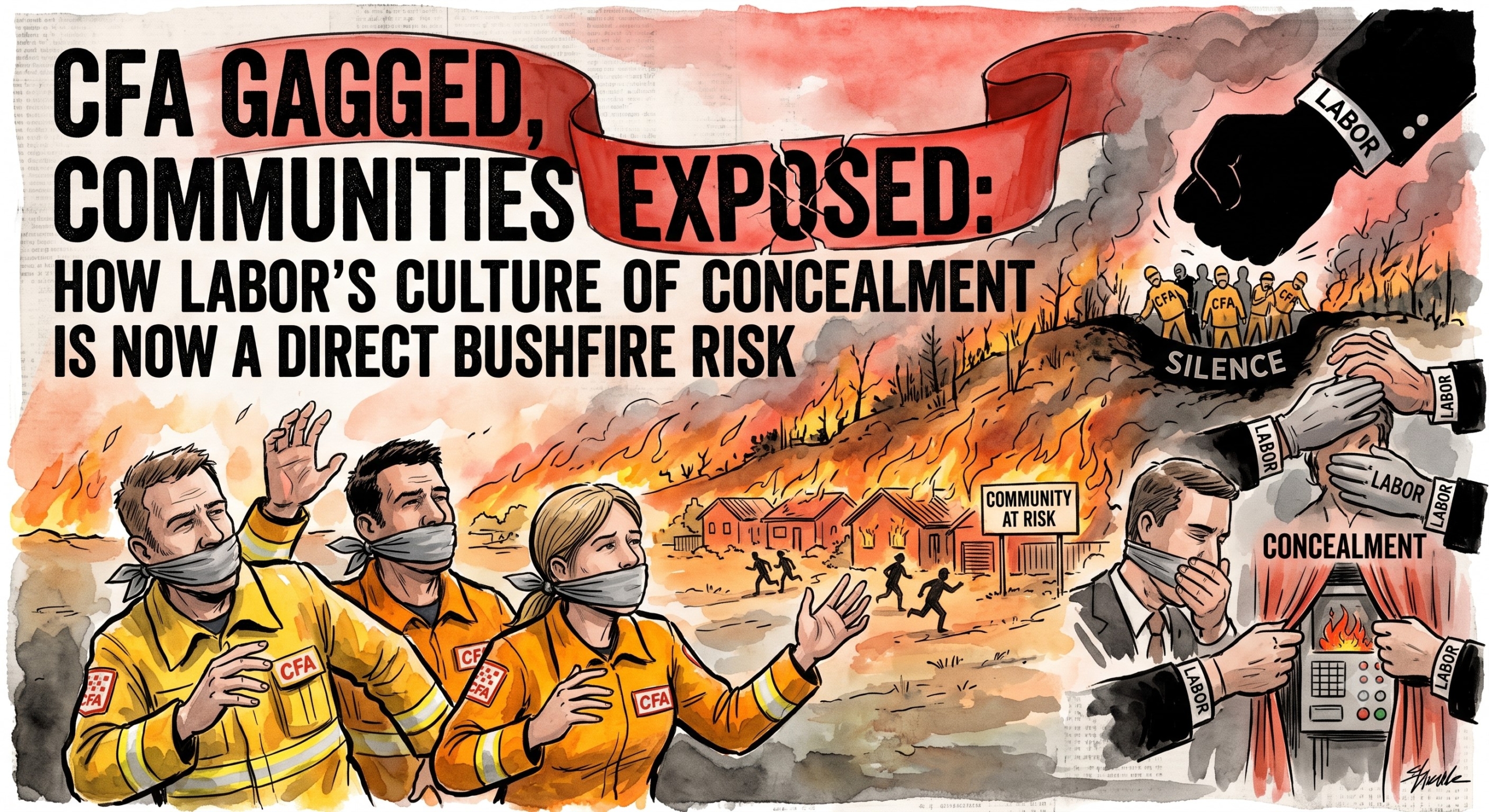
In early July, a seemingly mundane “administrative mistake” blew a hole in the Victorian Labor Government’s narrative about bushfire preparedness. It revealed, in black and white, what many volunteers and regional communities have suspected for years: the state is not ready, the frontline is under‑resourced, and the government’s first instinct when confronted with the truth is to sanitise, redact and bury.
During the parliamentary inquiry into the 2026 summer fires, the Country Fire Authority (CFA) lodged a 33‑page submission. That document set out in stark terms the funding shortfalls, vacant senior roles and crippling understaffing in precisely the regions hammered by January’s fires. It disclosed that the CFA had received only about one‑third of the funding it sought from the state government over three years, and that at the time the fires hit, close to 20 per cent of career firefighter positions across Victoria were vacant. In some of the worst‑affected areas, half the paid staff were unavailable.
That is the sort of evidence you would expect a responsible government to treat as urgent and sobering – the basis for a frank reckoning with its own failures. Instead, within hours, senior CFA management tried to pull the submission back. The CFA’s acting chief officer requested that the document be “returned”, suddenly describing it as an incomplete “working draft”. Shortly afterwards, CFA CEO Greg Leach suggested it should be disregarded entirely, citing “executive privilege”.
What followed was not a correction of minor errors, but a political clean‑up. The CFA submitted a second, heavily shortened 18‑page version that removed key detail about vacancies, resourcing gaps and absent staff during the fires. The parliamentary committee, to its credit, released both versions, exposing the attempted sanitisation. As one opposition MP put it, “We have a 33‑page original document containing some truly remarkable statements and data that the government subsequently attempted to conceal by submitting a sanitized 18‑page version.”
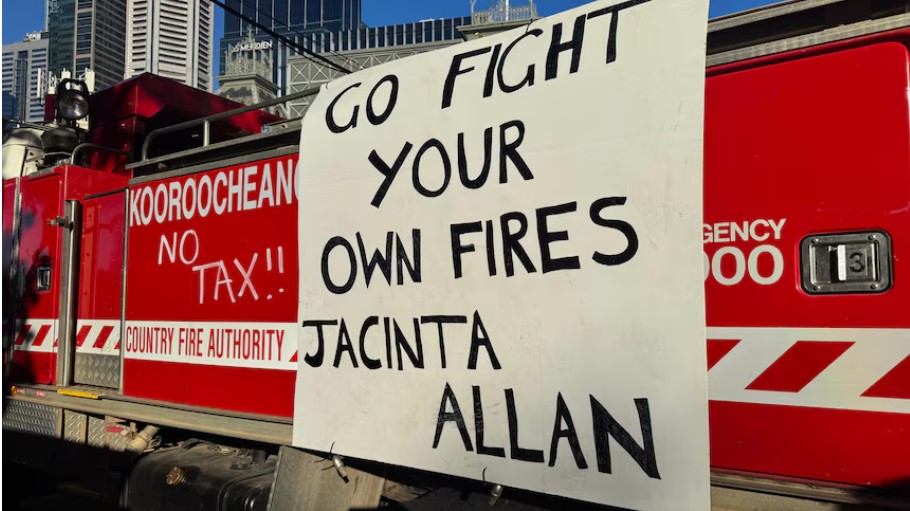
This is not an isolated episode. It is part of a pattern of governance under state Labor that would be familiar to anyone who has followed the CFMEU corruption scandal or the government’s behaviour around past bushfire inquiries and COVID‑era failures.
Consider the CFMEU report. Geoffrey Watson SC’s forensic investigation into Victoria’s construction sector found a systemic “corruption premium” – more than 15 billion dollars in inflated project costs, driven by coercive union behaviour, non‑competitive agreements and documented links to organised crime. Crucially, Watson alleged that senior state officials “knew or had a duty to know” about this conduct and did nothing to stop it.
What happened to that report? Large sections dealing with the Victorian branch and its relationship with the Labor Government were quietly removed before publication. The federal administrator, Mark Irving KC, later had to hand the full, unredacted document to police after public pressure – effectively conceding that material of serious public interest had been withheld. Attorney‑General Sonya Kilkenny responded by attacking the report’s credibility and insisting the government had been “unaware” of its details.
We have seen this film before. During the COVID hotel quarantine debacle, Premier Daniel Andrews told a parliamentary inquiry that the state had not been offered Australian Defence Force assistance to run quarantine. Defence Minister Linda Reynolds and federal officials later demonstrated that, in fact, such offers had been made and rejected. Opposition MPs accused the government of lying to Parliament and to Victorians.
The through‑line is unmistakable: when confronted with evidence that undermines its story, Victorian Labor’s instinct is not transparency and correction, but denial, editing and attack. The CFA case is simply the latest
chapter, and it is particularly egregious because of what is at stake.
Bushfire risk in Victoria is not theoretical. The 2009 Royal Commission spelled out in painful detail how under‑resourcing, communications failures and flawed policy cost lives. Fifteen years on, the state has embarked on an unprecedented expansion of high‑voltage transmission infrastructure across exactly the same landscapes – Western Renewables Link, VNI West and other projects that will introduce 80‑metre towers and dense overhead lines into firegrounds where CFA volunteers already operate at the limits of safety.
In that context, the revelation that CFA stations were short‑staffed, underfunded and missing key senior personnel during last summer’s fires is not just embarrassing; it is a direct warning signal. A government serious about community safety would treat such a submission as a trigger for overhaul, not a problem to be cut in half and swept aside under “executive privilege”.
Viewed through this lens, the CFA saga is not a clerical hiccup. It is another manifestation of a governing culture that treats inconvenient facts as something to be managed, not confronted. A government that will tolerate the attempted deletion of a 33‑page document detailing its own failures to staff and fund the frontline is not a government that can be trusted to tell the truth about the risks of transmission corridors, the state of its balance sheet, or the real cost of the energy transition.
The questions Victorians should now be asking are blunt:
- If the CFA’s original evidence about understaffing and underfunding during a deadly fire season had not been accidentally sent, would we ever have seen it?
- If the full Watson CFMEU report had not leaked and been handed to police, would taxpayers ever have been told that 15 billion dollars had been effectively siphoned out of their pockets?
- If independent inquiries and royal commissions had not dragged the truth out of hotel quarantine or Black Saturday, would Labor have admitted anything at all?
This is not a matter of partisan preference. It is a question of basic public integrity. A state government that repeatedly edits, buries and attacks evidence about its own failures – on fires, on corruption, on health and infrastructure – cannot be allowed to continue making life‑and‑death decisions about bushfire policy and the physical redesign of our landscapes without far more coercive scrutiny.
At minimum, the CFA incident should trigger three immediate demands from the public:
- Full, unedited publication of all submissions and correspondence relating to the 2026 summer fires inquiry, including any guidance or pressure exerted by ministers or departments on frontline agencies.
- A genuinely independent audit of CFA staffing, funding and readiness, tied to binding commitments from the government to fix identified gaps before any further transmission megaprojects proceed through high‑risk areas.
- A broader, joint state–federal royal commission with powers to examine not just bushfire policy, but the culture of concealment across emergency services, infrastructure and union relations that has now been exposed multiple times.
Without such steps, Victorians are being asked to trust a government that has already demonstrated it prefers a sanitised 18‑page version of reality to the hard 33‑page truth. In an era of compounding bushfire risk and radical changes to our energy system, that is not just dishonest. It is dangerous.