Stop Labors Towers Newsletter – July 18, 2026
HIT SHARE, HIT FORWARD – TURN THIS NEWSLETTER INTO PRESSURE
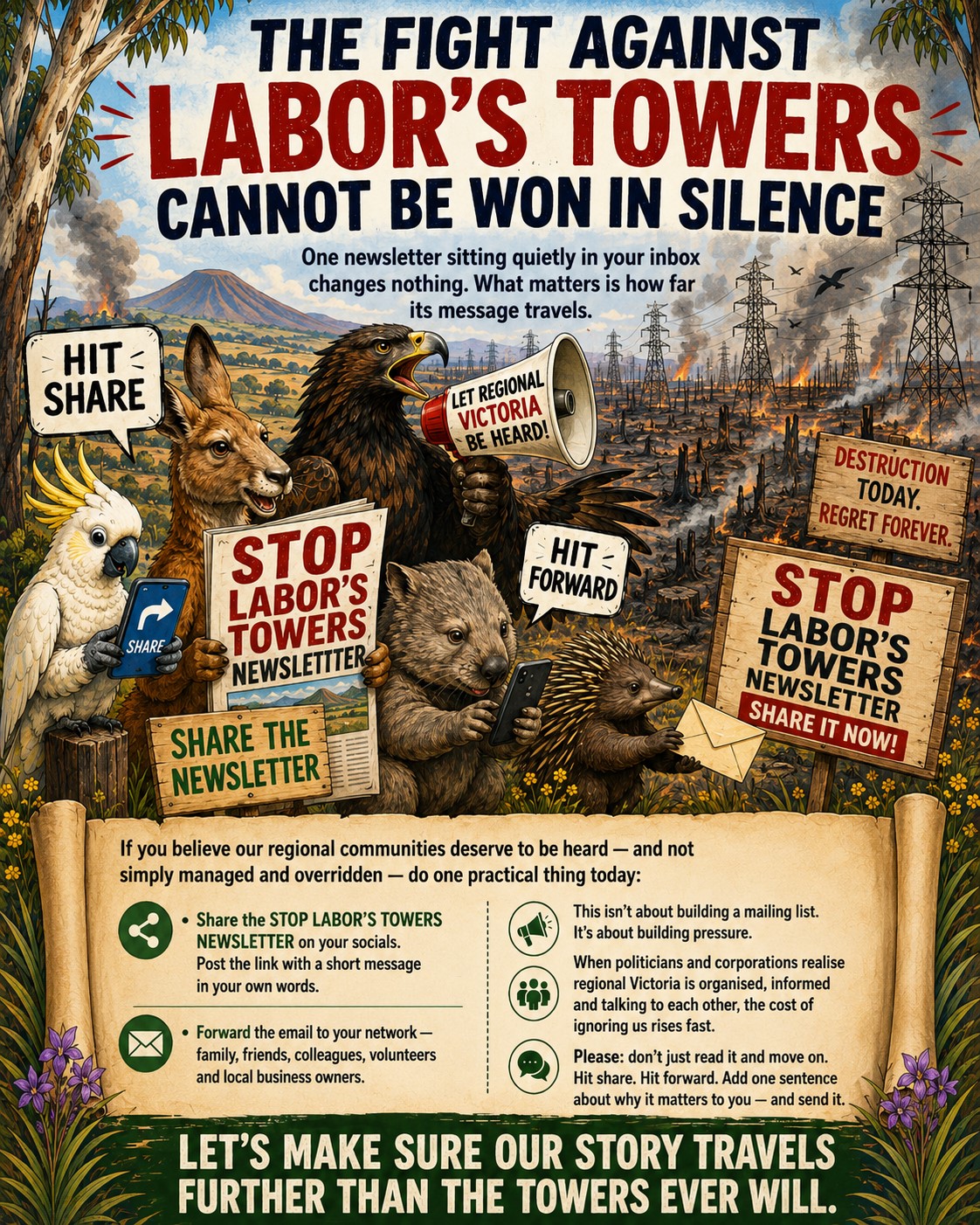
The fight against Labor’s towers cannot be won in silence – it will only move if thousands of ordinary people refuse to let this story stay buried.
A newsletter sitting quietly in your inbox changes nothing. What matters is how far its message travels.
If you believe our regional community deserve to be heard – and not simply managed and overridden – we are asking you to do one simple, practical thing today:
- Share the newsletter on your socials. Post the link with a short message in your own words. Every share brings new eyes and new voices into the conversation.
- Forward the email to your network. Family, friends, colleagues, fellow volunteers, local business owners – anyone who will be living with the consequences of these decisions.
This isn’t about building our mailing list. It’s about building pressure. When politicians and corporations realise that regional Victoria is organised, informed and talking to each other, the cost of ignoring us rises fast.
One newsletter, widely shared, can start conversations in farm kitchens, CFA sheds, council offices and city boardrooms. It can help people connect the dots between transmission corridors, bushfire danger, rising bills and a government that refuses to listen.
So please: don’t just read it and move on. Take thirty seconds to pass it on. Hit “share”. Hit “forward”. Add one sentence about why it matters to you – and send it.
The landscape has a memory, and so do its people. Let’s make sure our story travels further than the towers ever will.
WRL: THE WRONG LINE, THE RIGHT MOMENT TO STOP IT
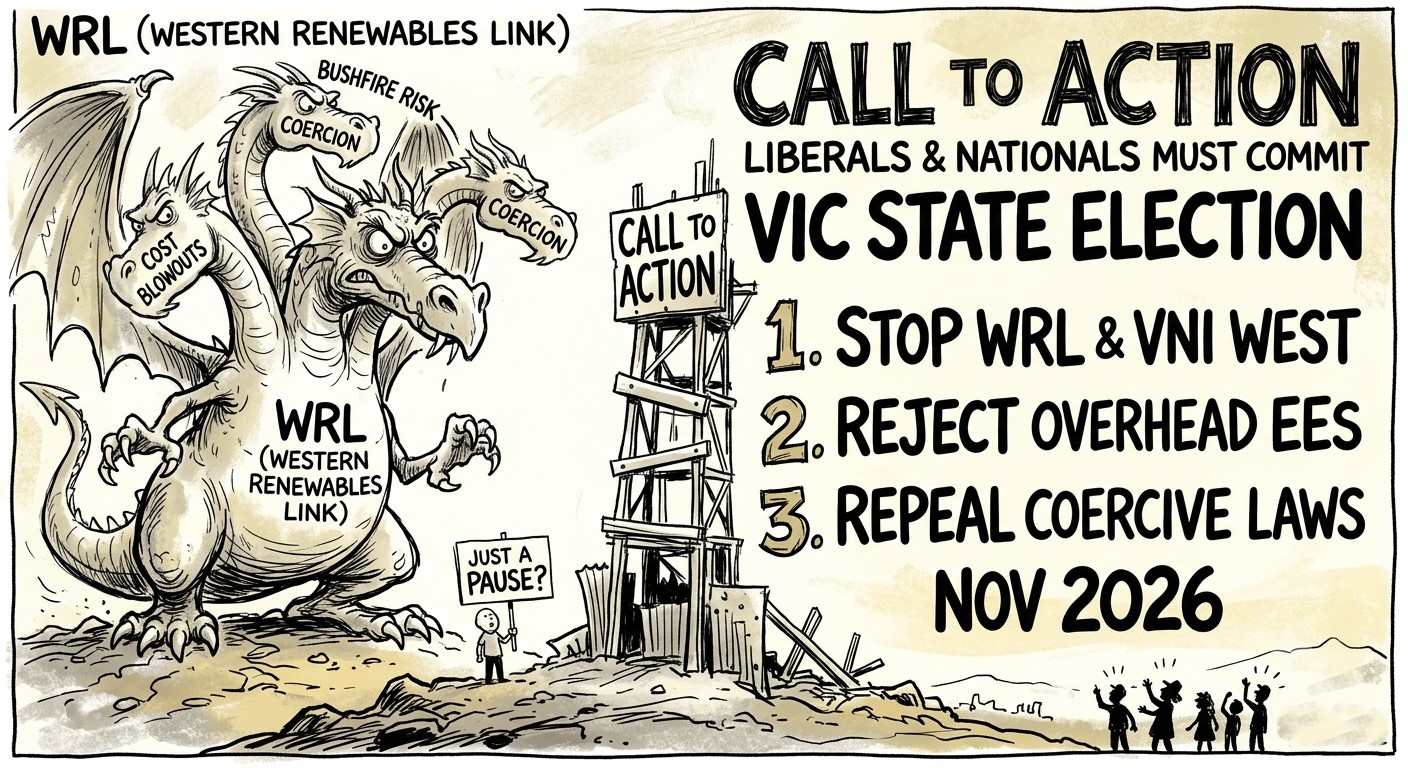
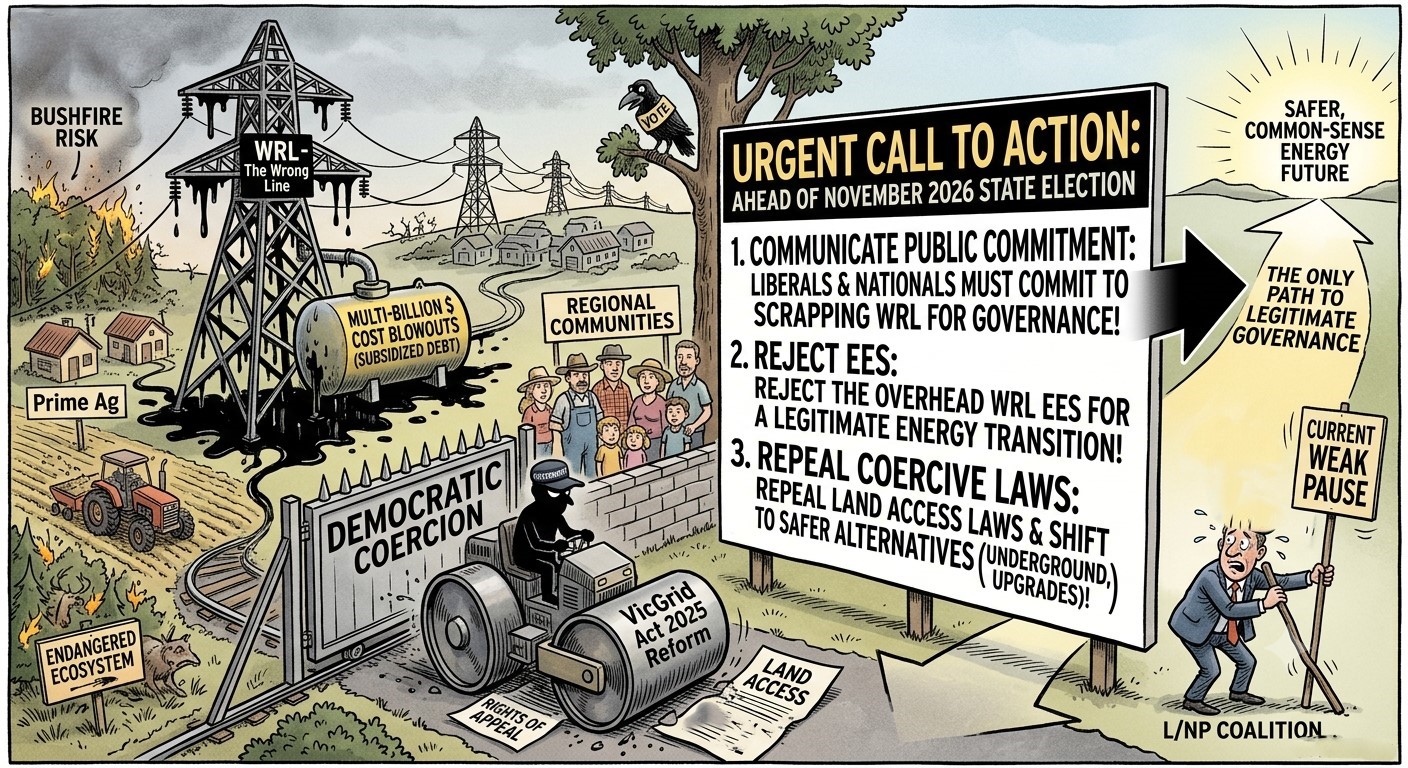
Any party seeking to govern Victoria must start by scrapping WRL and rebuilding the transition on trust, safety and common sense.
At the November 2026 state election, one commitment must sit above all others: the Liberals and Nationals must agree, clearly and publicly, to stop the Western Renewables Link as a core part of their policy platform. Without a promise to halt WRL in its current overhead form, talk of “standing with regional Victoria” risks becoming just another slogan. A party that wishes to govern this state cannot stay neutral on a project that so obviously fails regional communities on cost, safety, agriculture, environment and basic fairness.
If the Coalition is serious about governing for the whole state, this is the moment to prove it. Stopping WRL must be treated not as a niche regional grievance, but as the foundation of a credible energy platform: a clear pledge to end an uninsurable, bushfire‑exposed, food‑bowl‑carving project and replace it with safer, cheaper alternatives that communities can actually live with.
Conceived in 2019 as a modest $370 million upgrade, WRL has swollen into a multi‑billion‑dollar overhead calamity that would carve through fire‑prone country, prime food‑producing land and critically endangered environments.
For regional communities the verdict is already in: WRL has failed on cost, safety, agriculture, environment and trust.
A Project That Has Failed Every Public Test
Strip away the jargon and four simple truths remain.
- The cost has exploded. WRL has blown out from $370 million to conservatively more than $3 billion but likely closer to $6 billion; VNI West has grown from $2 billion to as much as $11.4 billion.
- The bill is being hidden. Up to $500 million a year in “energy subsidies” will quietly shift these blowouts from power bills onto state debt.
- The line is uninsurable. AusNet cannot secure commercial insurance for the WRL’s 190 km of overhead high‑voltage infrastructure, meaning storm and disaster costs are passed straight onto consumers.
- The risk is asymmetric. The corridor runs through some of Victoria’s most fire‑prone landscapes, paralyses firefighting, and exposes taxpayers to PG&E‑scale bailout liability if a line‑sparked wildfire overwhelms the grid owner.
On the land itself, the picture is no better. A 100‑metre easement blocks modern irrigation, precision farming, aerial spraying and agricultural aviation, while fragmenting and threatening species the Commonwealth has promised to protect.
In policy terms, WRL is a textbook example of how not to modernise a grid.
When Consultation Becomes Coercion
Faced with collapsing community trust and planning gridlock, the government has not paused to listen; it has reached for stronger tools.
The VicGrid Stage 2 Reform Act 2025 replaced negotiation with coercion. It allows officers to cut farmers’ locks and enter land by force, fines landholders for resisting, shields key documents from Freedom of Information, and strips councils and communities of normal appeal rights.
This is not the behaviour of a confident administration. It is the reflex of a government that has lost the argument and now relies on legal muscle.
No serious investor wants to back infrastructure that can only be built behind bolt‑cutters and police escorts.
No serious democracy should ask its citizens to accept it.
The Opposition’s Task: Stop WRL, Reset The Transition
Stopping WRL is not an act of vandalism against renewables.
Done properly, it is the first step towards a faster, cheaper and more legitimate transition.
The Opposition now has a clear, practical blueprint:
- Formally stop WRL and VNI West – Use existing powers under the National Electricity (Victoria) Act to direct VicGrid to halt early works, acquisitions and procurement on both projects.
- Reject the WRL EES – Rely on the independent Inquiry and Advisory Committee reports to find that WRL’s overhead impacts are unacceptable and deny the planning scheme changes required.
- Repeal coercive powers – Remove forced‑entry provisions, secrecy shields and the stripping of VCAT appeal rights, restoring normal protections for regional landholders and councils.
- Open the alternatives to genuine scrutiny – Mandate a transparent, peer‑reviewed comparison between WRL and options like the Bartlett–Mountain “Plan B”, which upgrades existing corridors, uses smaller towers, saves billions and avoids new greenfield scars.
This is not radical. It is modest common sense: abandon the megalomaniac project, fix the laws that broke trust, and put the cheaper, less destructive technology on the table.
What Communities Should Now Expect – And Demand
For affected communities, the ask is straightforward.
Any party seeking to govern Victoria at the next election should commit, plainly and publicly, to three promises:
- The Western Renewables Link, in its current overhead form, will not proceed.
- Coercive land‑access laws will be repealed, and normal rights of appeal restored.
- Future grid upgrades will start with existing corridors, undergrounding and community consent, not with new scars across the food bowl.
If the Opposition makes that commitment, regional Victoria can support a transition that protects both climate and country.
If it does not, WRL will remain the symbol of an energy policy that has lost its way – and a government that forgot who the grid is ultimately for.
TELL THE COALITION: STOP WRL NOW
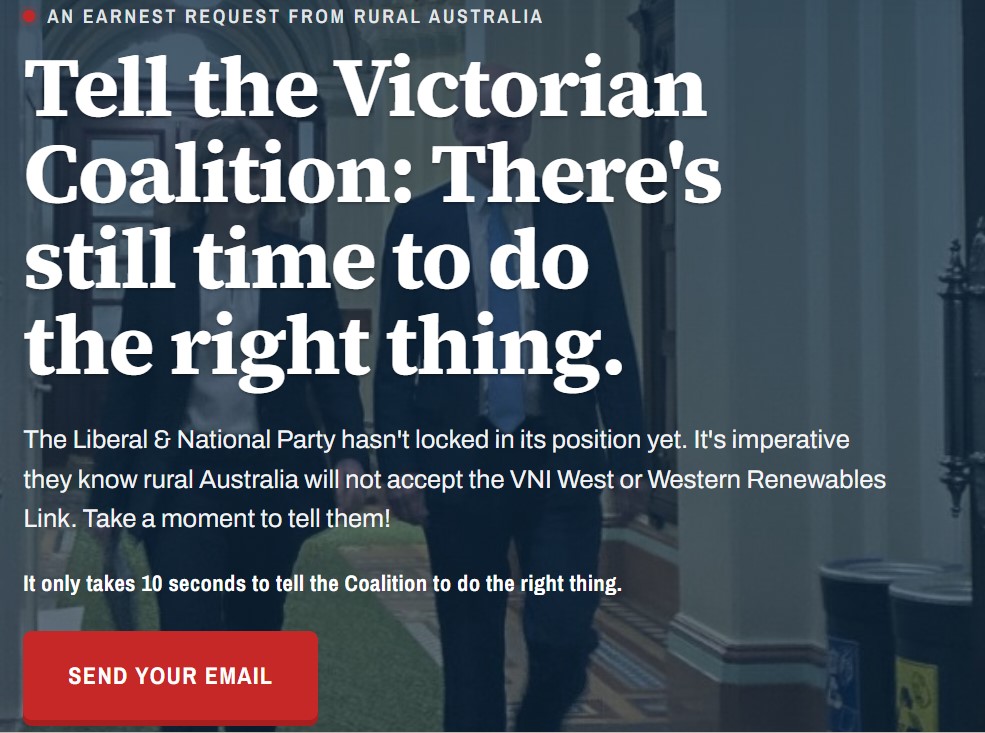
TELL THE COALITION: STOP WRL NOW
It only takes a few minutes to do something that could change the course of this fight.
If you want the Coalition to stop the Western Renewables Link, don’t just talk about it – tell them directly. Go to:
https://www.farmersfightback.com/askjess
Fill in the short form and demand a clear, public commitment to scrap WRL and protect regional communities, farmland and bushfire‑prone country.
One message might feel small, but thousands of messages from real people in affected areas are impossible to ignore. Take five minutes, add your voice, and make sure they know: no WRL, or no vote.
ETU POWER, WRL DAMAGE: HOW ONE UNION BOSS CAPTURED VICTORIA’S GOVERNMENT
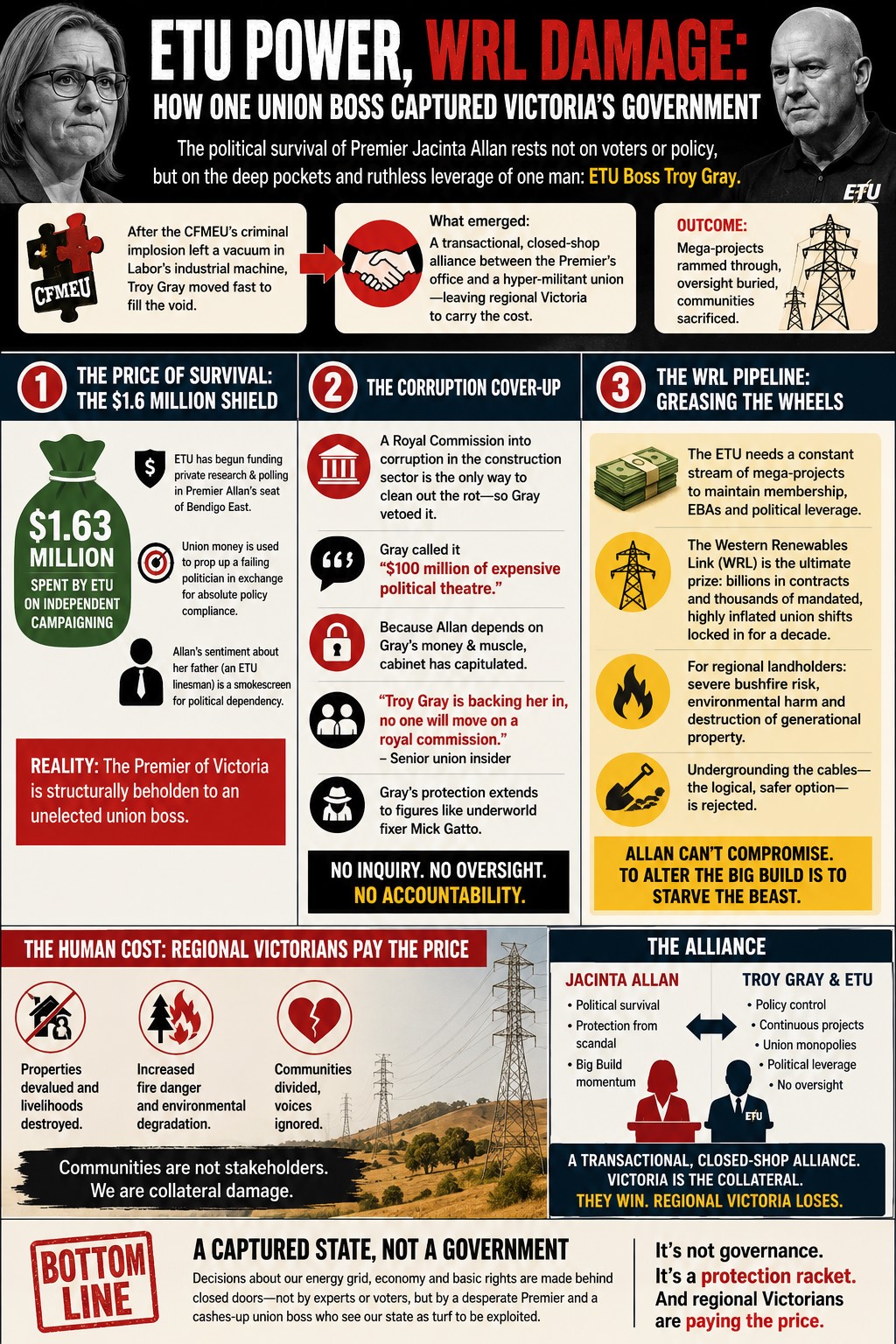
The political survival of Victorian Premier Jacinta Allan does not rest on the willpower of the electorate or the integrity of her policy. It rests on the deep pockets and ruthless leverage of one man: Troy Gray, the boss of the Electrical Trades Union (ETU).
As the catastrophic fallout of the CFMEU’s criminal implosion left a vacuum at the heart of Labor’s industrial machine, Gray moved swiftly to occupy the territory. What has emerged is a deeply transactional, closed-shop alliance between the Premier’s office and a hyper-militant union – an alliance that leaves regional Victoria, and specifically communities facing the catastrophic overhead transmission lines of the Western Renewables Link (WRL), carrying the cost of political survival.
Here is the anatomy of a captured state.
The Price of Survival: The $1.6 Million Shield
Jacinta Allan is a Premier on life support, presiding over an administration facing historic lows in public approval and deep panic over systemic corruption within her signature “Big Build” infrastructure agenda. In normal democratic conditions, a leader in this position falls. But Gray has deployed the ETU’s vast financial reserves as a private political shield.
The strategy mimics the dark-money Political Action Committees (PACs) of American politics. The ETU, which poured $1.63 million into independent campaigning at the last election, has quietly begun funding private research and polling inside the Premier’s own vulnerable seat of Bendigo East. It is a stark display of financial muscle: a union spending member funds to prop up a failing politician in exchange for absolute policy compliance.
When challenged on this dependency, Allan retreats into familial sentimentality, invoking her father’s history as an ETU linesman. It is a convenient smokescreen designed to mask a harsh reality: the Premier of Victoria is structurally beholden to an unelected union boss.
The Corruption Cover-Up
The most damning evidence of this institutional capture is the deliberate strangulation of an independent judicial inquiry into the construction sector.
Privately, elements within the Labor movement are terrified. They recognize that the rot within the state’s multi-billion-dollar infrastructure pipeline is terminal, with senior figures openly acknowledging that a carefully calibrated Royal Commission is the only way to purge the industry before an election sweeps them from power.
Yet, Gray has single-handedly vetoed the move, publicly dismissing a corruption inquiry as “$100 million of expensive political theatre.”
Because Allan’s political existence depends entirely on Gray’s financial and organizational machinery, the cabinet has capitulated. As one senior union insider admitted flatly: “Troy Gray is backing her in, no one will move on a royal commission.”
This resistance to oversight is part of a broader pattern of protecting questionable interests. Inside parliament, senior powerbrokers openly marvel at the impunity, noting that Gray’s refusal to allow a forensic look at the building game coincides with his public defense of notorious Melbourne underworld fixer Mick Gatto.
The WRL Pipeline: Greasing the Wheels of the Machine
This unholy alliance explains the brutal, unyielding momentum behind mega-projects like the Western Renewables Link.
The ETU is not a public utility; it is an enterprise that requires a constant, high-velocity stream of capital works to maintain its membership, its EBA monopolies, and its political leverage. The WRL – a multi-billion-dollar network of high-voltage transmission lines slated to rip through regional farmlands – is the ultimate prize. It represents thousands of mandated, highly inflated union shifts locked in for a decade.
For the landholders of regional Victoria, the project is a looming disaster that brings severe bushfire hazards, environmental degradation, and the destruction of generational property. The logical alternative – undergrounding the cables to safeguard lives and livelihoods – has been systematically rejected. The Allan government refuses to compromise because it cannot compromise; to alter the trajectory of the Big Build is to starve the beast that keeps the Premier in power.
A Captured State
What the state of Victoria is witnessing is not governance, but a highly disciplined protection racket.
Policy decisions regarding the state’s energy grid, its economic future, and the basic rights of regional property owners are no longer decided by independent experts or democratic consensus. They are negotiated behind closed doors between a desperate Premier and a cashed-up union leadership that views the provincial landscape as mere turf to be exploited.
In this environment, regional Victorians are not stakeholders; we are collateral damage in a cynical, multi-million-dollar campaign to keep a captured government on life support.
This must be stopped at all costs.