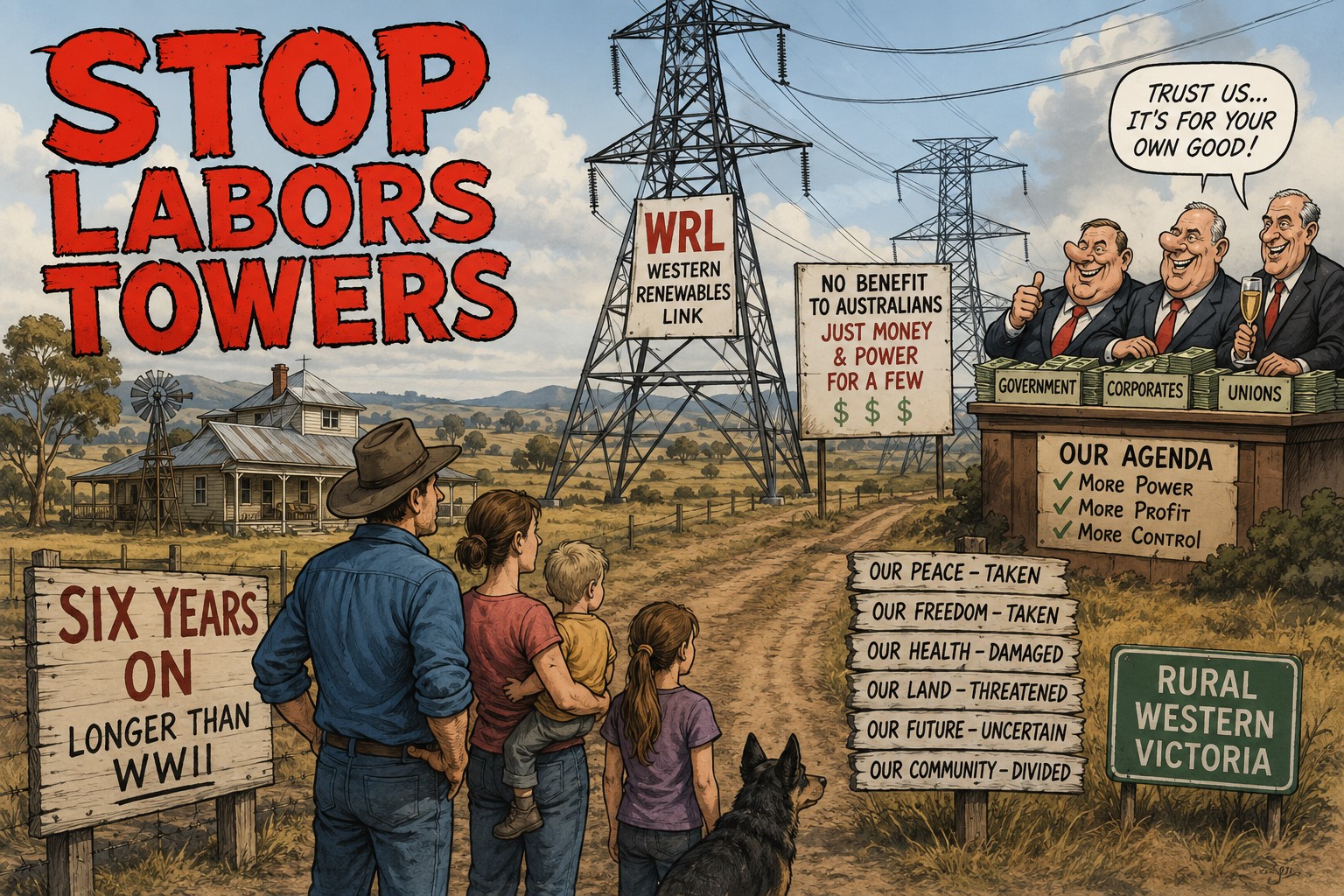
Stop Labors Towers Newsletter – July 25, 2026
SIX YEARS ON: WRL HAS TAKEN OUR PEACE, OUR FREEDOM – AND DELIVERED NOTHING
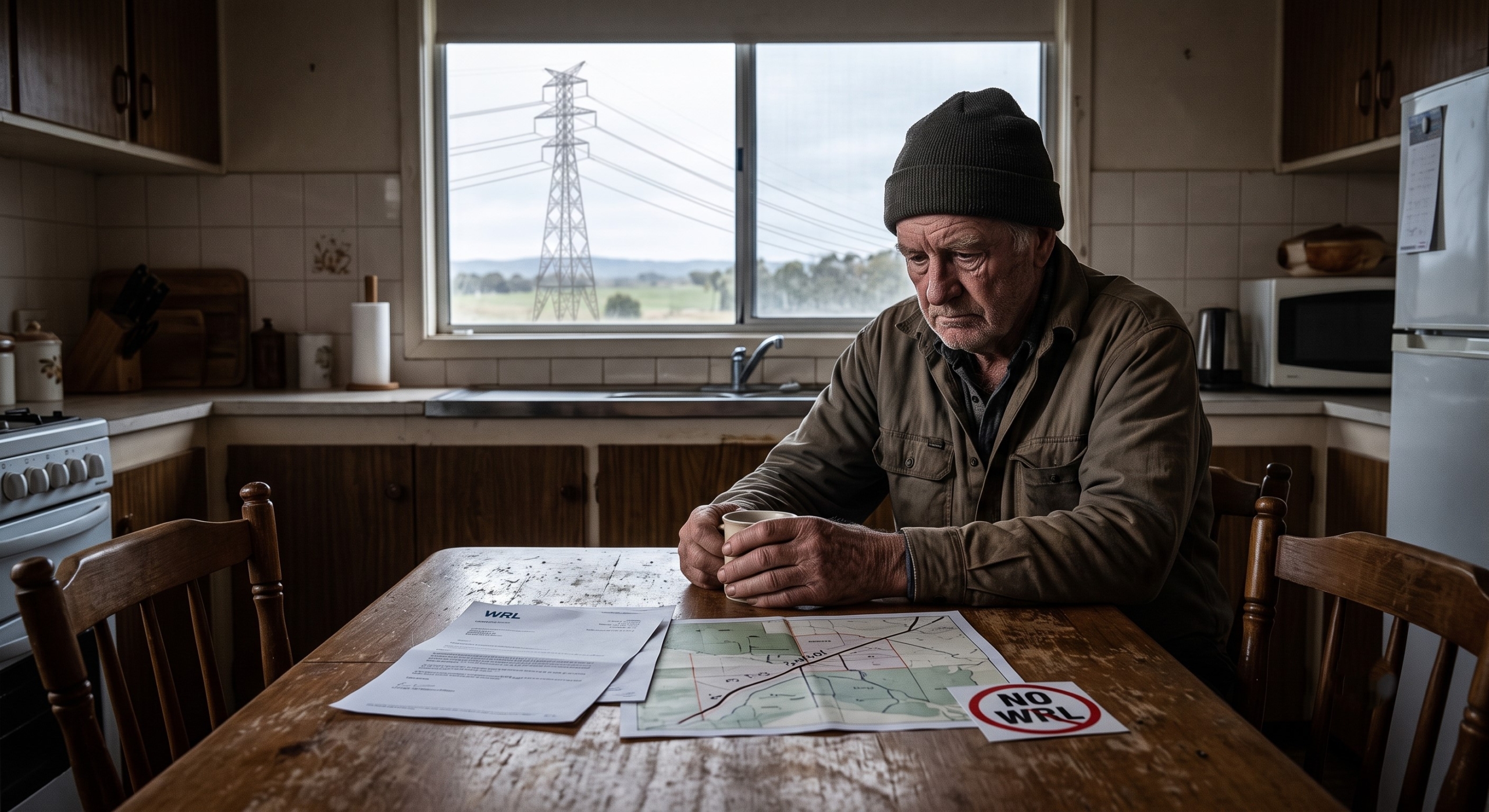
Six years.
That is how long ordinary western Victorians have been forced to live under the shadow of the Western Renewables Link – a project that still has not turned a single sod on our land, yet has already ripped through lives, families and communities.
For many of us, the damage is not theoretical, and it is not “manageable”.
It is six years of sleepless nights, six years of fights at the kitchen table, six years of watching your life’s work and your home turn into a line on someone else’s map.
And for what? No cheaper power, no safer grid, no real benefit to Australians – just a bonanza for a handful of corporates and a political class besotted with its own slogans.
This is not climate policy.
This is not fairness.
This is government power used against its own people.
________________________________________
A Project That Exists Mainly On Paper – But Lives In Our Heads
Here is the cruel joke: after six years, WRL still exists mostly on glossy brochures, legal threats and spin.
The towers are not up. The lines are not live. The concrete has not been poured. Yet the mental, social and financial toll on landholders is already immense.
People have delayed selling, delayed building, delayed retiring.
They’ve watched property values wobble while government and proponents pretend there is “no impact until construction”.
Tell that to the farmer who cannot confidently invest, the family who cannot in good faith sell, the landholder who has spent years writing submissions while their health deteriorates.
This is what happens when a government treats regional communities as a sacrifice zone: lives are put on hold indefinitely, while the project staggers from one stage-managed “consultation” to the next.
________________________________________
No Benefit To Australians – Just Money And Power For A Few
We were sold a story: big transmission lines equal green progress, cheaper bills and a safe climate.
What we actually got is a cartel of corporates, consultants and unions carving up the map, while politicians in Melbourne and Canberra pat themselves on the back and tell each other how “brave” they are.
This is why people are angry. Not because we are “anti-renewables”. Not because we “don’t understand”. But because the benefits are vague and distant, while the harms are local, immediate and permanent.
________________________________________
A Political Class That Won’t Admit It’s Wrong
In a healthy democracy, six years of community evidence, expert criticism and lived experience would cause a rethink.
Instead, we have Labor governments – state and federal – so welded to their own rhetoric, and so entangled with their favourite unions and corporate partners, that they simply cannot admit they have made a colossal mistake with WRL.
A political class that thinks it owns the truth, despises dissent, and treats ordinary people as an obstacle to be managed, not a public to be served.
Question their chosen path and you are smeared as anti-science.
Defend your home and you are branded a NIMBY.
Ask for real alternatives – undergrounding, different routes, better planning – and you are met with blank looks and boilerplate.
This is not consultation. It is control dressed up as virtue.
________________________________________
The Real Impact: Our Peace, Our Freedom, Our Future
The worst part is not just the lines on the map.
It is what six years of this has done to people’s sense of security and freedom.
When you cannot plan your future because a transmission easement may slice past your bedroom wall;
When your mental health is broken by constant uncertainty and official indifference;
When your land is treated as a disposable corridor for someone else’s agenda – your freedom has already been taken, even before the first tower goes up.
That is the real legacy of WRL so far:
Broken trust.
Broken health.
Broken faith in our institutions.
And remember: all of this damage has happened without a single tower being built.
If this is what “transition” looks like now, what will the next decade bring unless we draw a line?
________________________________________
What Needs To Happen Now
This fight is not just about one corridor in Western Victoria.
It is about whether ordinary Australians still have a say in how their country is changed in the name of “Net Zero”.
Here is what needs to happen:
• WRL, as currently designed, must be halted and fundamentally rethought – routes, technology, undergrounding and all.
• Any future projects must start with communities and land, not with a map drawn in a corporate boardroom or union office.
• Mental health, property rights, bushfire risk and food security must be treated as non negotiables, not footnotes.
• And above all, politicians must be reminded that their mandate comes from voters, not from global conferences, party donors, unions or political vanity projects.
Six years is long enough.
If they will not listen to evidence, submissions or lived experience, they will have to listen to something they fear a great deal more: a community that has had enough, is no longer afraid of their spin, and is prepared to use its vote – and its voice – accordingly.
THE FALSE PROMISE OF THE GRID: WHY A LANDSCAPE DOESN’T HAVE TO DIE TO SAVE THE PLANET
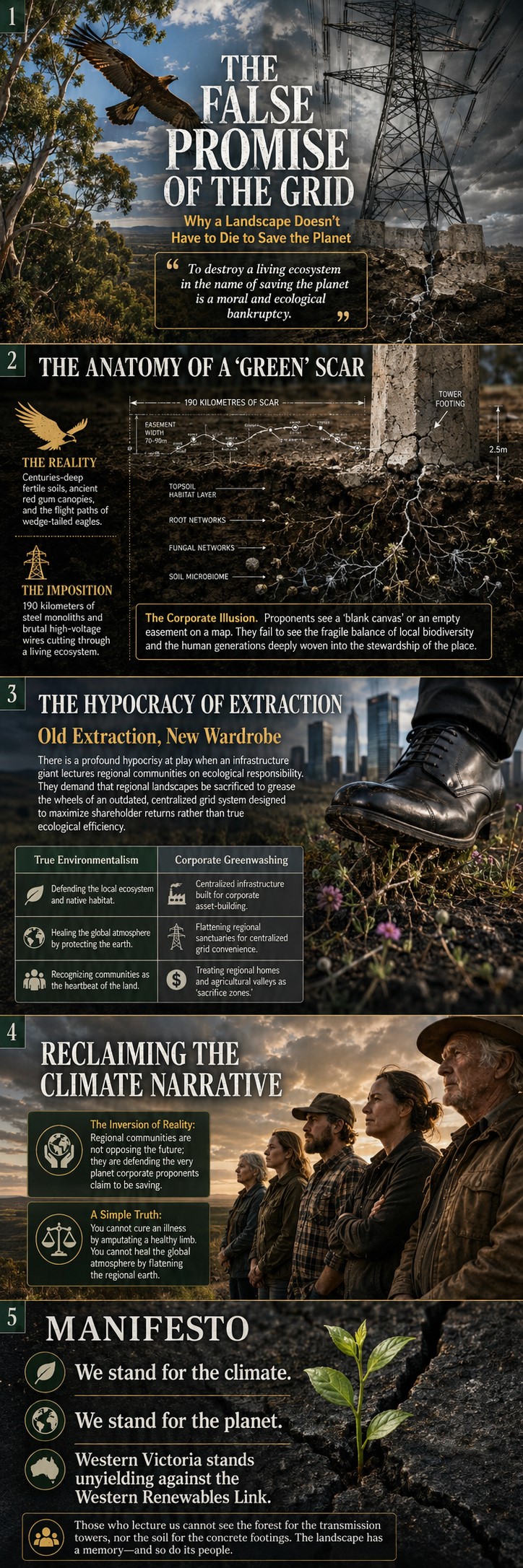
To look upon the landscape of Western Victoria is to understand that the earth possesses its own memory, written in the ancient canopy of red gums, the flight paths of wedge-tailed eagles, and the quiet, centuries-deep accumulation of fertile soils.
Yet today, a shallow and dangerous rhetoric has taken root in our capital cities. It is a language that confuses destruction with progress. Those who stand in resolute defense of this landscape against the Western Renewables Link (WRL) – a brutal scar of 190 kilometers of steel monoliths and high-voltage wires – are routinely branded by corporate proponents as “anti-renewables,” or obstacles to the arrest of climate change.
This is not just a falsehood; it is a profound inversion of reality. It is time to turn the tables on this narrative.
To destroy a living ecosystem in the name of saving the planet is a moral and ecological bankruptcy. The WRL is not a project born from an altruistic desire to heal the atmosphere; it is an exercise in industrial scale and corporate asset-building, driven by corporate greed and masked in the language of green transition. Regional communities are not opposing the future; they are defending the very planet the proponents claim to be saving.
The Illusion of the Green Scar
True environmentalism understands that you cannot cure an illness by amputating a healthy limb. The corporate architect looks at Western Victoria’s rolling hills, pristine remnant woodlands, and agricultural valleys, and sees only a “blank canvas” – an empty easement on a map through which to push 500-kilovolt currents. They do not see the micro-ecology of the soil, the fragile balance of local biodiversity, or the human generations deeply woven into the stewardship of the place.
There is a profound hypocrisy at play when an infrastructure giant lectures regional communities on ecological responsibility. They demand that regional landscapes be sacrificed to grease the wheels of an outdated, centralized grid system designed to maximize shareholder returns rather than true ecological efficiency. To lay waste to local ecosystems under the banner of green energy is not a transition; it is merely the old extraction disguised in a new wardrobe.
If we stand by and allow the industrialization of our regional sanctuaries, we are not solving the climate crisis; we are merely changing the currency of our consumption. We are told we stand in the way of saving the planet, yet those who lecture us cannot see the forest for the transmission towers, nor the soil for the concrete footings.
Reclaiming the Climate Narrative
True climate action begins with the defense of the local – you cannot heal the global atmosphere by flattening the regional earth. The Western Renewables Link is an architecture of convenience and corporate profit, built on the false premise that a landscape must die so that an iron grid may live.
We must boldly reclaim what it means to be a supporter of the planet. To be a climate defender is to be a defender of place. It means recognizing that the wedge-tailed eagles nesting in the path of these proposed lines, the native flora anchoring the volcanic plains, and the communities keeping watch over the land are the very heartbeat of our ecosystem.
When the history of this era is written, it will show that the true stewards of the earth were not those who drew high-voltage lines across maps from glass towers. It will show it was the people who stood their ground across Western Victoria, looked at the corporate machinery, and declared that regional homes and ecosystems are not sacrifice zones for a compromised transition.
We stand for the climate. We stand for the planet. And precisely because we do, Western Victoria stands unyielding against the Western Renewables Link.
Where We Stand
To lay waste to local ecosystems under the banner of green energy is not a transition; it is merely the old extraction disguised in a new wardrobe.
We are told we stand in the way of saving the planet, yet those who lecture us cannot see the forest for the transmission towers, nor the soil for the concrete footings.
True climate action begins with the defense of the local – you cannot heal the global atmosphere by flattening the regional earth.
The Western Renewables Link is an architecture of convenience and corporate profit, built on the false premise that a landscape must die so that an iron grid may live.
THE SOUND OF DECEIT: STANDING FIRM AGAINST THE WRL
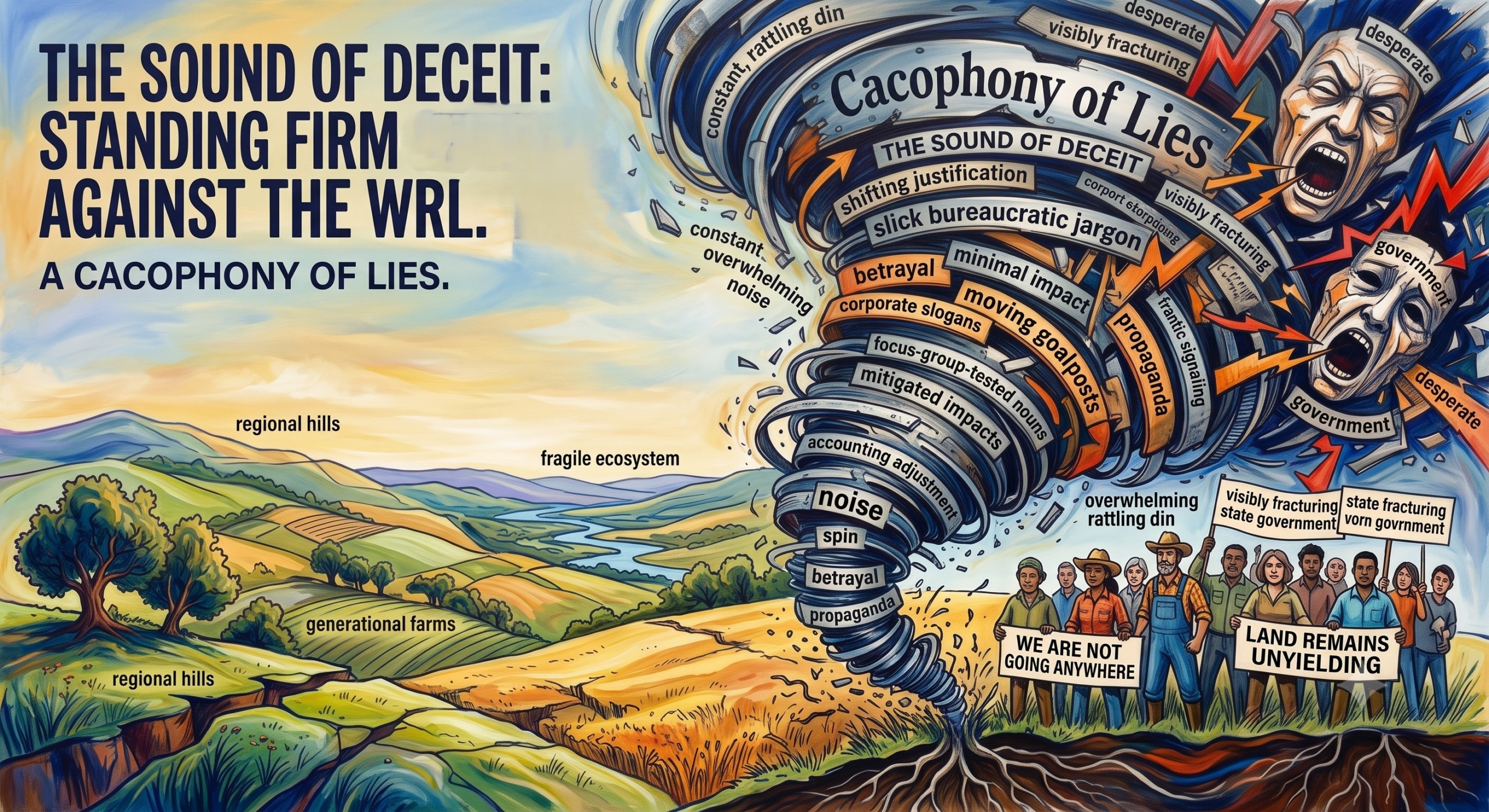
The wind across the regional hills used to carry the clean scent of the bush and the quiet promise of the seasons. Now, it carries a different kind of pressure. For six years, we have stood on the front lines of a battle we never asked for, defending our homes, our livelihoods, and the land we love against the looming disaster of the Western Renewables Link.
Meanwhile, in the distant halls of a visibly fracturing state government, the story changes by the hour. An unstable administration, desperate to justify a runaway project whose cost estimates have ballooned into the billions, has resorted to a predictable strategy: drowning out the truth with noise.
What we are witnessing is not leadership. It is a cacophony of lies.
They shout over the legitimate concerns of landholders, hoping the sheer volume of their spin will mask the desperation underneath.
Every press release is a discordant note; every shifting justification is a betrayal wrapped in slick bureaucratic jargon. They promise minimal impact while drawing lines on maps that carve straight through generational farms, high-value agricultural operations, and fragile ecosystems. They tell us it is about the future, even as they trample over the present.
But this overwhelming racket isn’t a sign of strength – it is the frantic signaling of a government losing its grip.
Behind the corporate slogans and the moving goalposts, the reality of the land remains quiet, solid, and unyielding. The people who actually live here, who understand the true value of this region, aren’t being deafened by the propaganda. We see the cracks in their narrative. We hear the panic in the din. And we aren’t going anywhere.
What we are witnessing is not leadership, nor is it planning. It is a “cacophony of lies”, dressed up in the bloodless attire of contemporary bureaucracy.
They emit a constant, rattling din of focus-group-tested nouns, hoping the sheer volume of their “community consultation frameworks” will blind us to the desperation underneath.
Every ministerial statement is a minor tragedy for the English language, a textbook exercise in saying nothing at immense length. They offer the smooth, frictionless promise of “mitigated impacts” while their maps casually dissect generational farms, high-value agricultural assets, and fragile regional ecosystems. They speak of the future with the pious certainty of true believers, entirely unbothered by the fact that they are trampling the living, breathing present to get there. It is a language designed not to inform, but to anesthetize; to make the destruction of a region sound like a routine accounting adjustment.
Yet this relentless institutional noise is not an expression of power. It is the frantic, metallic clatter of a machine whose gears have stripped.
Behind the moving goalposts, the “agile frameworks,” and the corporate slogans, the land remains precisely what it has always been: silent, real, and uncompromising. The people who actually live here—who know the difference between living topsoil and a PowerPoint slide—are completely immune to the propaganda. We see the cracks in the narrative. We hear the distinct note of panic inside the din. And we are not going anywhere.
TELL THE COALITION: STOP WRL NOW
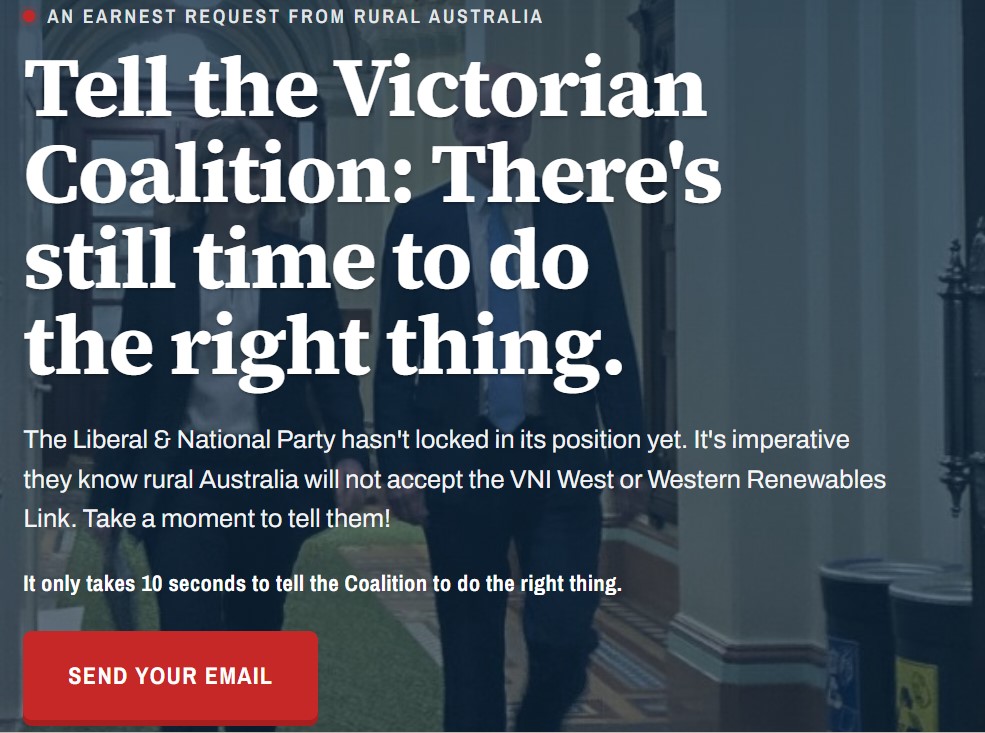
TELL THE COALITION: STOP WRL NOW
It only takes a few minutes to do something that could change the course of this fight.
If you want the Coalition to stop the Western Renewables Link, don’t just talk about it – tell them directly. Go to:
https://www.farmersfightback.com/askjess
Fill in the short form and demand a clear, public commitment to scrap WRL and protect regional communities, farmland and bushfire‑prone country.
One message might feel small, but thousands of messages from real people in affected areas are impossible to ignore. Take five minutes, add your voice, and make sure they know: no WRL, or no vote.