Stop Labors Towers Newsletter – June 6, 2026
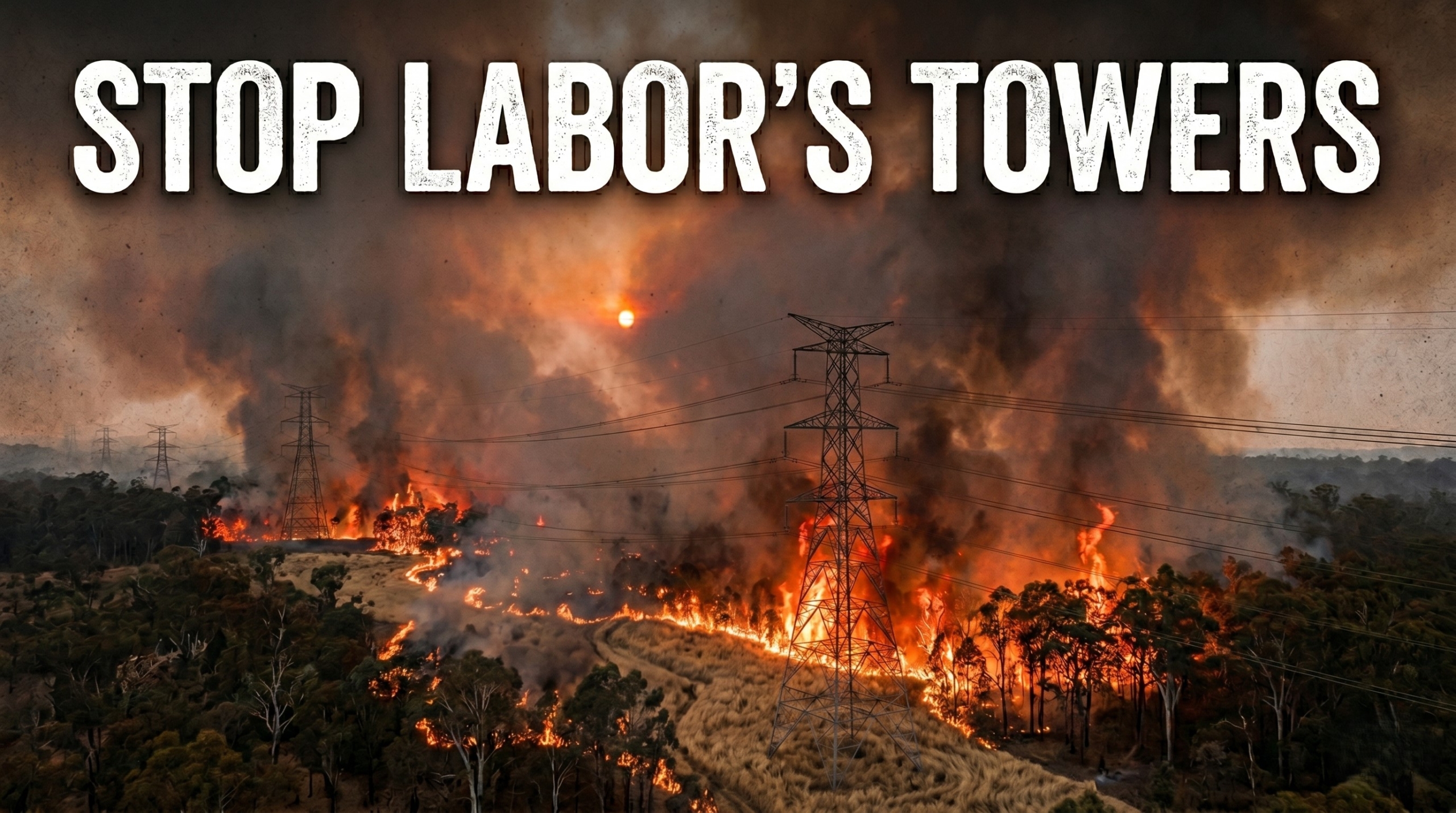
PLAYING WITH FIRE: THE RECKLESS DECEPTION BEHIND THE WESTERN RENEWABLES LINK
In corporate boardrooms and the halls of parliament, there is a dangerous breed of fiction disguised as public policy. Vic Grid, AusNet and the state government have wrapped themselves in a comforting blanket of corporate PR, repeating the soothing mantra that their high-voltage network has “never caused a bushfire in 96 years of Victorian history”. It is a masterpiece of deception. This “96-year myth” is being used as a shield to blind the public to a reckless reality: they are planning to ram the overhead Western Renewables Link directly through some of the most catastrophic, high-risk bushfire-prone terrain on Earth. The absence of a past disaster is not a testament to engineering excellence; it is merely a statistical fluke. It is evidence of luck, and luck is a pathetic excuse for a bushfire mitigation strategy.
What AusNet and the Minister are choosing to ignore or worse, actively covering up is that the laws of physics do not care about a marketing campaign. They are walking eyes wide open into a structural vulnerability that mirrors the infamous Pacific Gas and Electric Company (PG&E) disaster in California. Before the 2018 Camp Fire wiped the town of Paradise off the map and killed 84 people, PG&E boasted the exact same genre of reassuring safety narratives. Then, a single worn component on a century-old transmission line snapped, dropping a live conductor into dry fuel and triggering a catastrophe that ended in bankruptcy and 84 counts of involuntary manslaughter.
By pushing ahead with overhead lines across Victoria’s volatile landscapes, the state government and AusNet are showing a reckless disregard for human life and land. They possess the full, damning knowledge of Black Saturday, the 2026 transmission failures, and global climate data. Yet, they continue to rely on a slick slogan instead of hardening design or undergrounding the lines. If the Minister ignores the warning signs and signs off on this project, any future catastrophe will not be an “unfortunate” act of God. It will be a entirely foreseeable, politically sanctioned disaster.
WRL AND BUSHFIRE THREAT – A REALITY CHECK
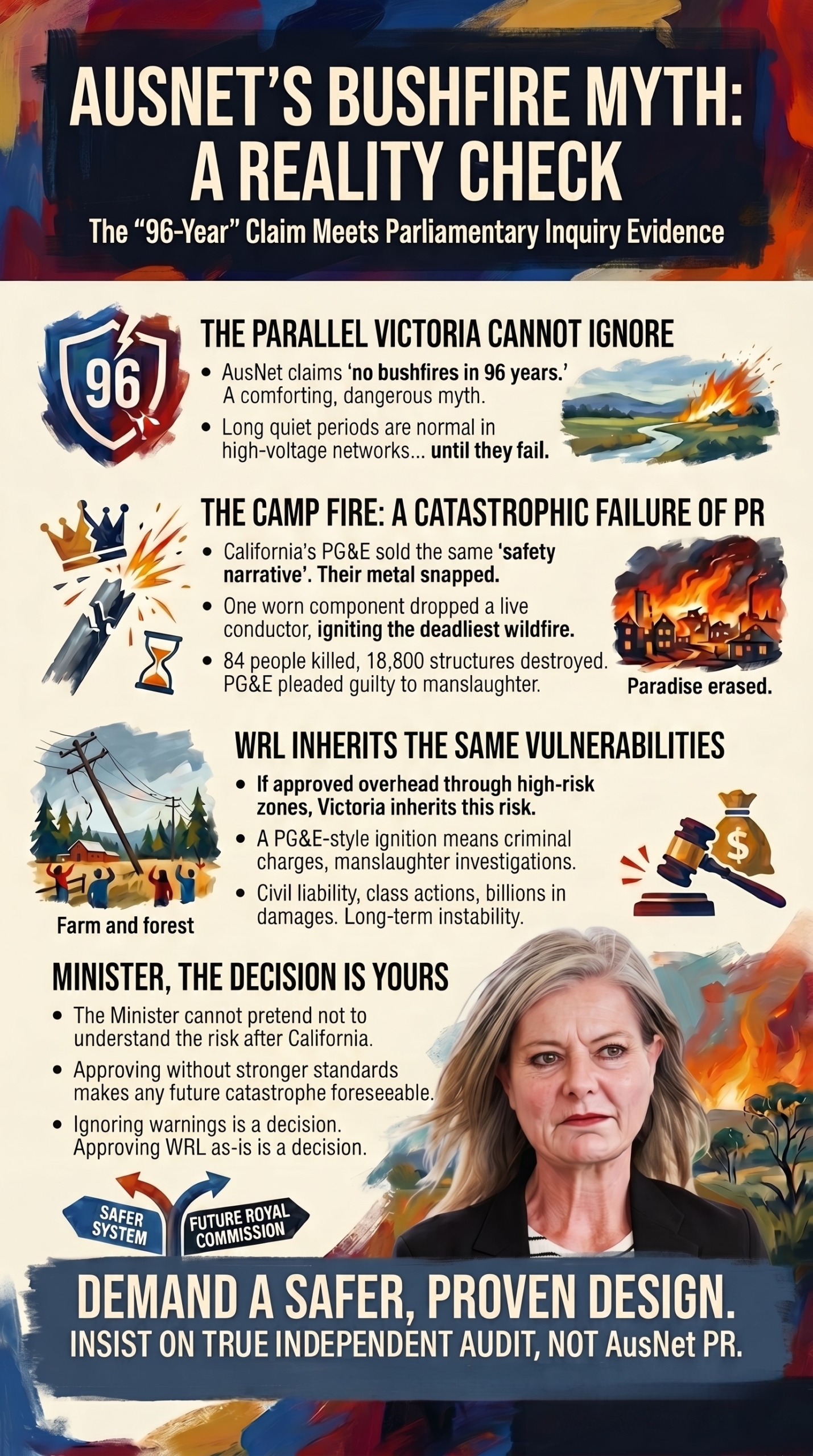
AusNet’s “96‑Year Myth” Meets Reality:
For months, AusNet has repeated a single, soothing line that its network has “never caused a bushfire in 96 years of Victorian history.”
It is a comforting claim – and a dangerous one.
Because as Victoria’s own parliamentary inquiry continues to examine what actually happened to transmission infrastructure during the January 2026 fire events, that line is starting to look less like a fact and more like a shield.
A shield that may not survive contact with the evidence.
And if the inquiry contradicts AusNet’s position or recommends tougher standards for transmission corridors through high‑risk zones, or even if it doesn’t the Minister cannot pretend not to have seen it and understood the risk.
-
Not after California.
-
Not after Pacific Gas and Electric Company (PG&E).
-
Not after the world’s most expensive, most deadly lesson in what happens when a transmission company believes its own PR.
PG&E Never Said “There Is No Risk” — But They Sold the Same Story as Ausnet
Before the Camp Fire, PG&E did not publicly declare that its transmission lines posed “no risk.”
They didn’t need to.
Their messaging was the same genre as AusNet’s:
-
We have robust inspection programs
-
We are leaders in vegetation management
-
We are taking extraordinary measures to keep communities safe
It was the language of reassurance — the corporate equivalent of a warm blanket.
And it worked… until a worn steel C‑hook on a tower snapped, dropped a live conductor, and ignited the deadliest wildfire in California history.
PG&E’s “safety narrative” evaporated in seconds.
The metal didn’t care about the marketing.
The Camp Fire: A Case Study in What Happens When Assumptions Fail
On 8 November 2018, the Caribou–Palermo 115 kV transmission line failed.
A single worn component — a C‑hook that should have been replaced years earlier — fractured.
The conductor fell, arced, and threw sparks into bone‑dry vegetation.
What followed was catastrophic:
-
153,000 acres burned
-
18,800 structures destroyed
-
84 people killed
-
The town of Paradise erased
Cal Fire determined the cause: PG&E transmission equipment. Regulators found years of missed inspections and unaddressed wear.
PG&E ultimately pleaded guilty to 84 counts of involuntary manslaughter.
The company entered bankruptcy with liabilities exceeding USD $30 billion.
For nearly a century, that line had not produced a disaster of that scale.
Then one morning, it did.
The Parallel Victoria Cannot Ignore
AusNet’s “96 years” line is meant to imply safety.
But long quiet periods are normal in high‑voltage networks — right up until the day they aren’t.
The Camp Fire tower was almost 100 years old.
It had never caused a catastrophe. Until it did.
The absence of a past disaster is not evidence of safety.
It is evidence of luck.
And luck is not a bushfire mitigation strategy.
What Happens If the WRL Fails the Way PG&E’s Line Failed?
If the Western Renewables Link is approved in its current form overhead, through high‑risk corridors, across farms, forests and fire‑prone landscapes then Victoria inherits the same structural vulnerabilities that destroyed Paradise.
If a PG&E‑style ignition occurs here, AusNet would face:
1. Criminal and Regulatory Consequences
-
Investigations into reckless conduct
-
Potential manslaughter charges if lives are lost
-
A Victorian equivalent of the PG&E prosecution
-
Forced redesign of transmission standards after the fact
2. Civil Liability
-
Class actions from landholders, insurers, and victims
-
Billions in damages
-
Long‑term financial instability for the operator
3. Political Accountability
-
The Minister’s approval decision would be scrutinised for decades.
-
If the parliamentary inquiry recommends stronger standards — and the Minister ignores them — any future catastrophe becomes foreseeable, not “unfortunate.”
-
California regulators were accused of complacency.
-
Victoria has no excuse.
-
We have the coronial reports, the royal commissions, the Californian case study, and now our own inquiry.
4. Community Consequences
-
Loss of lives, homes, farms, stock, livelihoods
-
Entire towns at risk
-
Insurance withdrawal from high‑risk corridors
-
Generational trauma
The WRL is not just a planning dispute.
It is a risk‑engineering decision with life‑and‑death consequences.
The Real Question for Victoria
PG&E walked into the Camp Fire with outdated assumptions and a complacent view of its own maintenance.
AusNet is walking into the WRL with full knowledge of:
-
Black Saturday
-
The 2026 transmission failures
-
The global evidence on climate‑driven fire behaviour
-
The PG&E disaster
-
The parliamentary inquiry’s findings (soon to be public)
If AusNet still leans on a “96‑year” slogan instead of hardening its design, rerouting high‑risk sections, or undergrounding where necessary,
That is not ignorance.
That is a decision.
And if the Minister approves the WRL without demanding higher standards, that is also a decision.
The Stakes Could Not Be Clearer
PG&E’s towers had “never caused a fire like this” — until the morning one did.
Paradise never imagined it would be wiped off the map — until it was.
California never thought its largest Power Utility would plead guilty to 84 counts of manslaughter — until it did.
Victoria is now standing at the same fork in the road.
One path leads to a safer, modernised, climate‑resilient transmission system.
The other leads to a future royal commission asking the same question Californians asked:
“Why did you ignore the warnings, and who do we hold accountable?”
VICTORIA’S BUSHFIRE REALITY: THE BENCHMARK NO ONE WANTS TO MEET
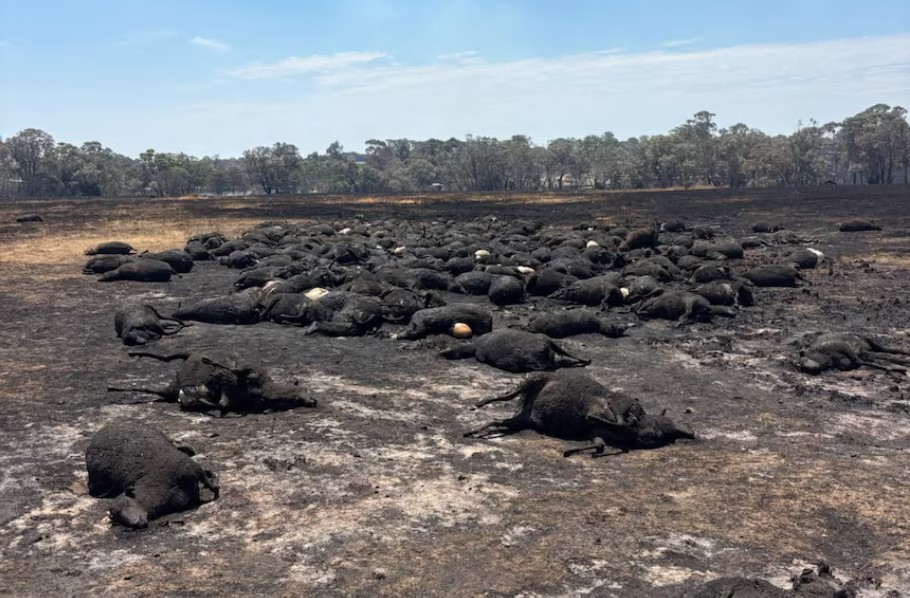
There is a reason veteran fire scientists from around the world pay close attention to Victoria.
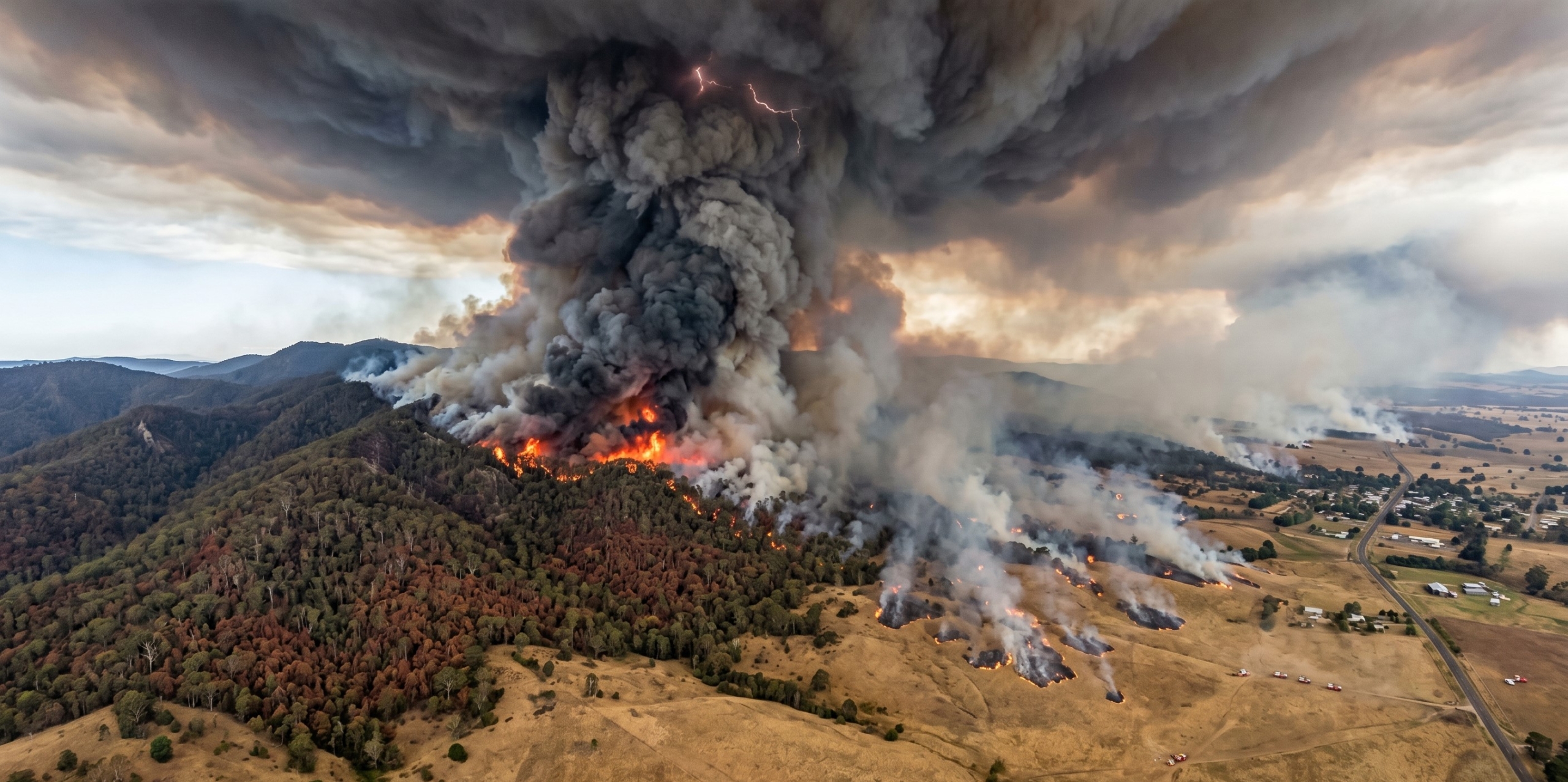
When catastrophic bushfire conditions emerge here, they do not simply produce larger fires. They can produce a form of fire behaviour that many experts regard as among the most dangerous on Earth.
That assessment is not based on folklore or national mythology. It is rooted in decades of scientific observation, historical records and repeated encounters with disasters that have reshaped entire communities.
California is often held up as the global benchmark for wildfire catastrophe. The comparison is understandable. The state has suffered some of the most destructive and expensive fires in modern history. Entire towns have been destroyed. Thousands of homes have been lost. Billions of dollars have been spent rebuilding what flames erased in a matter of hours.
Yet conversations with fire experts frequently return to an uncomfortable reality: on the worst days, Victoria can present conditions that are every bit as dangerous, and in some respects more extreme.
The explanation begins with the landscape itself.
Australia’s eucalypt forests contain highly volatile oils. Under conditions of prolonged drought, extreme heat and low humidity, those forests become vast stores of combustible energy. Add temperatures above 40 degrees Celsius, powerful northerly winds and decades of accumulated fuel, and the ingredients are in place for a fire environment unlike almost any other.
The consequences are not theoretical.
During Black Saturday in 2009, fires moved with extraordinary speed and intensity. Entire communities found themselves trapped by conditions that outpaced both expectations and response capabilities. More than 170 people lost their lives. It remains one of the deadliest bushfire disasters in modern history.
Researchers studying such events have documented fire behaviour capable of generating its own weather systems. Massive convection columns rise kilometres into the atmosphere. Embers are carried extraordinary distances ahead of the fire front. Wind conditions shift without warning. Traditional assumptions about containment become unreliable.
For communities in Western Victoria, these findings carry particular significance.
The region sits at the intersection of some of the factors most closely associated with catastrophic fire behaviour: extensive grasslands, heavily vegetated ranges, prolonged drought conditions, and weather systems capable of producing powerful wind changes. Many areas are served by limited road networks and rely heavily on volunteer firefighting resources.
Against this backdrop, questions about new infrastructure in high-risk landscapes are no longer merely planning questions. They become questions about risk management, emergency response and public safety.
What level of additional hazard is acceptable in an environment already recognised as one of the most fire-prone in the world?
What assumptions underpin those decisions?
And what evidence supports them?
These are not abstract policy debates. They are questions that determine how communities prepare for the next extreme fire season, and how governments justify decisions that may affect generations of residents.
The broader point is difficult to ignore.
Victoria occupies a relatively small corner of the globe. Yet when fire professionals discuss the most severe bushfire environments on Earth, this state is repeatedly cited not as an outlier, but as a reference point.
The world studies California to understand wildfire disasters.
Many fire experts study Victoria to understand their limits.