Stop Labors Towers Newsletter – June 20, 2026
THE ROT STARTS AT THE TOP: BROOKFIELD’S AGGRESSIVE BLUEPRINT FOR VICTORIA
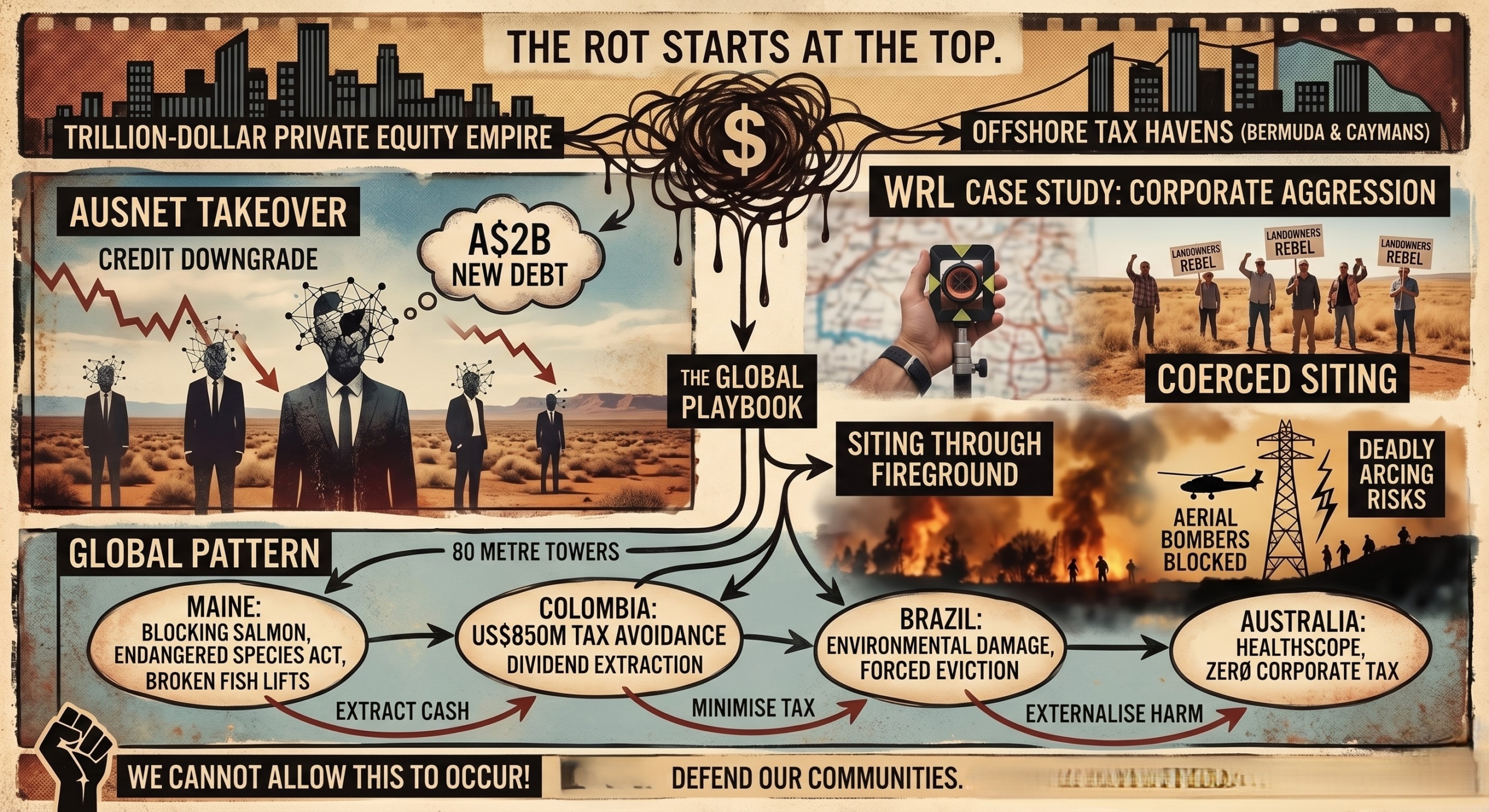
The culture driving the Western Renewables Link did not start in a Ballarat boardroom or a Moorabool field. It was engineered in offshore tax havens, refined in global takeover deals, and then exported into our paddocks and town halls as standard operating procedure. Brookfield Asset Management – the trillion‑dollar private equity empire that now controls AusNet – has built a business model on three pillars: aggressive tax avoidance, financial engineering of public utilities, and ruthless disregard for communities that get in the way of its asset pipeline.
When you understand that, the conduct we see on the WRL stops looking like a series of local “missteps” and starts reading as what it really is: the Victorian chapter of a global playbook.
From Bermuda to Bulgana: How Offshore Power Shows Up in Our Paddocks
Brookfield sells itself to the world as a responsible steward of “essential infrastructure” and a climate leader, fronted by figures like Mark Carney and dressed up in glossy ESG brochures. But the hard architecture behind that marketing tells a different story. Brookfield’s flagship transition funds – including the Brookfield Global Transition Fund and the Catalytic Transition Fund – are structured through Bermuda and the Cayman Islands, using entities registered at addresses Barack Obama once described as “the largest tax scam in the world.
This is not a side note; it’s the spine of the model. The same offshore machinery that strips tax revenue from Canada, Colombia and Australia also governs AusNet’s behaviour in western Victoria:
- AusNet was bought by a Brookfield-led consortium using a highly leveraged takeover that immediately loaded an extra A$2 billion of debt onto the network and triggered a credit downgrade.
- Through tax consolidation and asset revaluation, the group wiped out more than A$600 million in deferred tax liabilities and booked a A$939.7 million non-cash tax benefit – effectively shielding itself from paying corporate income tax in Australia for years while regulated revenue and EBITDA surged.
Every extra tower on the WRL is not just steel in a paddock; it is new capital added to AusNet’s regulated asset base, guaranteed to generate inflation‑indexed revenue for offshore investors for decades. That is why the company fights so hard for an overhead line through prime farmland and bushfire country: every metre of easement is a booked annuity.
The WRL as a Case Study in Corporate Aggression
Once you see the financial incentives, the WRL’s on‑the‑ground behaviour stops being a mystery.
Consultation as theatre
Local councils, CFA volunteers and landholders report the same pattern: short-notice “consultation” sessions, major route announcements dropped with less than 24 hours’ warning, and genuine concerns about fire, farming and property values brushed aside.
When farmers refused voluntary access for surveys, AusNet did not change its approach; it reached for coercive legislative powers to force entry and build an EES from desktop modelling rather than on‑ground science.
This is not clumsiness. It is contempt.
Siting through the fireground
Despite the Black Saturday Royal Commission’s warnings about power infrastructure in high-risk zones, Brookfield’s AusNet is pushing a 190‑kilometre, 500 kV double‑circuit line through some of the most bushfire-prone valleys in the state. CFA brigades and councils have laid out the facts:
- aerial bombers cannot safely operate around 80‑metre towers and high‑voltage lines
- thick bushfire smoke can cause deadly arcing and line trips
- wide “no‑go zones” for ground crews are required under fire.
In other words: the WRL would carve a permanent obstruction right through future firegrounds, making it harder to fight the next Harcourt or Lexton‑type blaze, not easier.
Refusing the safer alternative
Independent work for councils has shown that underground HVDC along road reserves is technically feasible, removes ignition risk, preserves farming operations and avoids the aerial and ground firefighting constraints that overhead lines create.
Yet Brookfield’s AusNet turned up to the IAC hearings with inflated costings and selective modelling, treating undergrounding as a threat to be neutralised, not an option to be tested in good faith.
That is what happens when your profit depends on maximising steel in the air, not safety in the landscape.
A Global Pattern, Not a Local Aberration
The behaviour we are seeing in western Victoria is not a one‑off. The record in your research file shows the same fingerprints across Brookfield projects on three continents:
- In Maine, Brookfield Renewable was accused by conservation groups and federal agencies of greenwashing while its dams blocked endangered Atlantic salmon and breached the spirit of the Endangered Species Act, even as PR material showed off “fish lifts” that did not work.
- In Brazil, subsidiaries linked to Brookfield were investigated for environmental damage, severe flooding impacts and operating plants without valid environmental licences, alongside allegations of attempted forced eviction of Indigenous communities and breaches of anti‑slave labour laws.
- In Colombia, Brookfield’s takeover of Isagen saw local infrastructure spending pared back while nearly US$1 billion in dividends was pumped out and an estimated US$850 million in tax was avoided via high‑interest loans from Bermuda entities.
- In Australia, Brookfield-controlled Healthscope and Aveo were structured through Cayman and Bermuda, generating billions in revenue while paying little or no corporate tax, thanks to related‑party debt and offshore holding chains.
Different countries, different regulators, same pattern: extract cash, minimise tax, externalise harm.
Why They Think They Can Get Away With It
Brookfield behaves this way in Victoria because the system lets it. The Australian Energy Regulator is explicitly barred from examining tax strategies, global governance structures or local social damage; it is confined to judging whether a proposal looks efficient on an Excel sheet of market benefits. AEMO and VicGrid control planning but disown responsibility for landholder treatment and consultation. AusNet claims it is “just following orders.”
Meanwhile, the real decision‑makers sit behind layers of Australian holding companies and offshore partnerships in Bermuda and the Cayman Islands, legally insulated from the fires, the fractured families and the devalued farms beneath their lines. That is not an accident. It is governance by design.
Drawing the Line in Western Victoria
When people describe AusNet’s behaviour on the WRL as arrogant, bullying or dismissive, they are reaching for words to describe a much larger reality: the collision between a predatory global capital model and a set of regional communities that refuse to be treated as collateral damage.
Brookfield’s model only works if projects like the WRL can be rammed through – overhead, on the cheap, across high‑value farmland and fire-prone country – while the real costs are dumped on ratepayers, landholders and local emergency services for the next fifty years.
We will not accept that.
What western Victoria decides now will echo far beyond this corridor. If Brookfield is allowed to use the “Bermuda Blueprint” here – offshore structures, aggressive tax minimisation, coercive land access and the deliberate sidelining of safer alternatives – it will become the template for every major transmission project that follows.
That is why this fight is not just about towers. It is about who governs our landscape: local communities and their elected representatives, or distant fund managers optimising spreadsheets in zero‑tax jurisdictions.
The choice could not be clearer – or more urgent.
BENDIGO’S BOILOVER: COUNTRY FIRIES REBEL AGAINST LABOR’S TAX AND TOWERS
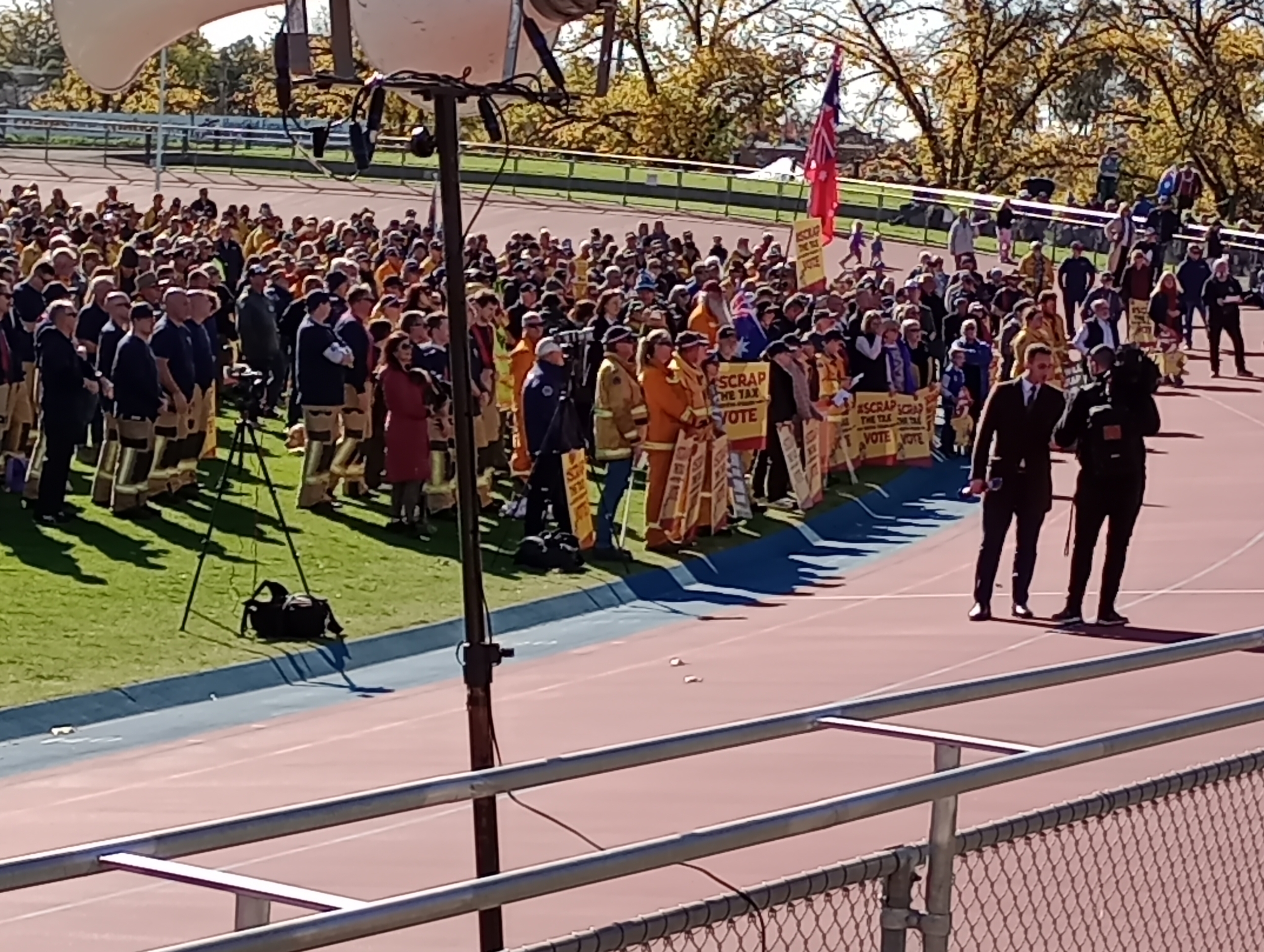
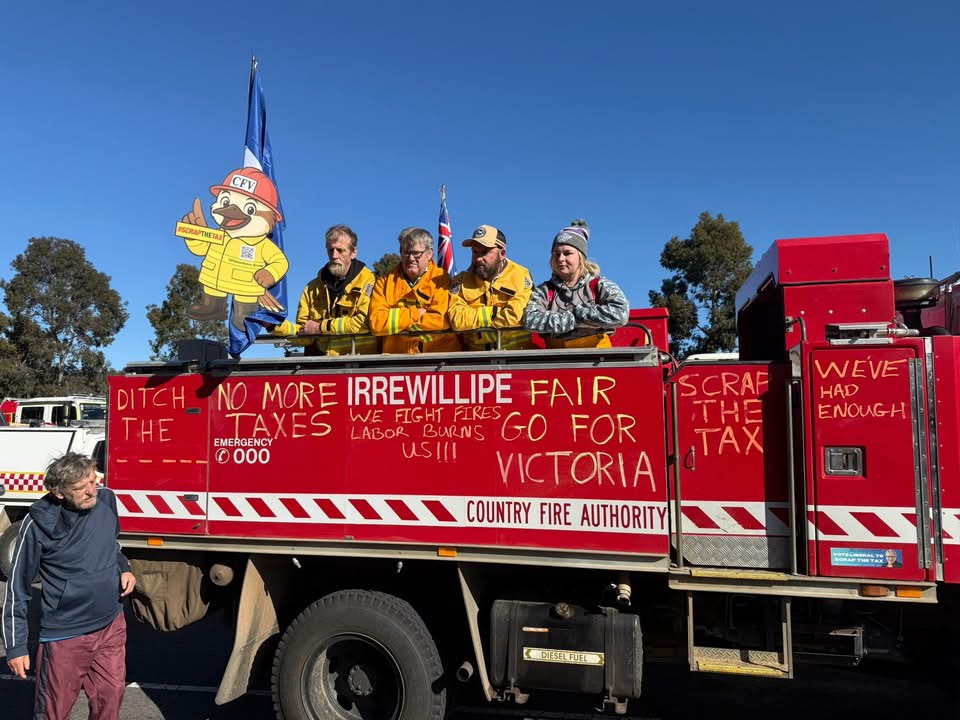
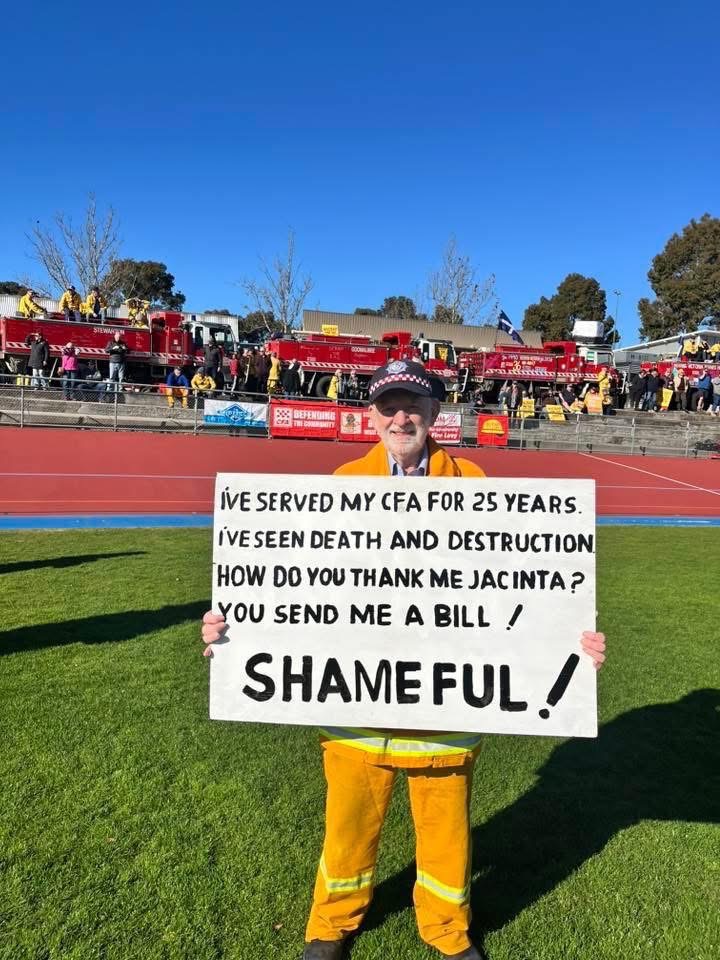
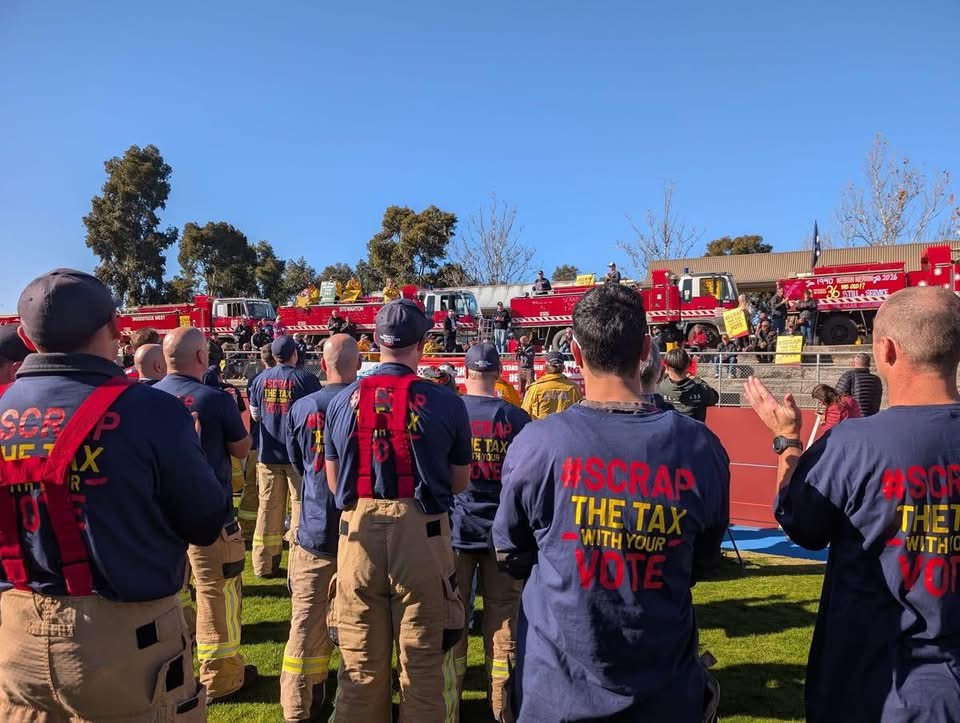
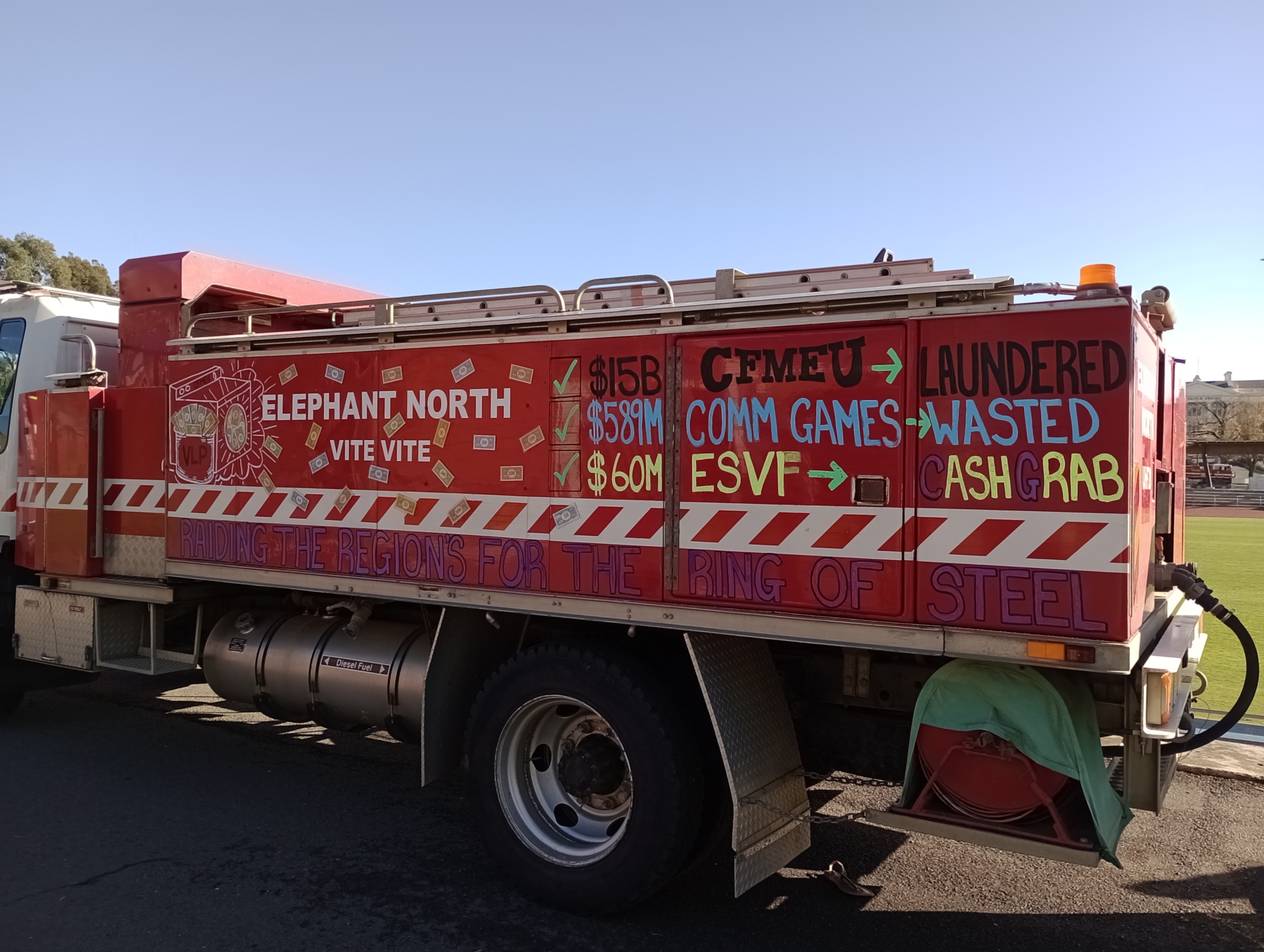
Hundreds of yellow jackets didn’t just roll into Bendigo to “axe the tax.” They came to deliver a much bigger message to a Premier who wouldn’t even face them in her own hometown: regional Victoria has had enough of being treated as a cash machine for a government that refuses to fix the real crisis in front of us – a broken energy and emergency infrastructure system that puts communities, farms and volunteers at risk.
Yes, the new Emergency Services and Volunteers Fund is an insult – a near 44 per cent revenue grab slapped onto households, farmers and even CFA volunteers themselves, while trucks commissioned when the Soviet Union still existed are still rolling out to fires. But behind the anger at this levy is a deeper reckoning: this is the same government that can find endless billions for mega‑projects like the Western Renewables Link, while ignoring the people who will be left standing under those towers when the next catastrophic fire hits.
CFA volunteers and country communities know exactly what is going on. They’re being asked to pay more tax into a system that still starves brigades of proper gear, still delays new stations, and still waves through high‑risk transmission projects like the WRL over their objections. The Allan government talks “safety” and “transition” in Melbourne, then turns its back when the very people who fight the fires, and live under the lines, demand to be heard.
Scrapping this tax is the bare minimum. The real fight is bigger: forcing this government to stop using regional Victorians as ATMs and sacrifice zones for bad energy planning. Until Labor fronts up to CFA volunteers, farmers and fire‑prone communities – and starts fixing dangerous, top‑down projects like the WRL – no amount of rebranding levies will repair the trust it has burned.
RELEASE THE FACTS: PUBLISH THE EES REPORT
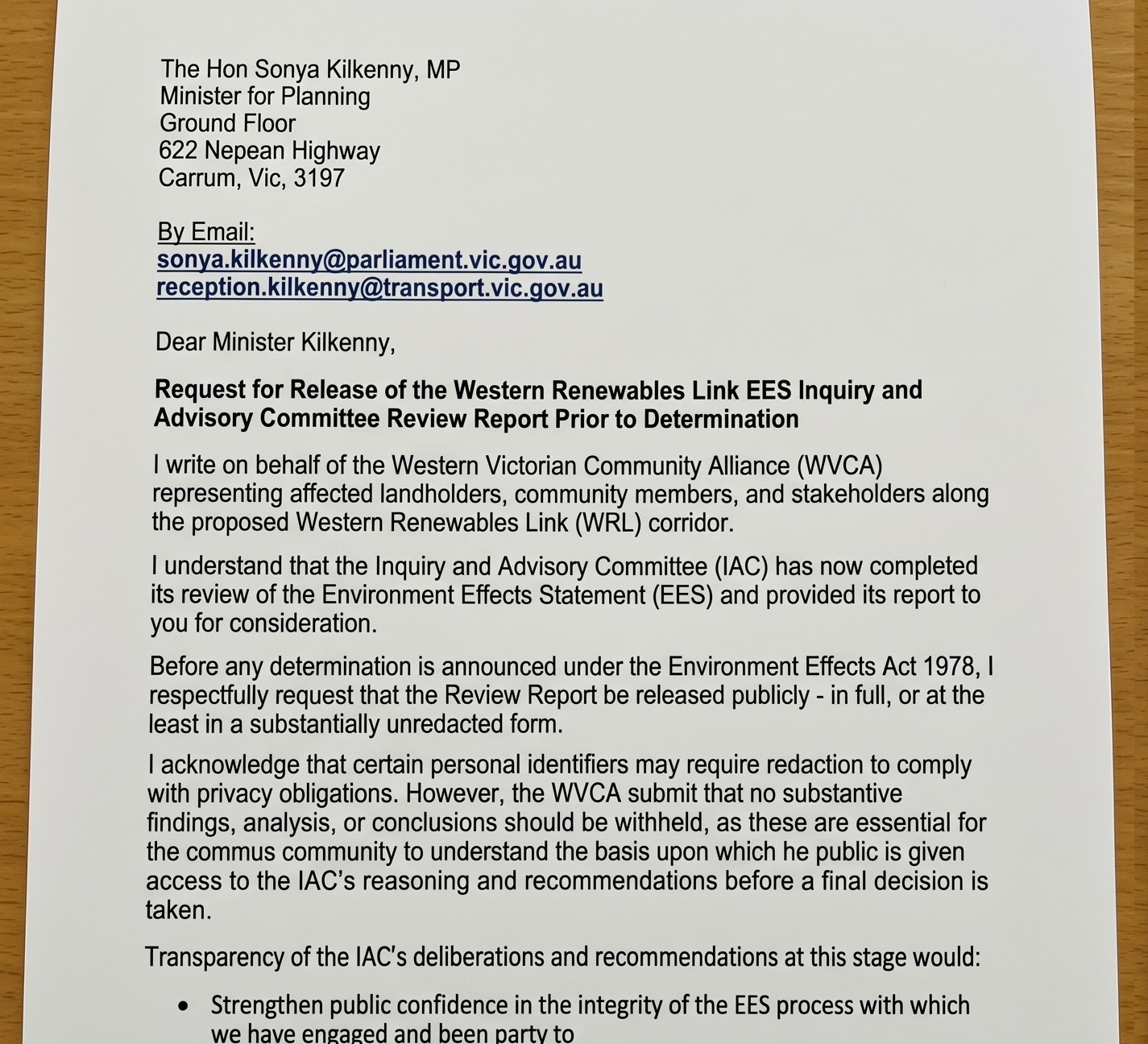
A government that believes in its own story welcomes scrutiny. A government that fears the truth buries it in process, delay and silence.
Communities along the WRL corridor have done everything that has been asked of them. We have sat through hearings, prepared submissions, opened our homes and farms to scrutiny, and engaged in good faith with a process we were told was independent and evidence‑based. The Inquiry and Advisory Committee has done its work. Its report now sits on the Minister’s desk.
And there it stays.
Despite the profound, long‑term consequences of this project for safety, land use and bushfire risk, the government has chosen secrecy over sunlight. Weeks have passed since the report was delivered. The Western Victorian Community Alliance has written formally, respectfully, and repeatedly. There has been no response. No explanation. No indication that the people who live under the shadow of this project will be allowed to see the evidence before the decision is made about their future.
This is not an administrative oversight. It is a political choice.
When a Minister refuses to release an independent report before making a determination, she asks the public to accept a verdict without ever seeing the brief. When a government hides behind legal technicalities and FOI delays, it sends a clear message to regional Victorians: “you are good enough to carry the risks, but not trusted with the facts.”
That is why this letter matters. It is more than a polite procedural request – it is a line in the sand. It says that decisions of this magnitude cannot be stitched up behind closed doors and handed down as a fait accompli to the people whose lives and landscapes will carry the consequences. It demands that the Allan Government step out from behind the cloak of secrecy and allow the IAC’s findings to be tested in the open, before the ink is dry on any WRL approval.
If this government is confident in the integrity of its process, it should prove it – by releasing the report now, not after the damage is done.
LETTER TO MINISTER
The Hon Sonya Kilkenny, MP
Minister for Planning
Ground Floor, 622 Nepean Highway
Carrum, Vic, 3197
By Email:
sonya.kilkenny@parliament.vic.gov.au
reception.kilkenny@transport.vic.gov.au
Dear Minister Kilkenny,
Request for Release of the Western Renewables Link EES Inquiry and Advisory Committee Review Report Prior to Determination
I write on behalf of the Western Victorian Community Alliance (WVCA) representing affected landholders, community members, and stakeholders along the proposed Western Renewables Link (WRL) corridor.
I understand that the Inquiry and Advisory Committee (IAC) has now completed its review of the Environment Effects Statement (EES) and provided its report to you for consideration.
Before any determination is announced under the Environment Effects Act 1978, I respectfully request that the Review Report be released publicly – in full, or at the least in a substantially unredacted form.
I acknowledge that certain personal identifiers may require redaction to comply with privacy obligations. However, the WVCA submit that no substantive findings, analysis, or conclusions should be withheld, as these are essential for the community to understand the basis upon which a decision will be made.
The WRL is a project of significant scale and consequence to the WVCA members and the many communities along its length, with long‑term implications for safety, land use, environmental values, and regional amenity. In good faith and in the spirit of procedural fairness is therefore critical that the public is given access to the IAC’s reasoning and recommendations before a final decision is taken.
Transparency of the IAC’s deliberations and recommendations at this stage would:
- Strengthen public confidence in the integrity of the EES process with which we have engaged and been party to
- Ensure that affected communities are not excluded from the final and most consequential stage of assessment
- Allow stakeholders to respond meaningfully to the IAC’s findings
- Reduce the risk of perceptions that the decision‑making process lacks openness or procedural fairness.
I note that Freedom of Information pathways are unlikely to provide timely access to the IAC’s report, given statutory processing periods and common delays. For this reason, the WVCA believes that a direct release by your office is both appropriate and necessary to ensure that the community is not denied critical information until after a determination has been made.
Given the high level of public interest and the substantial impact of this project throughout regional Victoria, I respectfully request that you release the Review Report as soon as practicable, and in any event prior to issuing your decision under the Act.
I would welcome the opportunity to discuss this request further and am available at short notice should your office require clarification.
Thank you for your consideration.
Yours sincerely,
Western Victorian Community Alliance
Email: info@stoplaborstowers.org