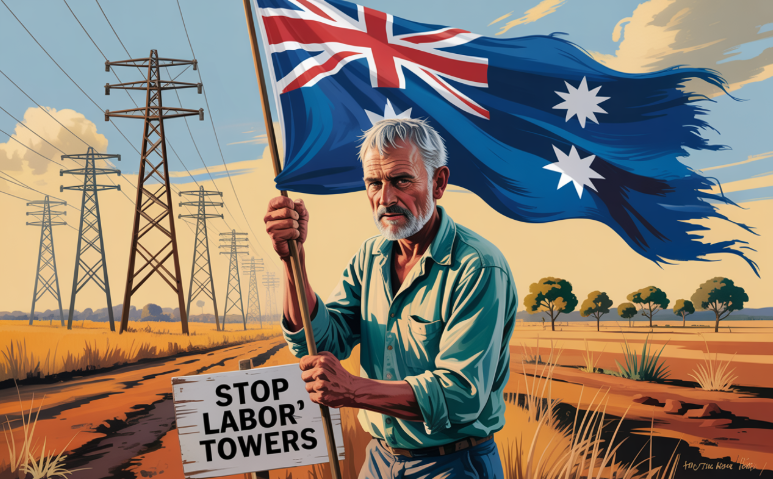
STOP LABORS TOWERS NEWSLETTER – June 28 2025
The Violence of Silence
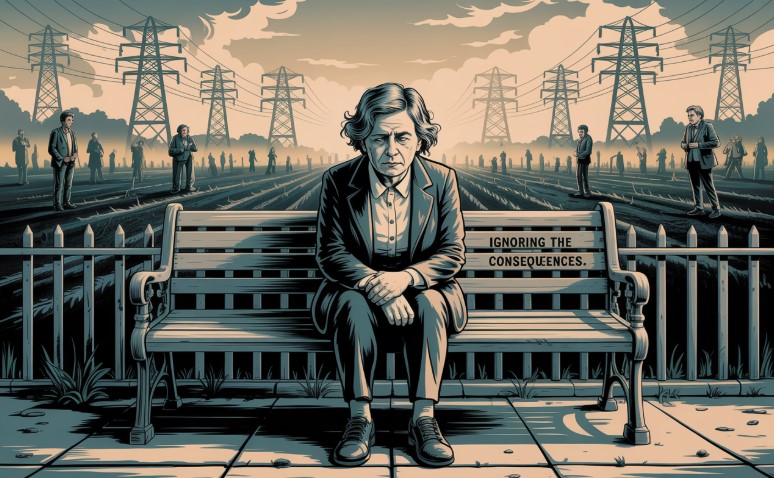
Sometimes the greatest violence is not what a government does – but what it refuses to hear.
Across the wide paddocks and ridgelines of Western Victoria, people are speaking. They are speaking in town halls and at kitchen tables, in submissions typed late into the night and banners strung across farm fences. They are saying: this project is not just. This process is not honest. And this future you are imposing does not include us.
And yet the Victorian Government, entrusted to listen, has folded itself into a smaller and smaller circle of approval, around corporations, construction schedules, and political expediency. The Western Renewables Link (WRL) is not a clean energy project. It is a story of consent denied, warnings ignored, and voices erased.
Minister D’Ambrosio speaks of partnership, but she acts alone. She offers words of climate urgency while signing off on legislation that would allow private contractors to arrive with police in tow, as if land stewardship were criminal and profit were law. She smiles in public, and in private pushes forward a project so riddled with contradictions it would be laughable if it weren’t being carved through communities, high-productivity farmland, rich environmental landscapes, and sacred cultural places.
When Traditional Owners raised concerns that survey works were proceeding without proper cultural clearances, the response was silence. When Country Fire Authority volunteers explained that transmission towers would increase ignition risks in some of the State’s most fire-prone terrain, their warnings were quietly filed away. And when 10,000’s of community members and landholders voiced their objections, not a single route adjustment was made in response.
AusNet, the project’s beneficiary, is not a partner to the land, it is a private monopoly owned by Brookfield, a foreign equity firm with a recent track record of collapse. Their business model is not to build trust but to extract value. The government’s model is now not much different.
And in this union of bureaucracy and capital, people are not obstacles. They are collateral.
We are told this is the only way. We are told the transmission must be built, and that this is the place. But alternatives have been proposed – carefully, credibly, and with community support. They have been ignored. Not disputed, not debated – just erased. And erasure, too, is a kind of violence.
This is the quiet cruelty of a government that calls itself progressive while practising something else entirely: coercion behind soft words, force behind process.
But people are watching. People are organising. What the State Government calls consultation, we call betrayal. What they call committed, we call contested. What they build without us, we will resist.
There is still time to listen. Still time to step back from this edge. But if the government continues to speak only to power and money, they will find themselves alone – with only their silence and our resistance echoing across the plains they tried to claim.
Forced Land Access – We Will Not Stand Down
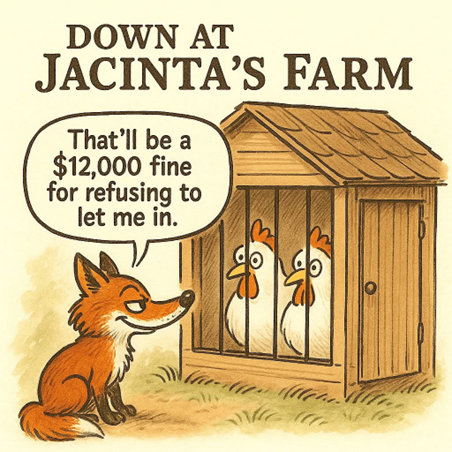
The Victorian Government’s proposed VicGrid Stage 2 Reform Bill is not just bad policy, it is a threat to everything regional communities hold sacred: land, rights, democracy, and trust.
Let’s call it what it is: an attempt to authorise corporate land grabs, backed by the authority of the police. If passed, this legislation would give VicGrid the legal power to access private farmland with police escort and “reasonable force.” This is not consultation. This is coercion -sanctioned at the highest level.
But we are not passive. And we are not afraid.
We will not accept a future where farmers are treated like criminals for protecting their land. Where rural police are used not to prevent crime, but to escort contractors for a foreign-owned transmission project. Where the values of community consent, transparency, and property rights are bulldozed in the name of so-called “progress.”
If this bill passes, we will not comply. We will not grant access. We will not legitimise a system that arms corporations with police powers. We will resist – with unity, with resolve, and with every lawful means at our disposal.
Because make no mistake – the WRL brings destruction:
• To food-producing farmland
• To fire-prone landscapes
• To sacred cultural sites
• To homes that will drop in value by hundreds of thousands of dollars
• To the very trust that binds country Victoria to its institutions
We demand better.
We demand a respectful, transparent, community-first energy transition not a militarised rollout of flawed infrastructure.
We demand our police remain neutral—servants of the public, not enforcers for private industry.
And we demand that Victorian MPs, especially those who claim to represent regional communities, have the courage to vote this legislation down.
This is not fringe protest. This is a movement. From Darley to Creswick, from the Mallee to the Otways, people are standing up not just against towers, but against the abuse of power.
If the government forces this bill through,they will inherit something far more serious than political fallout -they will face a rural uprising grounded in conviction, unity, and a promise: we will not be moved.
Five Years In, and We’re Just Getting Started
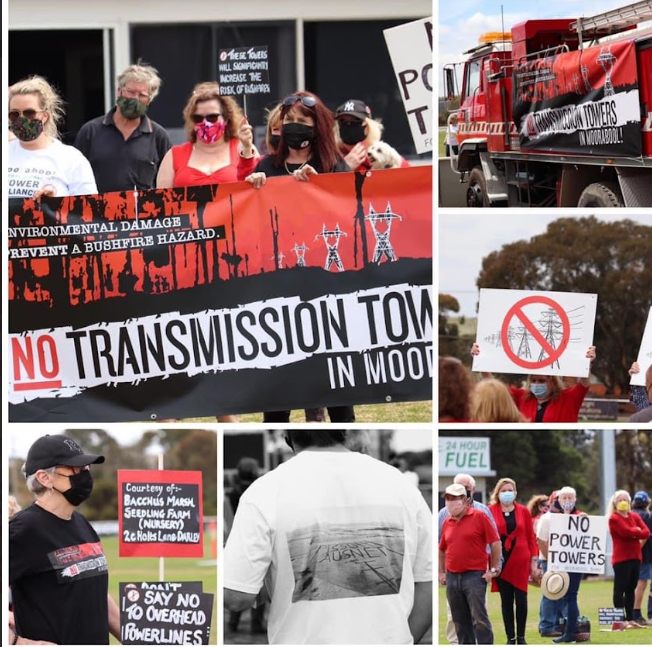
In October 1415, a bedraggled English army, outnumbered five to one, stood in a muddy French field and prepared to be wiped off the map. What happened next was the stuff of legend: against all odds, the little guys won. Not with more money. Not with more power. But with grit, clarity, and an unshakable belief that they were right. That’s us, five years into the fight against the Western Renewables Link.
When we started this campaign, they told us the towers were inevitable. They laughed off our concerns, waved around technical jargon, and assured us the process was “consultative.” The media ignored us. Politicians patronised us. AusNet gave us glossy maps and zero answers. And they just kept showing up at gates uninvited, like they owned the place.
But here’s the thing: five years on, we’re still here. Stronger. Smarter. Sharper. What started as a scattered resistance is now an organised, informed, and deeply pissed-off movement. We’ve exposed the dodgy costings. We’ve demolished the fantasy that WRL is “green” or “least regret.” We’ve written submissions, challenged ministers, built alliances, and made it clear: this isn’t over.
Like the French nobility at Agincourt, the Victorian Government assumed our communities would kneel. Instead, we’ve planted our boots in the soil and said no. And while they’ve thrown tens of millions at consultants and PR firms, we’ve built something more powerful, solidarity. Every new landholder who joins the fight, every environmental group, every farmer, every firefighter who speaks out, every local council who says “not here” that’s another arrow in our quiver.
We are not the same people we were in 2020. We are tougher. We are clearer. And we’ve learned how power works, where it hides, how it talks down to us, and how scared it becomes when ordinary people don’t back down. They may have written the first draft of the plan. But we’re rewriting the ending.
Stop Labor’s Towers. Hold the Line. Five years in – and we’re just getting started.
Power of the Voice –
Draft Victorian Transmission Plan Submissions
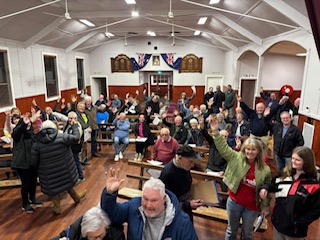
More than 300 submissions – just from communities along the WRL corridor – flooded into the Victorian Transmission Plan consultation. This wasn’t a fringe reaction. It was a coordinated, deeply informed response from landholders, farmers, families, and local leaders who refuse to be sidelined by a process designed to ignore them.
To everyone who stood up, spoke out,and submitted: thank you. Your voices matter. You are building political pressure. You are reshaping the narrative. And no matter how hard the system tries to dismiss or downplay our resistance, it is growing and it will bring about change.
A Project Built on Sand:
Why the
WRL – EES Must Be Stopped
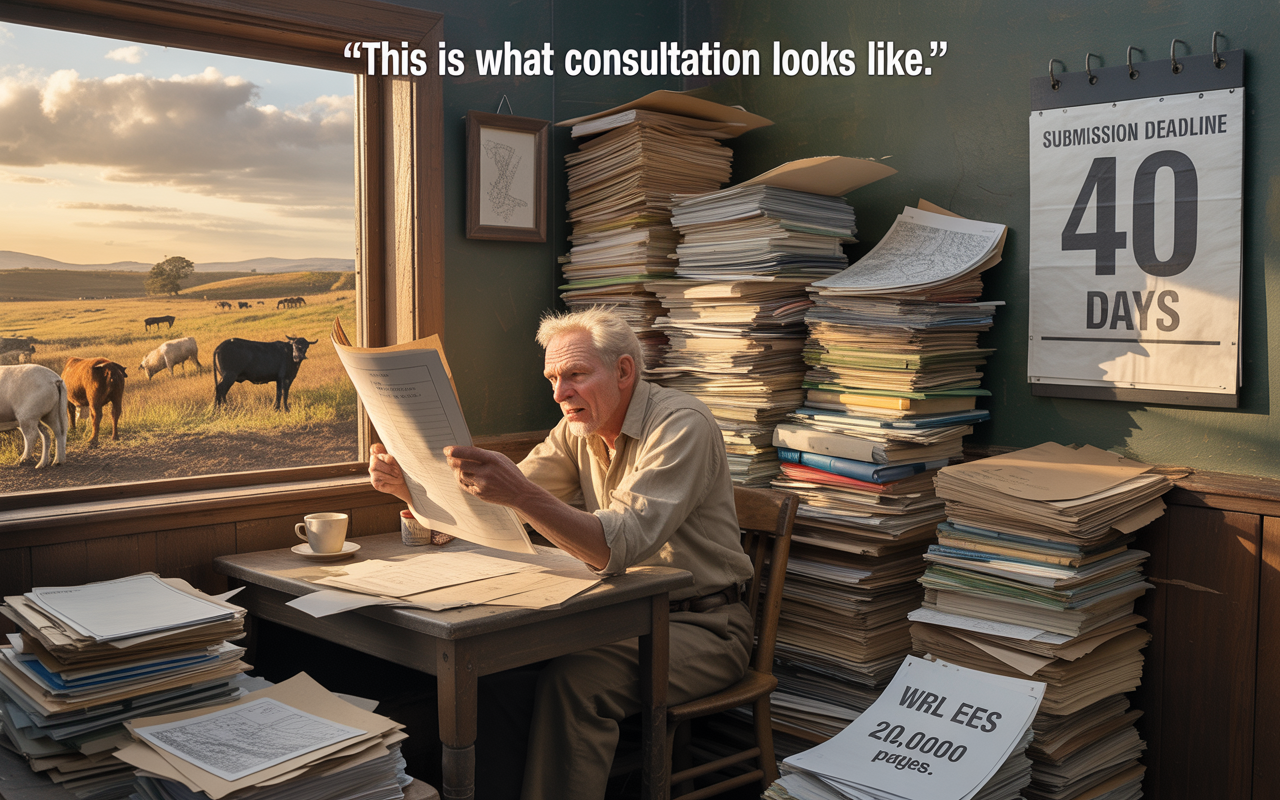
The Environmental Effects Statement (EES) process for the Western Renewables Link (WRL) should not be allowed to proceed, because the foundations on which it rests are fundamentally unsound.
At the heart of the problem is this: the WRL and its sister project, VNI West, were quietly excluded from the scrutiny they desperately require. The 460 kilometres of overhead lines cutting through farmland, bushland, and communities were ring-fenced, removed from proper analysis under the Draft Victorian Transmission Plan (VTP).
VicGrid claims these lines will be operational by 2027 (WRL) and 2029 (VNI West). But it’s a fiction. Neither project has undergone proper engineering assessment. Neither has been subject to a genuine cost-benefit analysis. And the deeper you dig, the worse the story gets.
The WRL now appears to have a cost-benefit ratio well below 1. In other words, for every dollar spent, the public may receive just 50 cents in return. Yet somehow, it still advances propped up by an EY report commissioned by AEMO in 2022 that modelled $2.2 billion in “benefits” without including a single estimate of the WRL’s true cost.
Worse still, the benefits assumed in that report are already being invalidated. They relied heavily on displacing offshore wind with cheaper solar and onshore wind from Western Victoria. But under the VTP, offshore wind is now forecast to grow significantly, while the Grampians and Mallee Renewable Energy Zones are expected to deliver far less than originally assumed. The supposed economic case for WRL has simply collapsed but no one has paused to notice.
And it gets more troubling. Over $3.5 billion in ‘brownfield’ network upgrades quietly embedded in the VTP are required just to make WRL viable. These include reinforcing the surrounding grid and building a second route into Melbourne to provide redundancy. This is not a smart grid it’s an expensive patchwork designed to prop up a failing plan.
By any reasonable reading of the law, WRL and VNI West should have been treated as ‘new projects’ under the VicGrid Act. They are not operational. They are not under construction. They do not have financing, easements, approvals, or meaningful community consent. After four years of effort, less than 10% of affected landholders have signed on. The environmental risks are substantial. And the timeline is slipping badly.
And yet, VicGrid pretends these projects are beyond scrutiny effectively shielding them from the very analysis and engagement the law demands. But let’s be clear: this is a breach not just of process, but of public trust.
The WRL is not the answer. It is an expensive, unpopular, and potentially redundant relic of a planning regime captured by political convenience and commercial momentum. Continuing with the EES under these conditions does not represent due process. It represents desperation.
Victoria deserves better: a transmission future that is grounded in evidence, responsive to communities, and capable of evolving with our energy system. That cannot happen while projects like WRL are fast-tracked through a wall of silence.
EES – PUBLIC SUBMISSION
Public submissions on the Western Renewables Link’s Environmental Effects Statement (EES) and draft Planning Scheme Amendment (PSA) will open from Monday, 30 June 2025, for a period of 40 business days. During this time, affected landholders and community members will be able to review the project’s documentation and lodge formal submissions. The EES outlines the proposed project, potential environmental impacts, and proposed mitigation measures. A full suite of documents, including reports, maps, and summaries will be available online, on USB (via mail), and in hard copy at select locations along the route. Making a submission is strongly encouraged to ensure community voices are heard. Further details, including how to lodge your submission via Engage Victoria, will be provided at the beginning of the exhibition period.
The Western Victoria Community Alliance (that’s us) along with Moorabool Shire Council will be assisting the community and Landholders with submissions via in person community meetings and other resourses – details to come shortly.