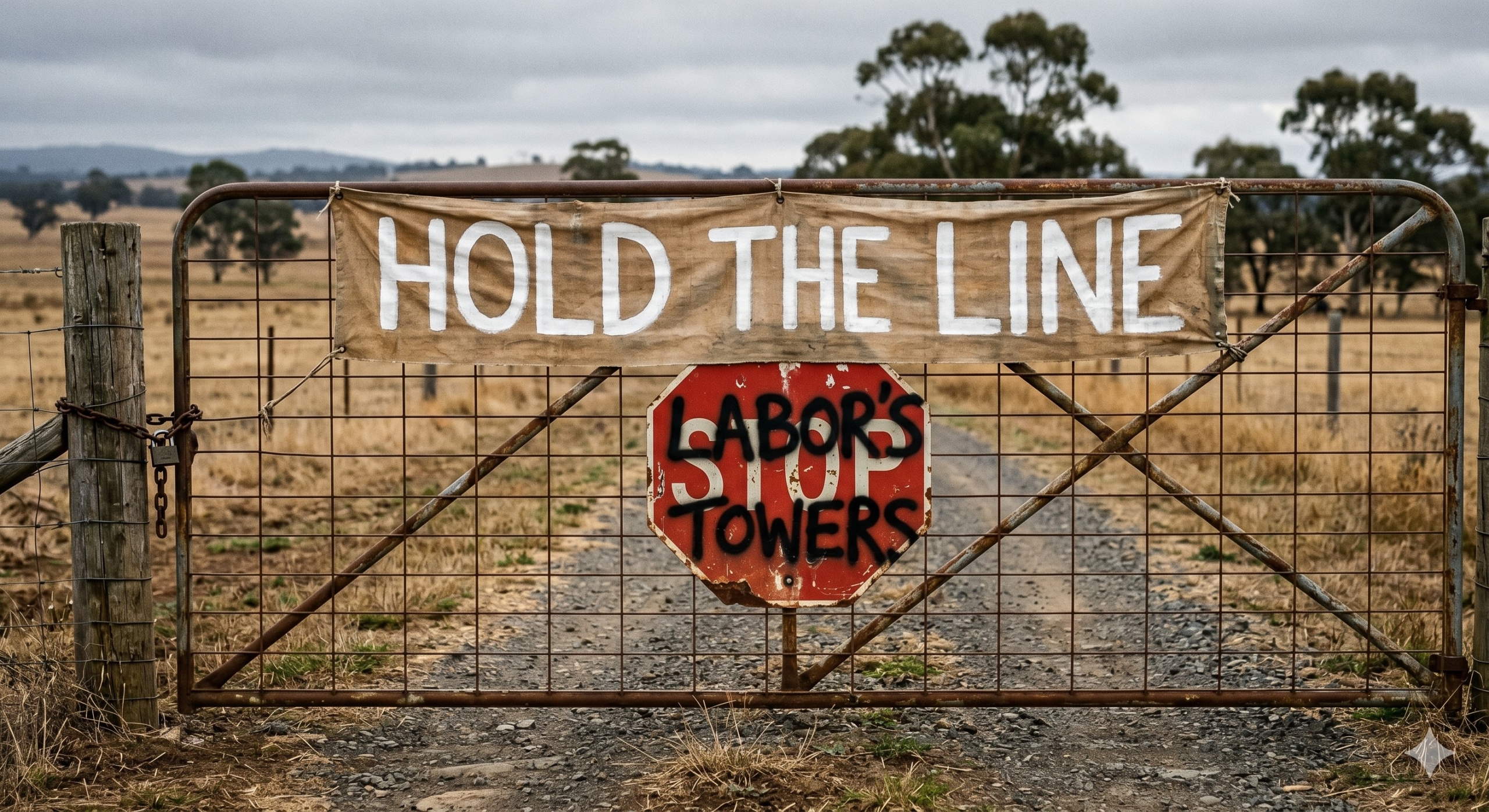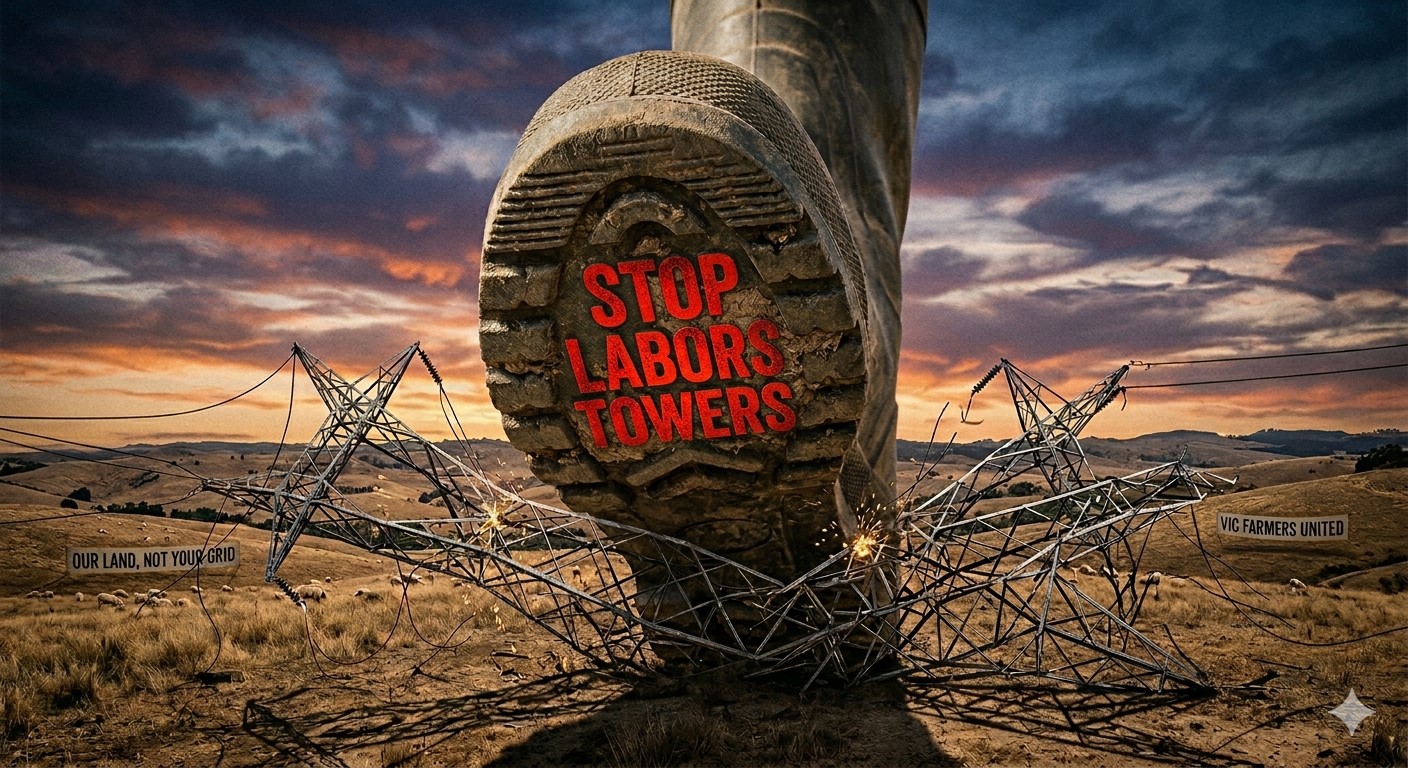
STOP LABORS TOWERS
NEWSLETTER – May 2, 2026
When diplomacy falls silent,
conflict finds its voice.
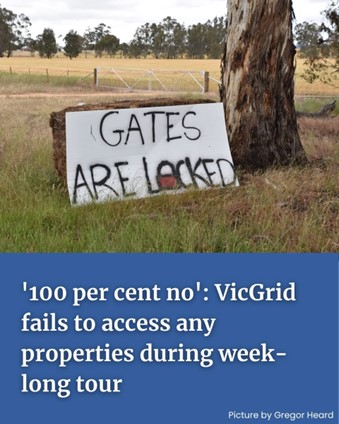
Respect the Land or Meet the Gate: We Stand United
From the Western Renewables Link to VNI West, it is now the same fight playing out along different fence lines. What began as scattered objections to isolated projects has hardened into a single, visible front: farming families, CFA volunteers and regional communities across western Victoria drawing a line at the farm gate and saying, in effect, “enough”. The tactics being used on VNI West communities – warnings, fines, forced access, and laws that strip away long‑held protections – are the same toolkit WRL‑affected landholders have been staring down for years.
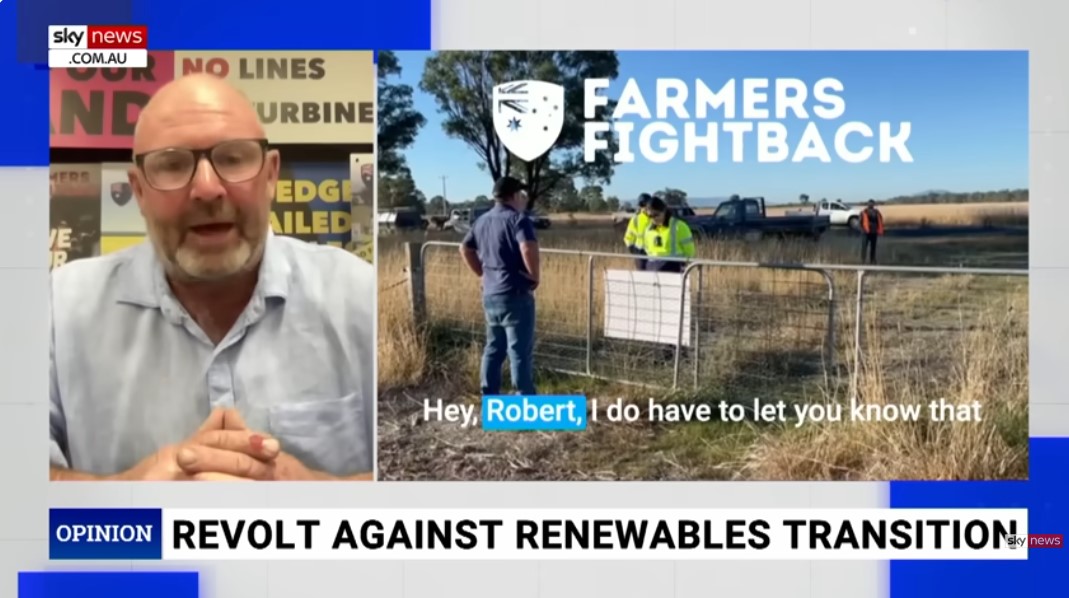
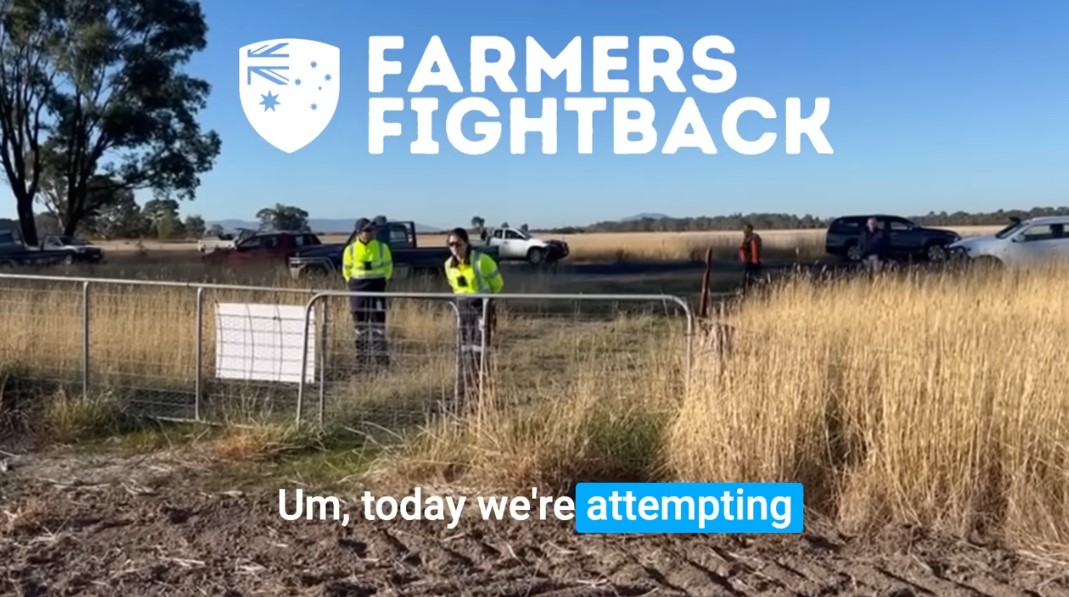
At Marnoo, more than 80 locals gathered at a farm gate, not to escalate, but to be seen, to be heard. The response? A warning that simply standing your ground could trigger enforcement action and court orders.
That is not engagement. That is escalation.
This isn’t an isolated moment. Across the VNI West corridor, landholders are being told that if they don’t grant access, fines may follow, and ultimately the state can force its way onto private land.
And it doesn’t stop there. Legislative changes have already lowered the bar for compulsory acquisition, allowing land to be taken even before full environmental assessments are complete.
Step back and look at the pattern.
First, consultation becomes notification.
Then, notification becomes direction.
Then, direction becomes enforcement.
That’s not partnership. That’s a system drifting away from consent.
When a government starts signalling that resistance will be met with fines, court orders, or compulsory access, it stops being about infrastructure and starts being about trust.
And trust, once broken, is almost impossible to rebuild.
This is where leadership matters. Real leadership doesn’t just deliver projects, it carries people with it. It listens, adapts, and earns consent.
Right now, too many regional Victorians feel like they are being managed, not heard. Directed, not consulted.
That is a political risk. But more importantly, it is a democratic one.
Because the moment communities believe the outcome is predetermined, that their role is simply to comply, the system itself starts to lose legitimacy.
And that’s when opposition hardens.
Not because people are unreasonable.
But because they feel they have no other option.
The path forward is still there. Reset the engagement. Rebuild trust. Put genuine alternatives on the table. Treat landholders as partners, not obstacles.
Until that happens, resistance won’t fade. It will grow.
And it will remain unified.
Almost six years on, WRL-affected communities are still standing, and we are not going anywhere. If anything, the pressure being applied has only strengthened our resolve. Efforts that sideline landholders and reshape the narrative do not build trust, they deepen opposition. Across western Victoria, communities who live and work on this land understand what is at stake, and they are standing together with clarity and purpose. We remain united, we will continue to stand our ground, and we will not accept outcomes imposed without genuine engagement.
HOLD THE LINE – STOP LABORS TOWERS
Who Really Benefits? The High-Voltage Politics of Australia’s Energy Transition
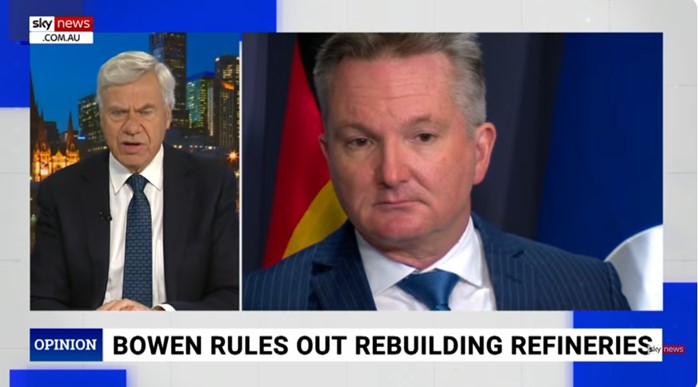
The veneer of the “Green Revolution” is beginning to peel, and what lies beneath is not a verdant utopia, but a calculated, state-led expansion of power that would make the old industrial central planners blush. While Federal Energy Minister Chris Bowen chants the mantra of “sun and wind” as a cure-all for our current fuel insecurities, a colder look at the facts suggests the environmental benefit is merely the decorative ribbon on a package of radical economic restructuring.
The Great Grid Takeover
The cornerstone of this transformation is the Rewiring the Nation initiative. While marketed as a necessary plumbing upgrade for a renewable future, the massive capital injection functions as a massive lever for state monopolization. By funnelling billions into specific, high-voltage transmission projects, the Labor government is effectively nationalizing the direction of the energy market.
This isn’t a level playing field for innovation; it is a “command and control” architecture.
The government, via the Clean Energy Finance Corporation, is now the primary financier and architect of the grid, ensuring that the only “solutions” that survive are those that fit the state’s centralized vision. Private players and decentralized alternatives are being crowded out by a state-backed monopoly that ensures the government remains the ultimate arbiter of energy flow and pricing.
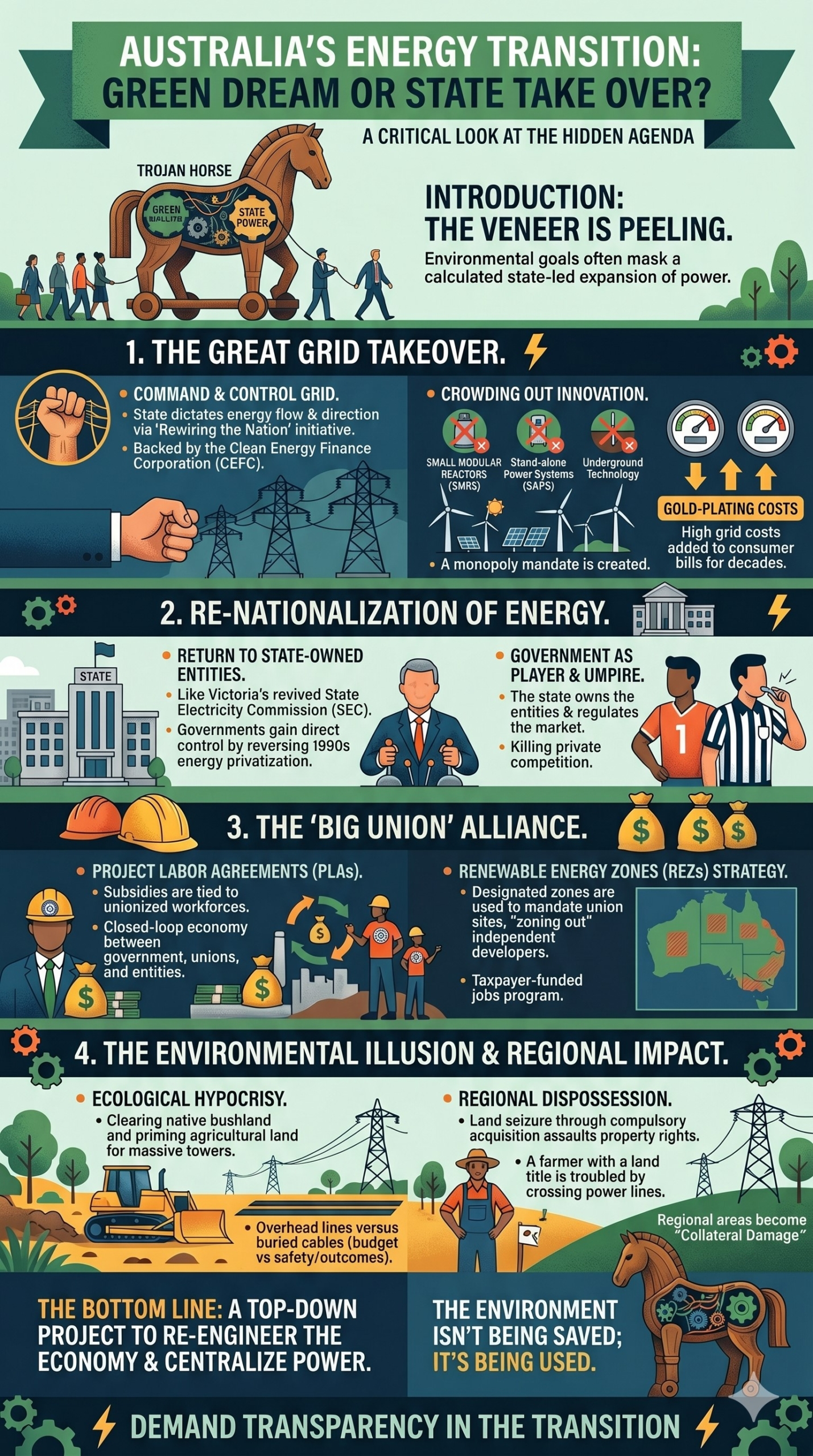
• Crowding Out Private Innovation: By backing specific high-voltage transmission projects through the Clean Energy Finance Corporation (CEFC), the state dictates which projects succeed and which fail. This creates a “monopoly by mandate,” where smaller, decentralized, or alternative technologies (like small modular reactors, stand-alone power systems and/or underground technology) are sidelined in favour of the government’s preferred industrial-scale projects.
• The Transmission Monopoly: Unlike traditional markets where competition drives down prices, the government-led rollout of thousands of kilometers of new lines creates a “gold-plating” effect. Once this infrastructure is built, the cost is locked into consumer bills for decades, ensuring a guaranteed revenue stream for the state-backed entities that manage them.
Re-Nationalization through “State-Owned” Entities
We are seeing a return to state-owned energy corporations, such as the revived State Electricity Commission (SEC) in Victoria.
• Direct Control: Labor is using renewables to reverse the privatization of the 1990s. While framed as “putting power back in the hands of people,” it effectively places energy production under the direct control of government ministers and department bureaucrats.
• Market Distortion: When the government is both the player (owner of the SEC) and the umpire (the regulator), private competition naturally evaporates. This leads to a monopoly where the government controls the supply, the price, and the distribution.
The “Big Union” Alliance
Follow the money, and you find it leads directly to the boardroom tables of Labor’s traditional affiliates. The rollout of Renewable Energy Zones (REZs) is less about where the wind blows hardest and more about where the state can most effectively implement Project Labor Agreements.
By centralizing energy production into these massive, government-managed hubs, Labor has created a closed-loop economy. The billions in taxpayer subsidies are tied to unionized workforces, essentially securing a perpetual feedback loop of political and financial capital between the government and its industrial base. The “transition” is becoming a taxpayer-funded jobs program for the few, disguised as a rescue mission for the many.
• Project Labor Agreements (PLAs): By centralizing energy projects into massive, state-run transmission “hubs,” the government can more easily mandate Union-only work sites. This ensures that the billions of dollars flowing into the “Green Transition” are funneled into unionized labor forces, effectively creating a closed-loop economy between the government, the unions, and the energy entities.
• The Renewable Energy Zone (REZ) Strategy: By designating specific geographic areas as Renewable Energy Zones, the government essentially “zones out” independent or non-aligned developers, ensuring that only those who comply with the state’s industrial and labor requirements can participate.
Why This Isn’t About the Environment
If the goal were purely environmental, the policy would likely focus on the most efficient and least invasive ways to reduce carbon, such as protecting existing local ecosystems or exploring nuclear energy. However, the current path often results in:
• Environmental Destruction for “Green” Goals: The irony of the “save the planet” narrative is the clearing of thousands of hectares of native bushland and the disruption of prime agricultural land to make way for towers and lines.
• High-Impact Infrastructure: The insistence on massive, overhead high-voltage lines – which are cheaper for the government to build but more destructive to the local landscape and fire safety – suggests that budgetary control and speed of rollout take priority over actual environmental or community outcomes.
The Bottom Line:
From this perspective, renewables are the “Trojan Horse.” The environmental rhetoric serves as the moral cover required to justify the seizure of land, the spending of billions in taxpayer wealth, and the re-establishment of a state-and-union-controlled energy monopoly that will dominate the Australian economy for the next century.
Regional Dispossession:
- The Human and Environmental Cost: The most stinging irony of the Bowen and Allen agenda is the environmental devastation it requires to “save” the environment. Across regional Victoria and beyond, the insistence on massive, overhead high-voltage transmission lines – rather than the more sympathetic but costlier option of undergrounding – reveals the government’s true priorities.
• Land Seizure: Regional landholders are being treated as collateral damage. The use of compulsory acquisition powers to carve transmission corridors is a direct assault on property rights.
• Ecological Hypocrisy: We see the clearing of tens of thousands of hectares of native bushland and the fragmentation of prime agricultural soil to make way for steel towers. If the agenda were truly environmental, the preservation of these existing ecosystems would be paramount. Instead, they are sacrificed on the altar of “Net Zero” targets that look increasingly like industrial quotas.
________________________________________
The narrative is clear: This is not action taken to protect our environment. It is a top-down, state-driven project to re-engineer the Australian economy, centralize power with State Government, and ensure that the energy of the future is owned, operated, and mandated by the state. The environment isn’t being saved; it’s being used.
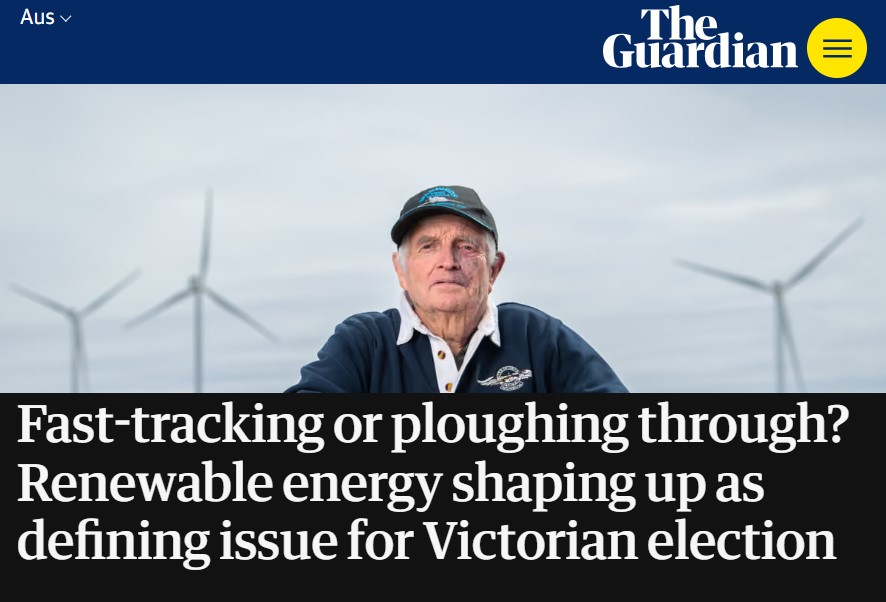
What’s taking shape in western Victoria isn’t a polite policy disagreement about climate targets; it’s a bruising contest over who gets to decide what happens to the countryside, and at what cost. The government calls it “fast‑tracking” the transition. On the ground, as The Guardian reports, it looks and feels much more like being ploughed through.
The pattern is stark. Transmission corridors and mega‑projects are mapped in Melbourne and handed down to farming districts that actually support renewable energy in principle, but discover that their only real role is to sign on the dotted line. Route decisions arrive like fait accompli. Consultation is described by farmers and local leaders as “appalling”. Volunteer fire brigades warn they may not be able – or willing – to defend properties once high‑voltage towers and easements turn familiar paddocks into dangerous firegrounds.
The official story is one of clean power and cheaper bills. The lived story is very different: new levies that land like punishment, land acquisition fights, and a planning regime that treats productive farms, bushfire risk and local ecology as acceptable collateral damage in the race to hit an election‑cycle milestone. It is little wonder that protests, court challenges and once‑tight rural communities now “torn apart” are becoming as much a feature of the transition as turbines and batteries.
Renewables are not being rejected because country Victorians suddenly love coal. They are being resisted because people can see, with unpleasant clarity, that the current rollout is rushed, heavy‑handed and dangerously indifferent to who pays the real price. Once that sense hardens – that the transition is something being done to them, not with them – it’s not just a few towers that are at risk. It’s the credibility of the entire project.