Stop Labors Towers Newsletter – May 30, 2026
The Unbroken Horizon
There is a quiet, dangerous comfort in silence. It whispers to us that if we sit still enough, if we hold our breath and blend into the background, the storm will pass us by. But that is a grand illusion. To remain silent in the face of what is wrong is not survival; it is the slow, quiet surrender of the soul. He who remains still while his world is torn apart has already allowed his fire to be put out.
It takes a fierce, bone-deep bravery to stand up when the giants arrive. They come with their heavy boots, their grand plans, and their casual arrogance, expecting you to scatter like dust before them. They think power is measured in the noise they make and the space they try to conquer.
But they do not understand the nature of true fortitude.
Your belief is not a fragile thing to be trampled. It is an anchor. When you plant your feet on the ground you love and say, “No further,” the math of the bully changes. Their power is loud, but it is hollow. Your power is quiet, deep, and rooted in truth. Let them run roughshod over their own conscience, but they cannot move a heart that knows its worth.
Stand tall, speak your truth, and remember: the horizon belongs to those who refuse to be shaken. “History, despite its wrenching pain, cannot be unlived, but if faced with courage, need not be lived again.”
COMMUNITY BRIEFING: VICTORIA’S CATASTROPHIC FIRE REALITY VS. THE WRL GRID DEFICIT
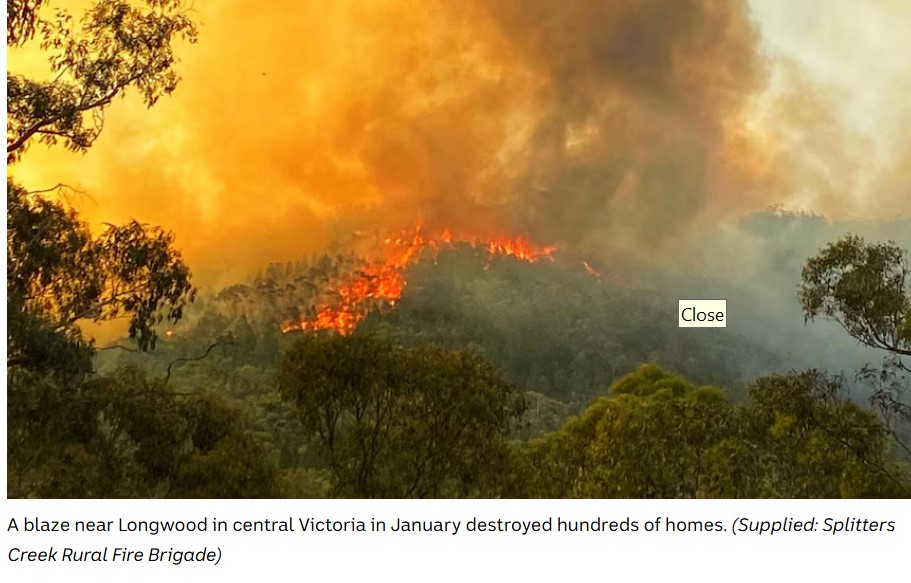
The stark reality of our state’s extreme vulnerability to fire was laid bare in a recent ABC News analysis, “Why does Victoria have so many bushfires?” The piece confirms what regional communities have argued for years: Victoria features some of the most intense, destructive, and unpredictable fire behavior on Earth.
When we look at this expert analysis alongside the immense volume of evidence presented by independent experts and local landholders at the Western Renewables Link (WRL) Environment Effects Statement (EES) hearings, a deeply alarming picture emerges. The planned overhead high-voltage transmission lines are fundamentally incompatible with the physical landscape they are being forced into.
The Anatomy of Danger: What the Science Tells Us
The ABC report brings together top fire modellers and emergency personnel to break down why our home state acts as a global tinderbox:
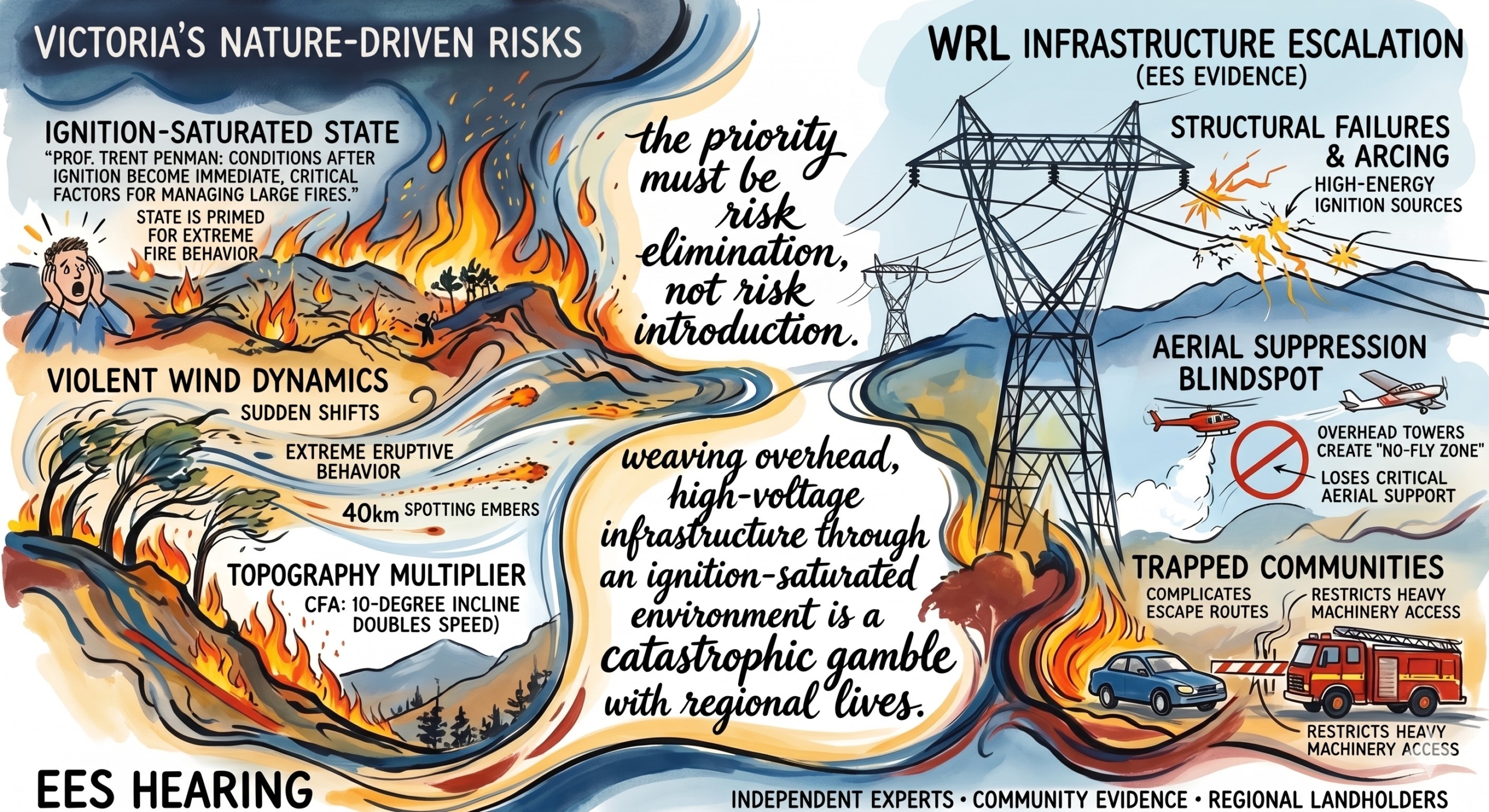
- The “Ignition-Saturated” State: Bushfire risk modeller Professor Trent Penman describes Victoria as “ignition-saturated.” Between thick fuel loads, dry heatwaves, and severe wind dynamics, the landscape is so volatile that adding any further ignition vectors threatens catastrophic outcomes.
- Violent Wind Dynamics: Victoria’s unique geography exposes it to both hot desert air from the interior and icy blasts from the Southern Ocean. This creates sudden, explosive wind changes. The ABC highlights that a fire front can be blown wide open in an instant, moving faster than 25 km/h, while spotting embers can shoot up to 40 kilometres ahead of the fire front.
- The Topography Multiplier: According to the CFA, a mere 10-degree incline doubles a fire’s speed. Because fire races uphill, our rolling regional valleys and hills inherently amplify a blaze’s speed and radiant heat.
Connecting the Dots: The WRL EES Hearing Evidence
During the extensive WRL EES hearings, our community and a panel of independent bushfire safety experts presented an overwhelming volume of evidence directly linking Victoria’s natural vulnerabilities to the specific hazards posed by the WRL.
The core of our submission remains unshakeable: weaving overhead, high-voltage infrastructure through an ignition-saturated environment is a catastrophic gamble with regional lives.
|
Victoria’s Natural Risks (ABC Analysis) |
The WRL Escalation Factor (EES Testimony) |
|
Wind & Sudden Shifts: Powerful blasts create unpredictable fire fronts and cause extreme “eruptive” fire behavior. |
Structural Failures & Arcing: High winds increase the risk of line slap, structural failure, or airborne debris hitting live lines, creating high-energy ignition sources exactly when conditions are at their worst. |
|
Spotting Embers (Up to 40km): Wind-driven embers leap over traditional containment barriers and outrun defenses. |
The Aerial Suppression Blindspot: Expert testimony at the hearings confirmed that massive overhead towers create a physical “no-fly zone” for fire-bombing aircraft. Ground crews lose critical aerial support to suppress spot fires near the corridor. |
|
Complex Topography: Terrain features like hills and valleys double fire speeds and restrict access. |
Trapped Communities: Dropping heavy infrastructure across regional easements complicates escape routes and restricts heavy machinery access in areas where firefighting is already physically restricted by the terrain. |
The Unavoidable Takeaway
The underlying message from both the public record and the latest meteorological warnings is clear. We do not live in a landscape that forgives structural planning failures.
When emergency leaders note that Victoria stands out globally for asset destruction and loss of life over the last 25 years, the priority must be risk elimination, not risk introduction. The massive volume of community and expert evidence provided at the EES hearings established a definitive case: to protect regional families, agricultural assets, and the landscape itself, overhead high-voltage lines cannot be permitted through these high-risk fire corridors.
The Language of Anesthesia: How the Government Plans to Burn the Province to Keep the Metropolis Alight
There is a distinct, bloodless dialect spoken by modern bureaucracy when it is forced to confront catastrophe. It is a language designed not to reveal, but to anesthetize.
In the wake of January 2026, when 400,000 hectares of Victoria burned, when the skies over Walwa turned the colour of dried blood, and when fifty-four homes and businesses in Harcourt were reduced to ash, we might have expected a language of raw reckoning. Instead, as the Victorian Parliamentary Inquiry into the Summer Fires begins to process its mountain of submissions, we find ourselves corralled into the sterile terminology of “infrastructure resilience.”
“Resilience” is the great talisman of contemporary governance. It sounds robust, noble, and forward-facing. But under Term of Reference 5 of this inquiry, it functions as a conceptual blindfold. It asks a single, self-serving question: “How can our critical electricity infrastructure survive a bushfire?”
Notice the direction of the gaze. The inquiry is invited to look at the fire hitting the wire, not the wire hitting the landscape. It treats the massive, sprawling network of proposed transmission lines most notably the 190-kilometer scar of the Western Renewables Link (WRL) and VNI West as a passive victim of a warming climate.
This is not just bad policy; it is a profound act of intellectual cowardice. The true question the hard-edged, terrifying question that the Allan government is desperate to evade is not how the grid endures a bushfire, but how a hostile, high-risk bushfire region endures the grid.
To drop 500 kV overhead transmission towers into a Flame Zone is not an act of green modernization; it is an act of spatial arrogance. The rural communities who dragged this government kicking and screaming into this inquiry know this intimately. Their submissions do not speak of abstract grid reliability. They speak of the visceral reality of fire suppression: of CFA volunteers who cannot safely drive their trucks beneath sagging, high-voltage lines in thick smoke; of low-altitude water bombers forced to turn back because a maze of steel towers has compromised the airspace; of the undeniable fact that inserting massive electrical infrastructure into a powder keg dramatically increases the risk of the spark that sets it off.
For years, the corporate custodians of this transition have operated on a doctrine of immaculate conception. Prior to the horror of January 2026, AusNet felt comfortable broadcasting the astonishing claim that transmission networks had “never caused a bushfire in 96 years of Victorian history.” It is a statement that belongs in the same category of corporate hubris as the tobacco executive marveling at the crisp, refreshing taste of a cigarette. The fires of this summer have rendered such mythologies obsolete.
Yet, the state government remains in hiding, treating the systemic risks of their chosen infrastructure paths as an inconvenient footnote. They initially opposed this inquiry because they knew what a genuine post-mortem would look like. It would show that under Term of Reference 11, we are trapped in a ghoulish loop of administrative liturgy—where the recommendations of past Royal Commissions, stretching back to Black Saturday in 2009, are solemnly accepted, quietly filed away, and systematically unfulfilled.
The timing of this inquiry is a matter of acute political gravity. The Legislative Council’s Environment and Planning Committee is due to table its final report on July 28, 2026. This lands the findings precisely four months before the next fire season peaks, and a mere heartbeat before the November state election.
As of this month, May 2026, the Minister’s assessment of the WRL Environment Effects Statement remains pending. The government wants to keep it that way. They want to treat the transition to renewable energy as a mathematical equation balanced entirely on the backs of regional communities, while treating the literal tinderbox on the ground as a separate, unavoidable act of God.
They cannot have it both ways. You cannot claim to be planning for a climate emergency while ignoring the localized catastrophes your own planning decisions create. If this parliamentary inquiry contents itself with looking at whether steel towers can withstand a firestorm, it will have failed its most basic civic duty. It must look at the impact of the infrastructure itself. It must mandate independent, on-ground fire risk assessments before a single piece of steel is bolted together in a high-risk zone.
True progressivism does not involve burning down the province to keep the lights on in the metropolis. The government cannot continue to hide behind the bloodless prose of “resilience” while regional Victoria prepares to burn. The report on July 28 must not be an autopsy of what happened; it must be a intervention into what is currently being planned.
A REPORT THAT COULD CHANGE EVERYTHING – DUE 28 JULY 2026
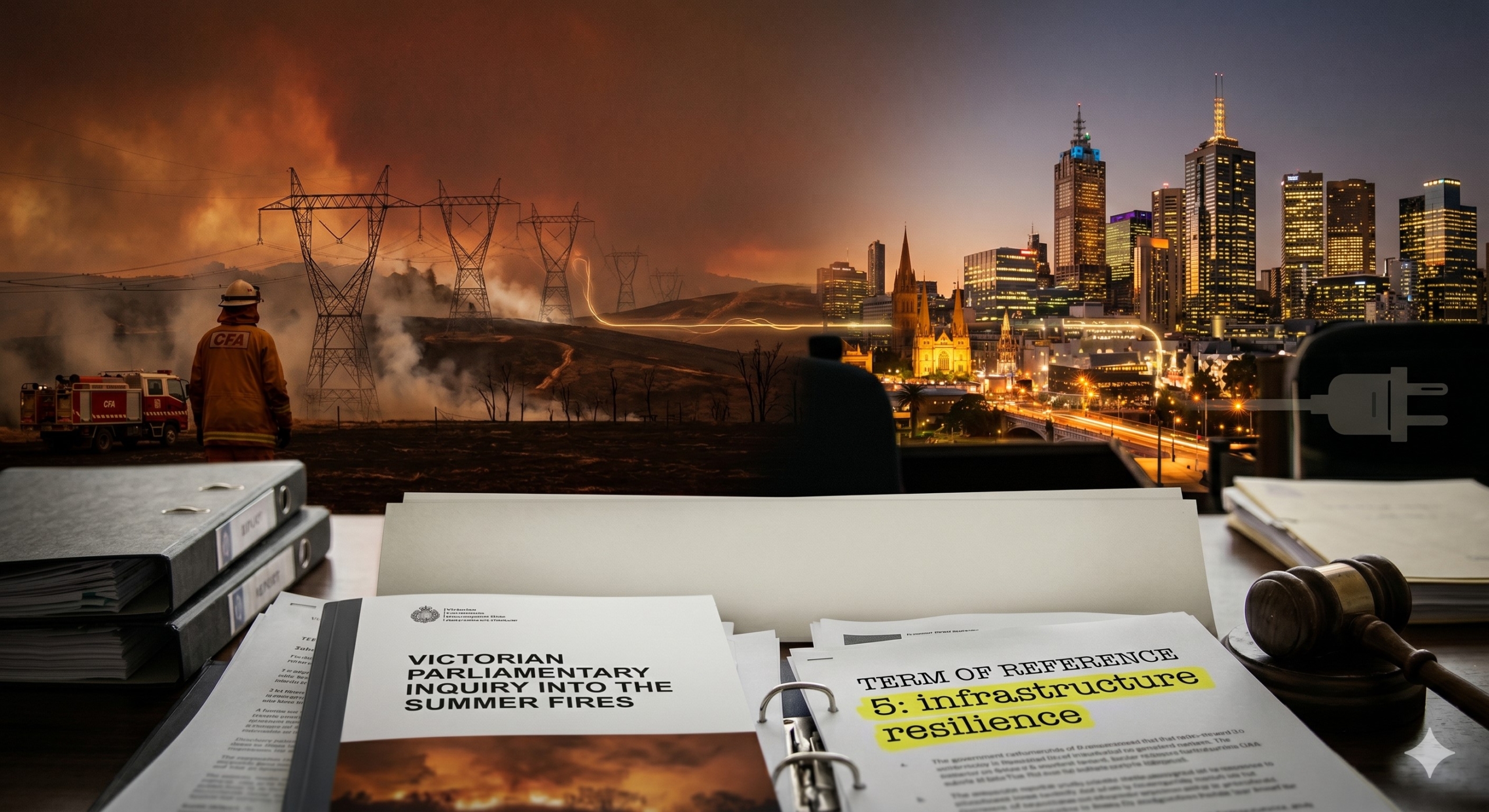
When Parliament tabled the formal inquiry into Victoria’s 2026 summer fires, it set a deadline that deserves every community’s attention: 28 July 2026 – four months before the next fire season peaks, and four months before a state election.
The fires that triggered this inquiry were not routine. In January 2026, Victoria burned. More than 400,000 hectareswere lost, over 500 structures destroyed, 54 homes and businesses in Harcourt wiped out, and 121,500 hectares consumed in the Northeast alone. A State of Disaster was declared. Labor initially refused an inquiry, then reversed under pressure from the CFA Volunteers Group, the United Firefighters Union, the Liberals and Nationals, and a community petition demanding answers.
The inquiry is broad. Its eleven terms of reference cover everything from CFA resourcing and fuel management to climate change, telecommunications failures and the resilience of electricity infrastructure during fire events. That last one matters enormously to western Victoria.
The WRL connection
Term of reference 5 requires the committee to examine how electricity infrastructure performed and failed during the January fires. This is the same inquiry that sits alongside a Minister’s desk holding the WRL EES assessment. The WRL route passes directly through landscapes that were active fire country in January 2026. Community and expert witness submissions to the WRL EES documented in detail how 190 km of 500 kV overhead transmission line through these areas would increase ignition risk, block suppression access and put CFA volunteers in danger.
AusNet has falsely claimed its networks have “never caused a bushfire in 96 years of Victorian history.” That claim was made before a formal parliamentary inquiry examined what actually happened to transmission infrastructure in January 2026. If the report contradicts that position or recommends tougher standards for new transmission corridors through high-risk zones the Minister cannot ignore it when deciding the WRL’s fate.
Why the timing matters
The report will be public before the 2026–27 fire season begins. The government will face immediate pressure to demonstrate it has acted on findings before spring conditions arrive. And with a state election in November 2026, any finding about CFA underfunding, failure to implement past Royal Commission recommendations, or electricity infrastructure risk becomes a direct electoral liability.
Watch for these findings
When the report lands on 28 July, these are the questions communities should ask immediately:
- Does it recommend specific siting or design standards for new transmission lines through high-risk bushfire zones?
- Does it find that past inquiry recommendations on electricity infrastructure were not implemented?
- Does it call for independent fire risk assessments before new transmission corridors are approved?
- Does the government commit to acting before the next fire season – or quietly defer?
The answers will matter not just for fire safety. They will matter for the WRL. They will matter for the election. And they will matter for every community that spent January 2026 watching their country burn.