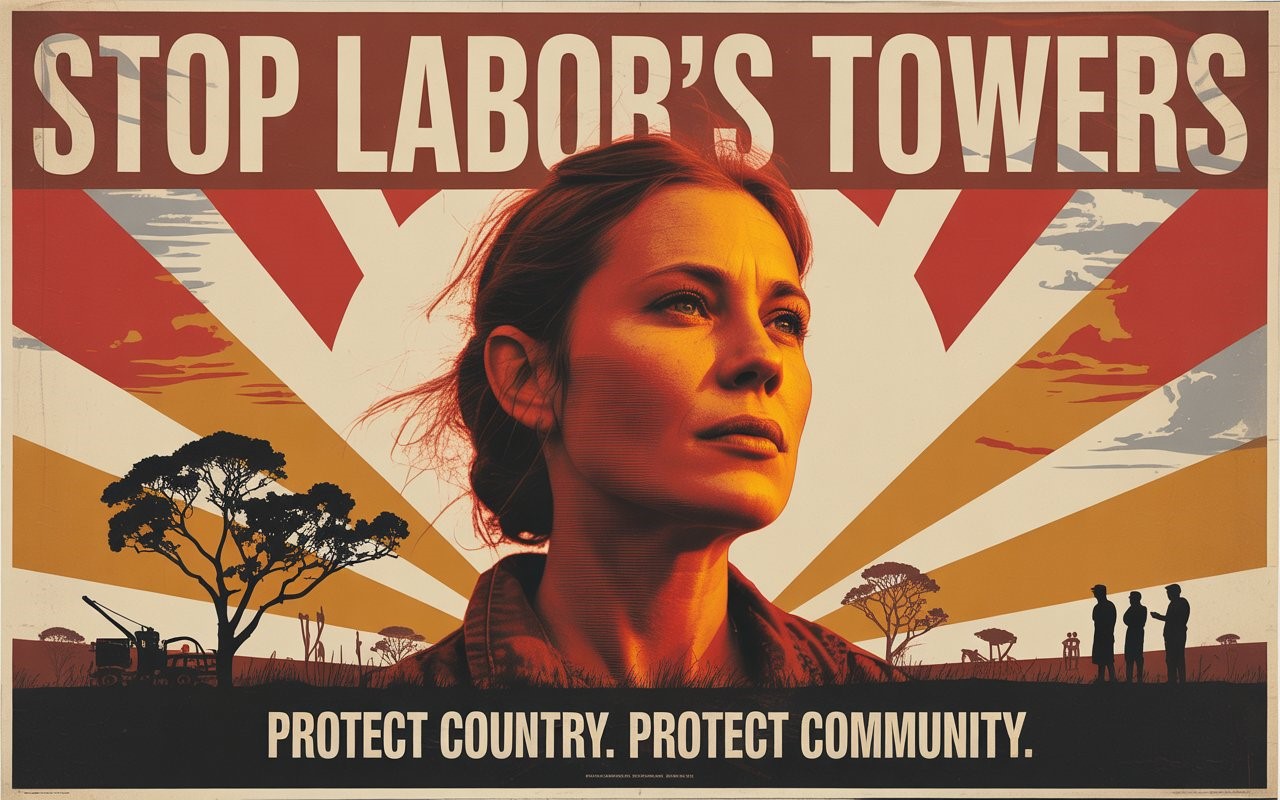
STOP LABORS TOWERS
NEWSLETTER – November 9 2025
A Thin Line (A short story cycle)
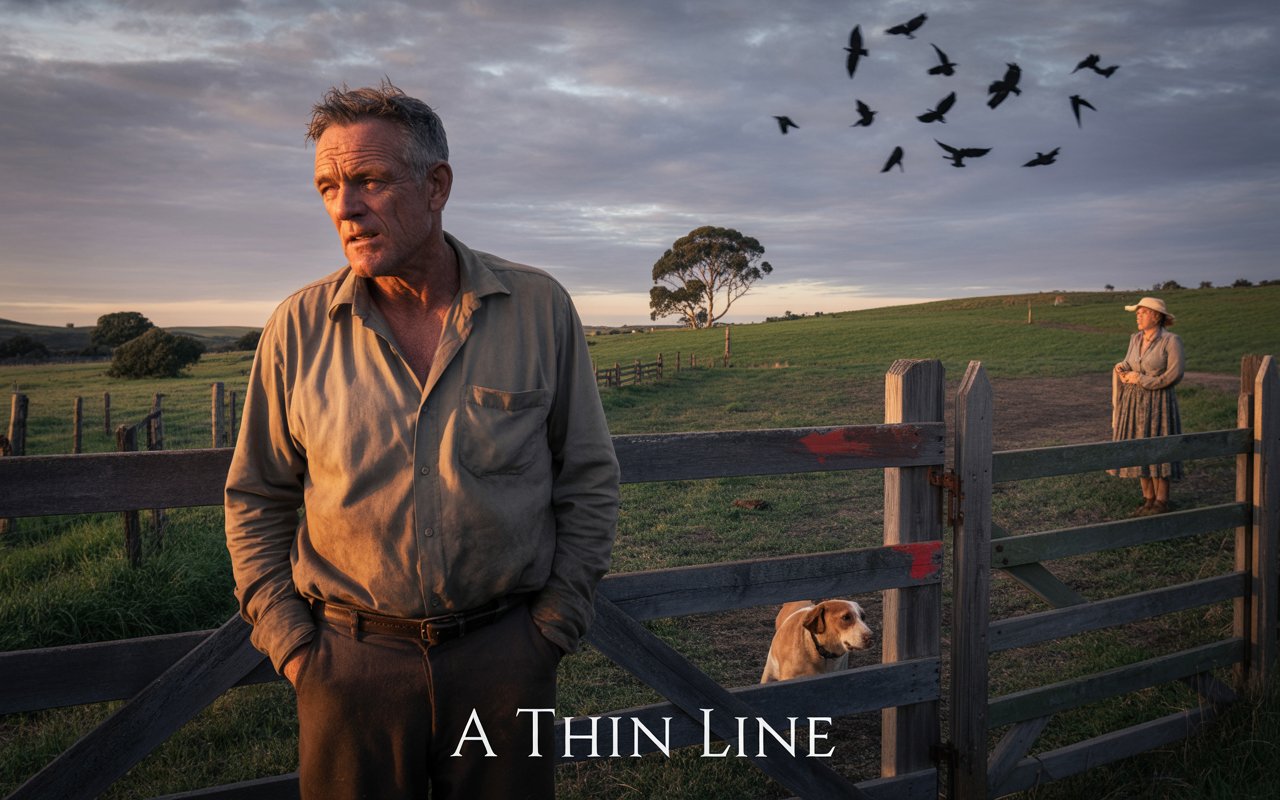
A Thin Line (A short story cycle)
Foreword
This story is set in rural Victoria, where a proposed high voltage transmission line cuts not only across land, but through the fragile bond between belonging and betrayal. In the quiet space between resignation and revolt, ordinary people find themselves standing for something larger than a paddock or a view.
Part I: The Letter
It started with a letter.
White envelope, printed logo in the corner: Western Renewables Link.
Jack opened it at the kitchen table. He didn’t say anything at first. Just looked at the page. The paper curled at the corners like it didn’t want to be read.
Mary asked what it was.
He said, “They’re putting a line through the paddock.”
That was all.
The dog barked outside. The kettle started to whistle. Somewhere down the road, a truck changed gears and the sound dragged across the paddocks like something wounded.
Mary read the letter twice. Then she laughed – the kind of laugh that doesn’t belong in a kitchen.
“Through our land?”
“Yeah.”
They didn’t talk much after that. He went out to the shed, fiddled with the tractor. She stood by the window watching the clouds crawl in from the west.
That night she asked, “They can’t do that, can they?”
Jack said, “Looks like they can.”
A week later there was a meeting in town. Farmers, kids, retirees. Everyone had that same letter folded in their hands. You could tell by the way they held them – careful, like something alive and dangerous.
Afterward, someone gave Jack a sticker: STOP LABOR’S TOWERS. He didn’t like stickers, but he took it anyway.
That night they sat outside under a hard sky.
Mary said, “It’s not right.”
He said, “No.”
He looked over the paddock, where the grass rippled like water. He could almost see the invisible line already there, slicing through everything that mattered.
“There’s a thin line,” he said quietly. “Between shame and rage.”
Mary didn’t ask what he meant.
She already knew.
Part II: The Meeting
It was raining the night they met again.
The hall smelled like dust and wet coats. Someone had made coffee in a thermos and laid out Tim Tams, Originals on a paper plate.
Jack sat near the back. Mary stayed home.
A man from the city stood up front. “Community engagement,” he called it. He talked about progress and clean energy and Victoria’s bright future. He smiled too much.
A widow from the next valley asked about fire.
“If a line goes down in a northerly, who carries that?”
The man shuffled his papers. “We’ll be working closely with the CFA to ensure safety.”
Someone laughed. Not kindly.
Another voice from the back: “You ever seen a fire run through bluegum?”
Silence followed. Long enough for the rain to fill it.
The man smiled again, weaker this time.
Jack said, “Concern’s not the word, mate.”
The man blinked. “What word would you use?”
Jack looked at him, steady. “Betrayal.”
You could feel it in the air then – something shifting.
Not noise, not outrage. Just a low, shared certainty.
When it ended, people stood in small groups, whispering. Someone handed Jack another flyer. Lawyers, maps, next steps.
He folded it and left.
Outside, the sticker on his ute caught the light from the hall – STOP LABOR’S TOWERS – red against the rain.
He thought of his father’s ashes on the hill, of mornings before dawn when he’d built this place from nothing.
The line they were drawing wasn’t just through land.
It was through people.
Part III: Hold the Line
They came on a Tuesday.
Two white utes with orange lights. Men in vests.
The first one had a clipboard. “Mr. Bennett? We’re just marking the corridor.”
Jack looked past him to the paddock. “That right?”
“Yes, sir. Nothing final.”
He didn’t answer. The wind carried the smell of rain and sheep dung.
The man pointed with his pen. “It’ll come through that ridge, across the gully.”
Jack followed his hand and saw the spot under the old gum – where his father’s ashes lay.
“You’ll have to come back another day,” Jack said.
“Sorry, we’re authorised.”
Jack nodded. “Not here, you’re not.”
The other men started walking up from the gate. Jack picked up the posthole shovel by the fence. He didn’t raise it, just held it.
Nobody spoke.
The crows called from the trees.
Finally, the man folded his map.
“We’ll note your objection.”
“You do that,” Jack said.
When they left, he stood there until the dust settled.
Then he walked the ridge again, slow and steady. The sun dropped behind the hills, long shadows cutting across the paddocks – black lines drawn by the day itself.
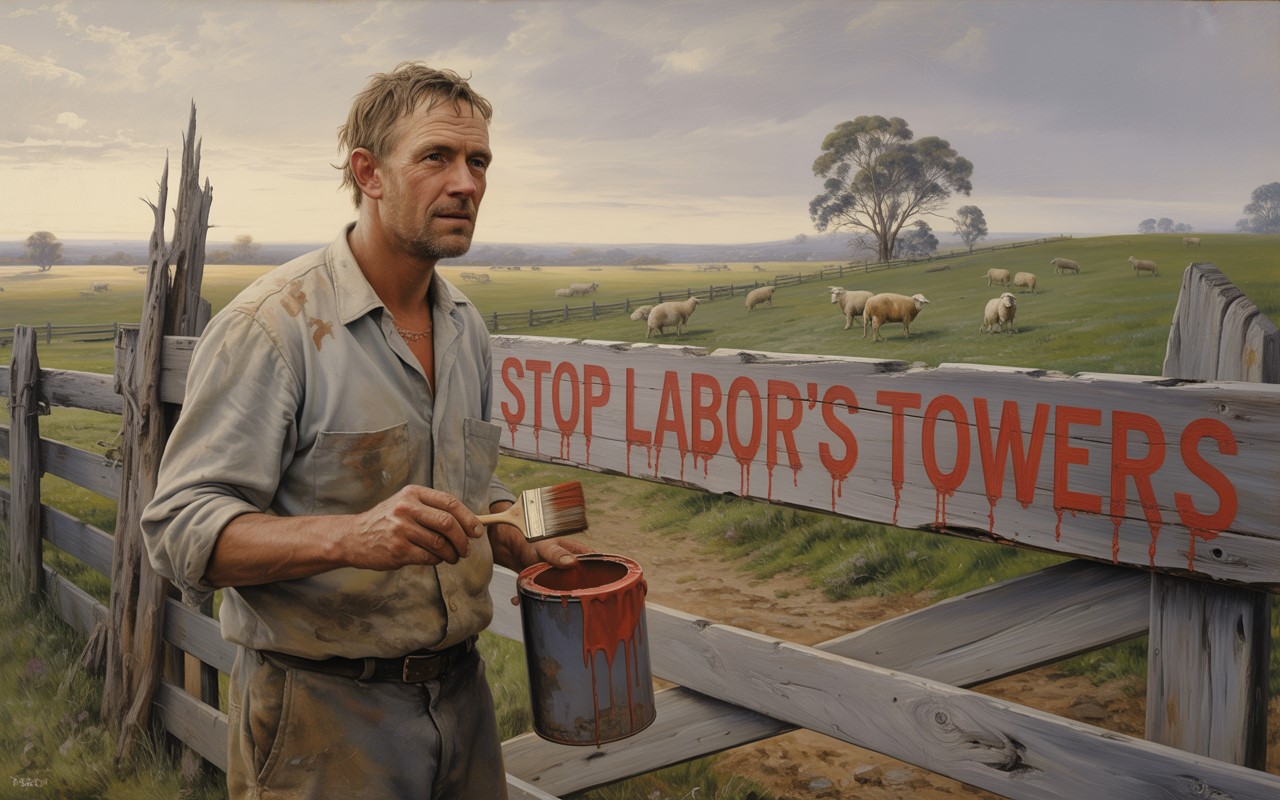
Later, he found an old can of red paint in the shed.
He walked to the mailbox and painted the words in rough strokes:
STOP LABOR’S TOWERS
When he was done, he stood back and watched the paint drip.
He didn’t feel proud.
Didn’t feel angry anymore.
Just steady.
Mary came out, wiping her hands on a towel. She stood beside him.
“What happens now?” she asked.
Jack looked at the road. At the painted words still shining in the light.
“We hold the line,” he said.
Epilogue
In every small town across the Western Victoria, the same words began to appear – on fences, in windows, on the backs of dusty utes.
Not rage. Not shame.
Something quieter, stronger.
A promise.
To hold the line.
There’s a thin line between shame and rage.
And when the government crosses it, the people learn to hold their own.
Afterword: Shame and the Line
For me – and for the tens of thousands of us living under the shadow of the proposed Western Renewables Link – shame isn’t guilt or wrongdoing. It’s a quiet humiliation that comes from being disregarded, from realising my life and labour can be erased by decisions made in distant offices.
I’ve felt the sting of being talked down to by consultants, of seeing my home reduced to coordinates on a map. I’ve felt the ache of knowing that someone else’s profit and political praise are being built over my dignity.
But shame doesn’t stay still. It turns into something else if you let it.
When the first tower markers appeared, I stopped bowing my head. The humiliation hardened into resolve – a line that couldn’t be crossed.
I began to speak plainly. I refused politely.
And from that silence, from that steadiness, came the one phrase that still holds me — and all of us – together:
Hold the line.
WRL EES Hearing – Week Two
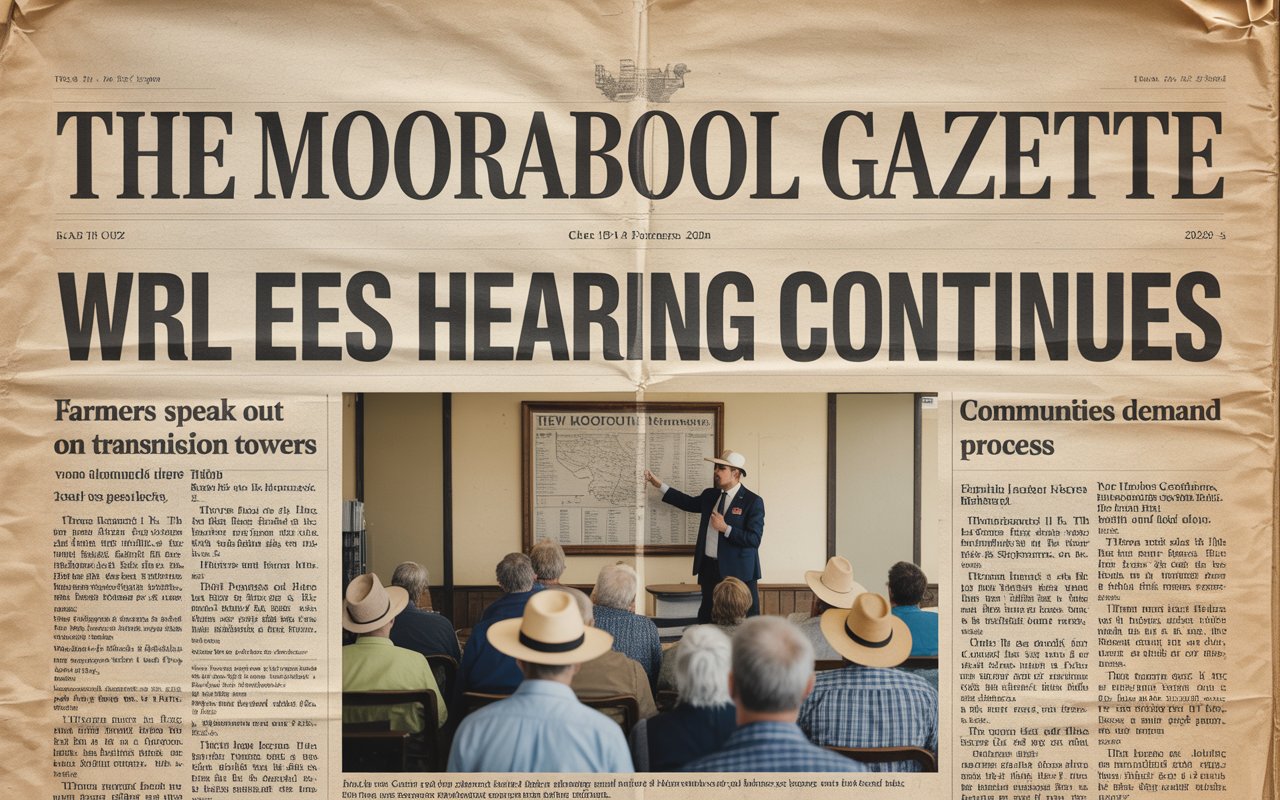
WRL EES Hearing Update
Last week marked the end of Week Two of the Western Renewables Link (WRL) Environmental Effects Statement (EES) hearing.
The four-day session was dedicated to the proponents witness statements and cross examinations and focused on key topics including Aviation, Electromagnetic Fields (EMFs) and Electromagnetic interference (EMI), Noise and Vibration, and Visual Impact.
Throughout the week, the proponent’s expert witnessesdemonstrated glaring bias, repeatedly downplaying the devastating impacts this project would have on communities, landscapes, the environment, and livelihoods.
The importance of strong community presence both in person and online cannot be overstated. Your attendance and engagement remain vital in holding this process accountable and ensuring that local voices are genuinely heard.
Call to Action
If you haven’t yet attended the hearings – either in person or online – now is the time to get involved.
We’ve fought long and hard for more than five years, and showing our resistance where it matters most is crucial.
The next two weeks of the proponent’s presentations are critical – this is our opportunity to question, challenge, and expose what they are saying.
Every voice, every presence, and every question counts.
Stand with us. Be seen. Be heard.
Hold them accountable.
What has become increasingly clear is the proponent’s ongoing contempt for affected communities. Their “experts” who, let’s be honest, are for all intents and purpose paid employees of the proponent have abandoned any sense of professional independence. Whether their background lies in history, aviation, or visual assessment, they have chosen the path of self-preservation over integrity, ignoring the moral cost of their testimony and the real-world consequences of their words.
One particularly striking moment came from the proponent’s visual amenity expert, who repeated that the visual impact was “low” so many times you’d think Harry Potter’s invisibility cloak had been draped over the 80-metre-tall industrial towers the same ones that will be visible from nearly 50 kilometres away.
The hearings continue this week, and we encourage everyone to stay involved, stay vocal, and hold the line against this deeply flawed project.
This Week’s Schedule
- Monday: Bushfire and fire risk — Mark Potter and Graeme Taylor (Fire Risk Consultants)
- Tuesday: Social and wellbeing — Glenn Weston (Public Place) and Jackie Wright (Enriks)
- Wednesday and Thursday: Biodiversity nd offset strategy Brett Lane (Nature Advisory) and Andrew Stephens (Jacobs)
The Independent Advisory Committee (IAC) will consider the EES, all public submissions, and the evidence presented at the hearing before providing its report and recommendations to the Minister for Planning.
Community Action Guide: Western Renewables Link (WRL) EES Hearings
Holding Power to Account
A strong community presence is essential to hold the proponent (AusNet) and its so-called independent experts accountable. In Week 1, we have already seen examples of the proponent’s witnesses downplaying significant and life-threatening risks associated with the project.
This disingenuous and dangerous approach must be confronted.
Your participation matters. Each voice contributes to transparency, truth, and community strength.
Below is a practical step-by-step guide to help you follow the hearings, access documents, and take part directly in questioning.
Step 1 – Access the Hearing Timetable
The Western Renewables Link (WRL) Environment Effects Statement (EES) Public Hearingscommenced on Monday, 27 October 2025, and will run through to Thursday, 5 March 2026.
How to Find It
- Visit the Inquiry and Advisory Committee (IAC) main page:
🔗 WRL EES Hearing Main Page - Go to “Tabled Documents.”
🔗 Tabled Documents Page - Download the latest Hearing Timetable (Document Here)
The timetable lists:
- Which expert witnesses are scheduled to appear,
- Their topics (e.g., bushfire risk, landscape and visual impacts, agriculture), and
- The session dates and times.
Community Submissions
The current timetable lists expert evidence, councils, and agencies through to late December 2025.
Community submitters are expected to present between January and March 2026, with Ballarat hearings (Weeks 11–14) scheduled for February 2026.
Keep checking for timetable updates to confirm your appearance date.
Step 2 – Review Expert Materials
Before each presentation, the proponent’s “independent” experts usually upload an overview of their evidence to the Tabled Documents section.
You can find them here:
🔗 Tabled Documents – Expert Evidence
Examples of Key Expert Documents
- Joint Expert Statement – Economics (AusNet)
- Joint Expert Statement – Bushfire (AusNet)
Tip
Read these expert summaries before their scheduled presentation.
They reveal the assumptions, omissions, and technical biases underpinning the evidence – crucial for preparing questions or identifying misleading claims.
Step 3 – Request to Cross-Examine (Ask a Question)
If you wish to pose a question or cross-examine an expert, you must register your intent with the IAC Secretariat no later than 12:00 pm the day beforethe expert is due to appear.
| Requirement | Action to Take | Details / Contact |
| Notify the IAC | Email your intention to cross-examine. | 📧 planning.panels@transport.vic.gov.au |
| Deadline | Before 12:00 PM (noon) on the day prior to the expert’s scheduled appearance. | Confirm the expert’s date in the hearing timetable. |
| Email Content | Simply state your name, the expert or topic, and the approximate time required. | Example: “[Your Name] requests time to cross-examine [Expert Name] on [Topic] and estimates [X] minutes is required.” |
| Your Safeguard | You are formally listed as a participant for that part of the evidence. If your question is answered during the session, you may simply pass. | This ensures your right to speak is protected and recorded. |
Why This Matters
By following these steps, you help ensure the WRL hearing process remains transparent and accountable.
Every individual who observes, questions, or challenges the evidence strengthens the integrity of the process.
The hearings are not merely procedural – they are a test of truth.
When the facts are distorted, community participation becomes the only real counterbalance to corporate spin and political complacency.
Quick Links Recap
Climate Crusade: A Government Gone Rogue
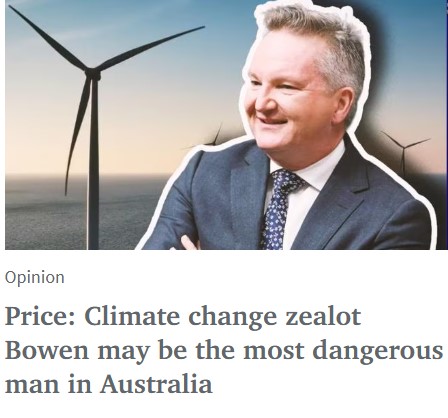
The agenda led by Chris Bowen, Australia’s Climate Change and Energy Minister – dubbed a “climate zealot” for his “unwavering push toward a Net Zero future” – is not a responsible policy; it is an ideologically driven crusade that has weaponized climate policy against the Australian heartland. For too many in regional Australia, this recklessness has made Bowen the most dangerous man in the country, as his agenda’s real-world impacts threaten their very way of life. The promise of Net Zero is collapsing into a reality of ruin, resentment, and a betrayal of the people it claims to protect.
Read the article in the Herald Sun
Scarring the Land: Rural Australia as a Sacrifice Zone
Under the banner of “green” energy, the government is inflicting irreparable damage on the environment and regional livelihoods.
- Destruction of Farmland and Ecosystems: Vast areas of prime farmland and fragile bushland are being cleared to make way for massive wind and solar farms, leading to “green” infrastructure that is ironically “chewing up nature”. This rush to build is “threatening biodiversity and regional livelihoods”.
- Forced Land Invasion: The Net Zero vision demands a colossal expansion of hundreds of kilometers of new high-voltage power lines – stark symbols of Canberra’s haste. Farmers are watching in dismay as these industrial towers invade their properties. Worse, while some landowners may benefit from hosting a turbine, being forced to host a transmission line brings “nothing but headaches” and “little benefit or choice”.
- Betrayal of the Bush: For people who love their land, this forced clearing of trees, disturbance of wildlife, and loss of fertile acres is an infuriating act. It is clear that the climate crusade is turning rural Australia into a sacrifice zone for the sake of an abstract political target.
Grid Chaos and Economic Collapse
The central lie of the transition was the promise of cheaper, more reliable power. The reality is the opposite: power prices are soaring, and the grid is failing, hitting regional Australia “first and worst”.
- Soaring Bills and Collapsing Reliability: Electricity and gas prices are “all through the roof”, leaving households and businesses with “jaw-dropping power bills”. The reckless rush to shutter coal plants before affordable, reliable alternatives were in place has strained the grid, prompting the national energy market operator to warn that electricity supply could “fall short of demand by 2025”.
- Blackouts and Industrial Destruction: This shortfall raises the specter of blackouts or rationing, with rural fringes certain to be the first to go dark if city grids falter. Meanwhile, high energy costs and uncertainty are forcing manufacturers and industries to “cut back or shut down”,causing Australia to lose its “manufacturing industry, and our energy competitiveness”.
- Shattered Communities: These are not mere economic statistics; the early closure of coal power stations, like those in the NSW Hunter region, is leading to hundreds of job cuts. When a regional factory, like the Tomago aluminium smelter, considers closing due to energy woes, it signifies a community devastated. Country towns “feel the factory closures, lost incomes, and families leaving”.
Government Arrogance and Social Division
This Net Zero plan represents a top-down agenda driven by political expediency, distinguished by a profound lack of honest consultation and respect for regional Australians.
- Job Cuts and False Promises: The “kick in the guts” of job losses in traditional energy sectors is met with hollow assurances of “green jobs”. Furthermore, the agriculture sector is on edge,fearing new costs or limits to livestock from policies like methane targets.
- The Whitewash of Consultation: Policy decisions that “reshape entire local economies” are being made with minimal input, fueling distress and division. Landholders in New South Wales and Victoria describe the consultation as “simply appalling”, feeling the process is a “whitewash and they’re just going to do what they want at the end”.
- Ideology Over Reality: This ideological charge dismisses legitimate concerns, with critics arguing the 2050 Net Zero target is a “marketing ploy, not an engineering plan”. By labeling all criticism as climate denial, the government avoids engaging with the suffering it is causing.
Regional Australians, far from being “anti-climate”, are against this reckless, one-size-fits-all policy that is trampling their land and their lives. The government is telling them to “cop it on the chin” while city policymakers applaud themselves for hitting climate targets. This is a dangerous path that is fracturing our social fabric, proving that this “climate action” is being pursued in a way that is disrespectful, unbalanced, and ineffective.
Why Australia Should Rethink Net Zero
Climate change is real – but the push for Net Zero is being weaponised into an economic and environmental wrecking ball. The policy, as it stands, threatens to cause more harm than good – to our economy, our communities, and the very environment it’s supposed to protect.
- The Cost Is Astronomical and Unjustified
The Institute of Public Affairs (IPA) estimates Australia’s Net Zero transition will cost between $7–9 trillion by 2060. That’s a colossal burden for a country whose emissions are already minimal, and it comes at the expense of essential public services and national resilience.
- Australia’s Emissions Are a Drop in the Ocean
We account for just around 1% of global emissions. Yet we’re being asked to dismantle our economy, industries, and landscapes to hit a target that won’t shift the global climate dial. Meanwhile, major emitters like China, India, and the U.S. continue to expand fossil fuel use with minimal restraint.
- Deindustrialisation Is Accelerating
Net Zero is gutting Australian industry. Over 1,400 manufacturers collapsed in 2022–23 alone, a direct result of rising energy prices and regulatory chaos. Projects are shelved, jobs are lost, and regional economies are hollowed out as Australia becomes increasingly uncompetitive.
- Australians Are Being Driven Into Energy Poverty
Power prices are soaring. Inflation is rising. Interest rates are staying higher for longer. All of this puts immense pressure on families and small businesses. Far from saving households money, Net Zero is making life unaffordable for millions.
- Environmental Destruction in the Name of “Green Progress”
The Net Zero rollout is devastating the Australian landscape. According to the IPA, replacing coal and gas with wind and solar will require up to 18% of our agricultural land—an area equivalent to 10 times the size of Tasmania. Farmland, bushland, and wildlife corridors are being sacrificed to meet arbitrary targets.
- High-Voltage Transmission: A Bushfire and Ecological Disaster in the Making
One of the most overlooked threats is the massive expansion of high-voltage transmission infrastructure to connect remote solar and wind projects to the grid. These towering lines cut through forests, hills, and farms — often with minimal consultation.
The consequences are severe:
- Bushfire Risk: Transmission lines are known ignition sources. With longer, more exposed infrastructure crossing fire-prone terrain, the chance of catastrophic man-made bushfires increases dramatically.
- Ecological Loss: To install these lines,large tracts of bushland and native habitats must be cleared – wiping out critical ecosystems, threatening endangered species, and fragmenting landscapes.
- Land Use Conflicts: Communities are already in open revolt over the lack of consultation and the visual, environmental,and safety impacts. Prime agricultural land is being repurposed for corporate renewables, while locals are left voiceless.
And all this destruction? It’s in service of a policy that won’t meaningfully affect global emissions.
- Political Gain Disguised as Environmental Action
The irony is staggering. The same politicians who claim to be saving the planet are carving it up for personal and political capital. They declare climate emergencies while green-lighting projects that destroy the very ecosystems they claim to protect. These aren’t just misguided policies – they’re calculated strategies to win votes, chase headlines, and funnel billions into favoured industries.
- There Is a Better Way
Australia can reduce emissions without wrecking the economy or the environment. A smarter approach would:
- Prioritise low-impact, localised energy solutions
- Embrace emerging technologies like small modular nuclear reactors and carbon capture
- Respect landowners, farmers, and Indigenous custodians
- Put environmental protection above political theatre
Conclusion
Australia’s Net Zero path isn’t just expensive – it’s destructive, divisive, and deeply hypocritical. Climate action must be responsible, effective, and honest. Right now, we’re being asked to sacrifice prosperity, community cohesion, and biodiversity for a target that won’t change the climate – but will reshape Australia in ways we may never recover from.
Let’s choose a path that protects the planet without destroying our nation in the process.