STOP LABORS TOWERS
NEWSLETTER – October 19 2025
The Ivory Buyers and the Blind Regime

When elephants are slaughtered for their tusks, it is not just the poacher who bears responsibility. The real power sits with the ivory buyer. Without the person who hands over the money, the poacher has no reason to pull the trigger. The market exists because the buyer exists.
This same principle applies to politics. When citizens cast their vote, they are not making a neutral transaction. They are enabling an agenda. And today, those who continue to vote or support the Australian Labor Party (Victoria) are not supporting the Labor Party of old, built on working-class ideals, fairness, and accountability. They are empowering a government that has grown increasingly authoritarian, unaccountable, and blind to the communities it governs.
This Is Not the Labor of Old
There was a time when Labor stood shoulder to shoulder with working families, farmers, and communities. That time has passed. The current leadership governs through centralised control, legislation used as a weapon rather than a tool of service, and a deliberate deafness to the voices of regional Victoria.
Voting for this Labor government is not an act of nostalgia. It is an act that fuels a regime that is driving decisions like the disastrous Western Renewables Link – a project that this government is trying to force through against overwhelming community opposition, environmental risk assessments, and significant life threating concerns such as increased fire risk.
Just as buying ivory sustains the poacher, voting Labor sustains the machine that is bulldozing through our state, stripping away trust, local decision-making, and accountability.
The Authoritarian Drift
This government now behaves as if it answers only to itself. Legislation is introduced to silence dissent. Regulatory processes are manipulated to fast-track projects without meaningful consent. Communities are treated not as partners but as obstacles to be managed, surveilled, or ignored.
When people say, “I’ve always voted Labor,” they are not making a neutral statement. They are propping up a government that uses that loyalty as a shield to continue unchallenged. Habit has become complicity.
A Moment of Choice
The fight against ivory poaching was never won by convincing poachers to stop. It was won when buyers stopped paying for it.
In the same way, meaningful political change in Victoria will not come from pleading with those in power to listen. It will come when ordinary citizens stop enabling them with their vote, their silence, or their resignation.
Every vote has weight. And right now, support for Labor is fuelling a government that has lost its moral compass, its accountability, and its respect for the people it was meant to serve.
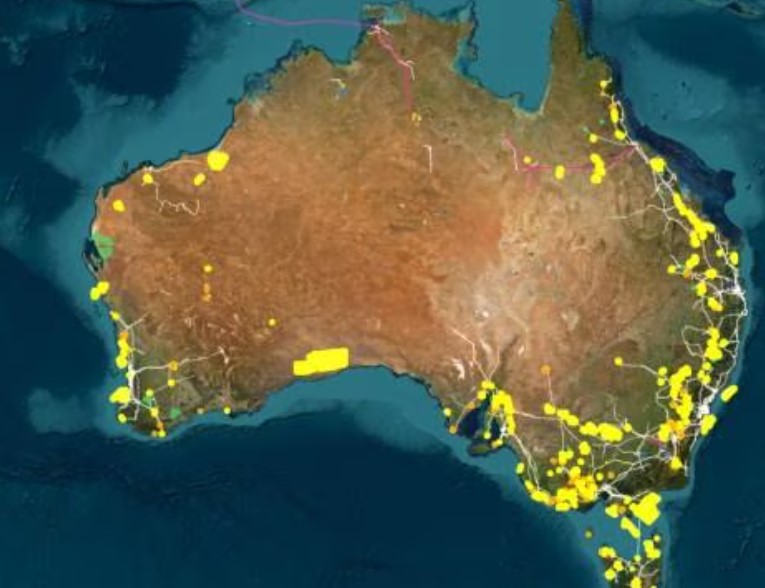
Here are some striking statistics from the article and related mapping efforts that paint a harsh narrative around the scale and ecological cost of Australia’s current renewable-energy rollout:
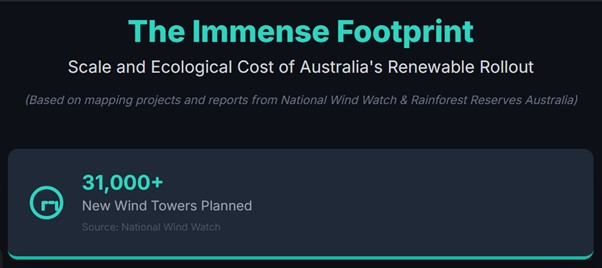
- The mapping project identifies that Australia may require around 31,000 new wind towers in the pipeline. (National Wind Watch)
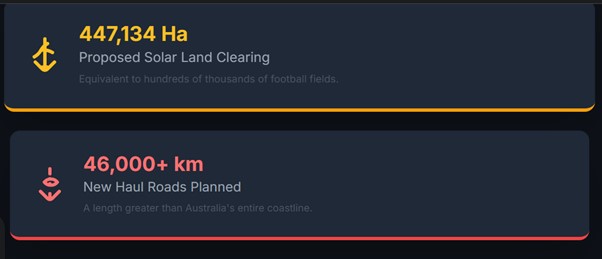
- Proposed solar development covers an estimated 447,134 hectares of land (in addition to existing 29,675 ha). (Rainforest Reserves Australia)
- More than 46,000 km of new haul roads planned for wind-farm access — a length greater than Australia’s entire coastline. (Rainforest Reserves Australia)
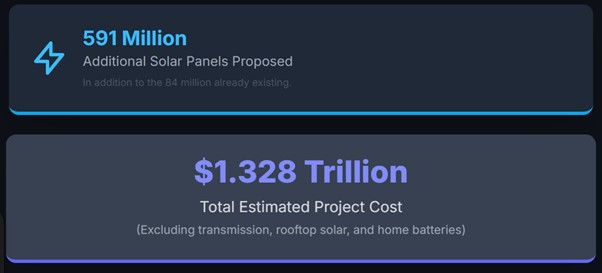
- Over 84 million existing solar panels, with an additional 591 million panels proposed. (Rainforest Reserves Australia)
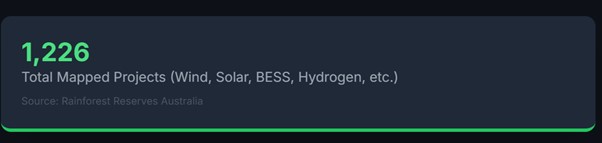
- Total number of mapped projects (existing + proposed) reaches 1,226 across wind, solar, BESS, hydrogen, offshore/land-based. (Rainforest Reserves Australia)
- The total cost estimate (excluding transmission, rooftop solar, home batteries & some gas projects) is $1.328 trillion. (Rainforest Reserves Australia)
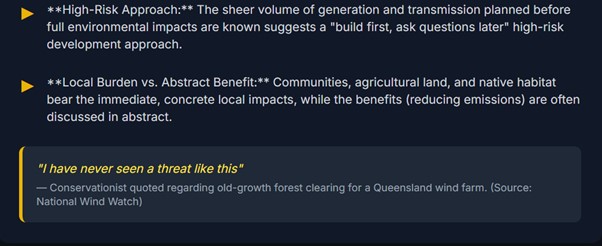
- Specific example: in Queensland, old-growth (never logged) forest being cleared for a wind farm: “I have never seen a threat like this” says the conservationist quoted. (National Wind Watch)
Narrative these numbers support:
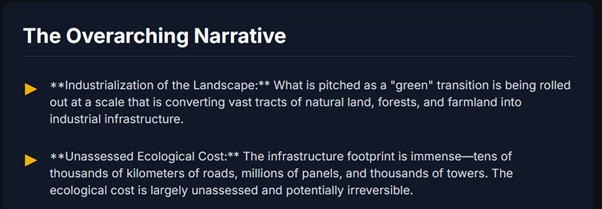
- What is pitched as a “green” transition is being rolled out at a scale that is devastating vast tracts of land – including forests, farmland and natural landscapes – into industrial infrastructure.
- The infrastructure footprint is immense: tens of thousands of kilometres of roads, hundreds of thousands of hectares cleared, millions of panels and thousands of towers. The ecological cost is, according to the article, still largely unassessed and may be irreversible.
- The fact that so much new generation and transmission is planned before full environmental impacts are known suggests a high-risk approach: “build first, ask questions later”.
- Communities, agricultural land, native habitat and wildlife stand to bear much of the burden of this transition – while the benefits (reducing emissions) are often discussed in abstract, the local impacts are concrete and immediate.
- The massive cost and land use suggest that urgency in deploying renewables might be overshadowing strategic planning, biodiversity protection, community consent and land-use integrity.
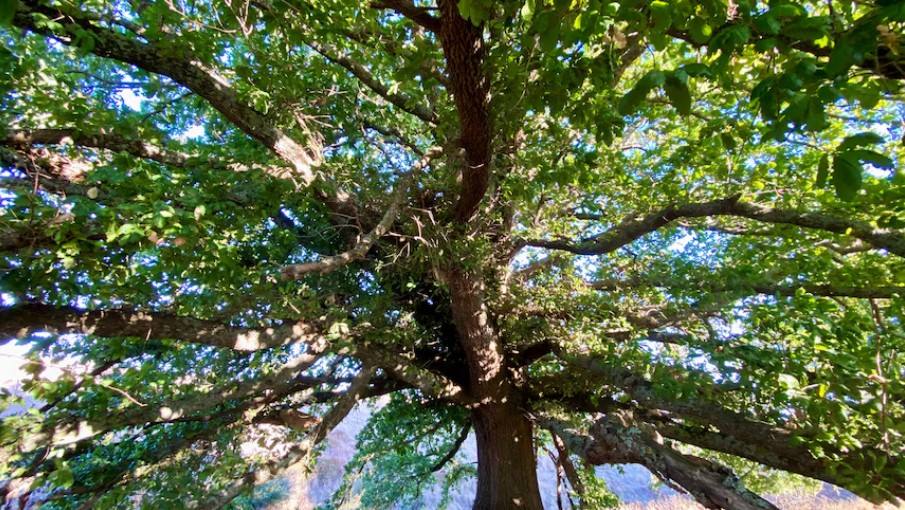
Kingston residents are campaigning to save a 130-year-old Algerian oak tree that faces removal to make way for the Western Renewables Link power transmission project in western Victoria. Local campaigner Jeremy Harper has led rallies, started a petition, and nominated the tree for the National Trust’s Tree of the Year contest to raise its profile and strengthen protection efforts. The tree, with its massive branches and unique presence, is a community landmark and considered crucial for local heritage and wildlife, including nearby Birches Creek Nature Reserve.
The proposed transmission route by AusNet puts the oak – and surrounding environment—at risk, sparking widespread opposition and concerns about threatened flora and fauna. The Western Renewables Link spokesperson said an independent environmental assessment is underway and that community concerns will be considered in the inquiry process. Meanwhile, residents remain determined to protect the tree and continue urging politicians and the government to intervene as the campaign and environmental review continue.