Stop Labors Towers Newsletter – September 5, 2026
THE FRONT BENCH FAILURE: VICTORIA’S TWO TRANSITIONS
There are two transitions underway in Victoria, and only one of them will face the judgment of the ballot box.
We are fed a steady diet of talk about the mechanical shift – electrons, poles, wires, and megawatts. But the more profound and corrosive shift has happened in political power. A state government has quietly transitioned from serving the citizens who elected it to acting as a corporate concierge for a botched renewables rush.
The sales pitch is a pristine exercise in marketing: net-zero utopia. The reality on the ground is an administrative disaster. Transmission corridors are drawn like a child’s scribble straight through productive farms and regional communities, environmental protections are treated as bureaucratic hurdles to clear, and public “consultation” is just a polite word for telling locals what is already going to happen to them.
Instead of planning anchored in hard engineering and local constraints, we get least-cost models that magically suit the bottom lines of corporate proponents. Instead of an honest reckoning with trade-offs, we get glossy PR brochures promising no significant impact while the maps show industrial towers marching across the landscape.
This exposes the lie at the heart of the word “power.” On one level, it is about moving current. On another, it is about who decides, who benefits, and who gets sacrificed. Right now, the government overseeing this engineering mess has already completed a political transition of its own – trading the public interest for an alliance with network monopolies, corrupt unions, foreign capital, and an army of consultants.
Which brings us to the core choice. The most urgent transition required in Victoria is not another line on a flawed energy roadmap; it is a change in who holds the pen. Landscapes and grids can eventually be repaired. Trust in public institutions, once detonated, is much harder to rebuild. If you hand historic planning powers to an administration that treats the law as an obstacle and communities as a public relations problem, you don’t just get bad projects – you get a democracy running on fumes.
The change that matters most now is moving away from captured, complacent rule toward accountable government. Until that happens, every fresh promise of green power will come with a flicker: a stark reminder that the real power failure in Victoria isn’t out on the grid – it’s sitting on the front bench.
MARNOO: THE NIGHT FARMERS FOUGHT BACK
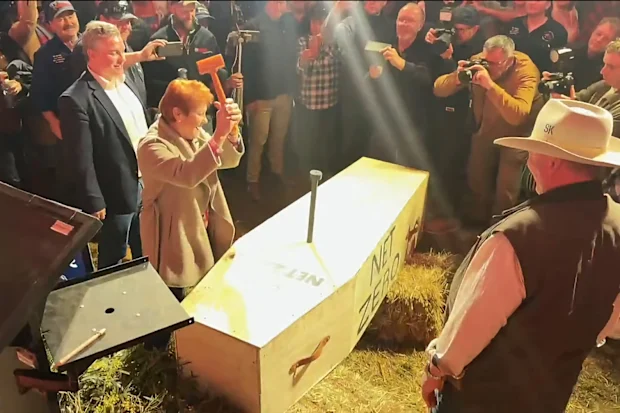
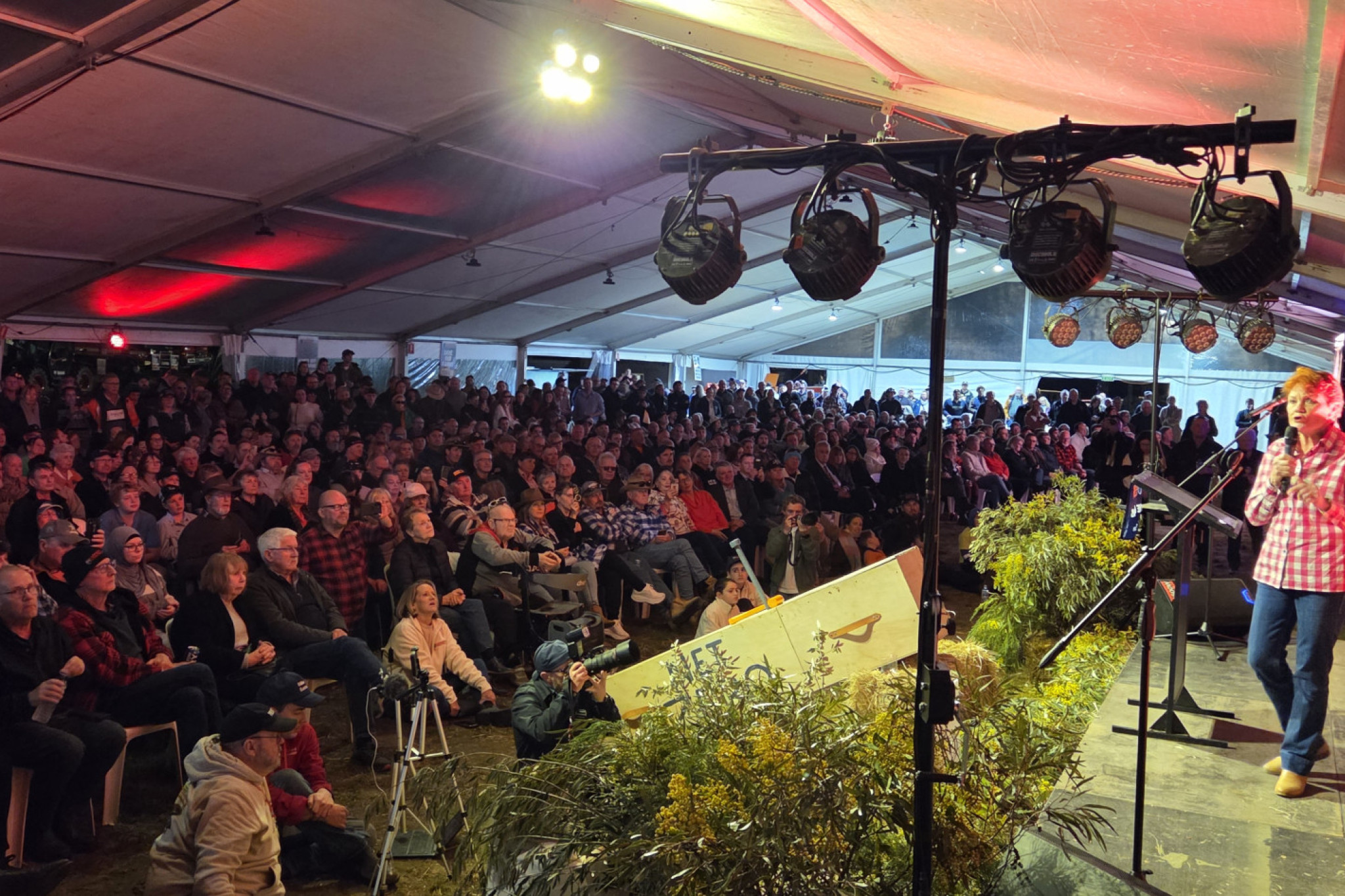
Pauline Hanson’s visit transformed the Wimmera town into the centre of Victoria’s revolt against forced transmission and net zero politics.
Approximately 1,000 people gather in the farming town Marnoo and governments should pay attention.
They did not come because they were confused about what was happening to regional Victoria. They came because they understood it perfectly.
They see productive farmland being carved into industrial energy corridors. They see renewable energy zones imposed across communities that never consented to become them. They see massive transmission projects advancing despite escalating costs, missed deadlines, bushfire concerns and entrenched opposition.
Most importantly, they see a government that stopped listening years ago.
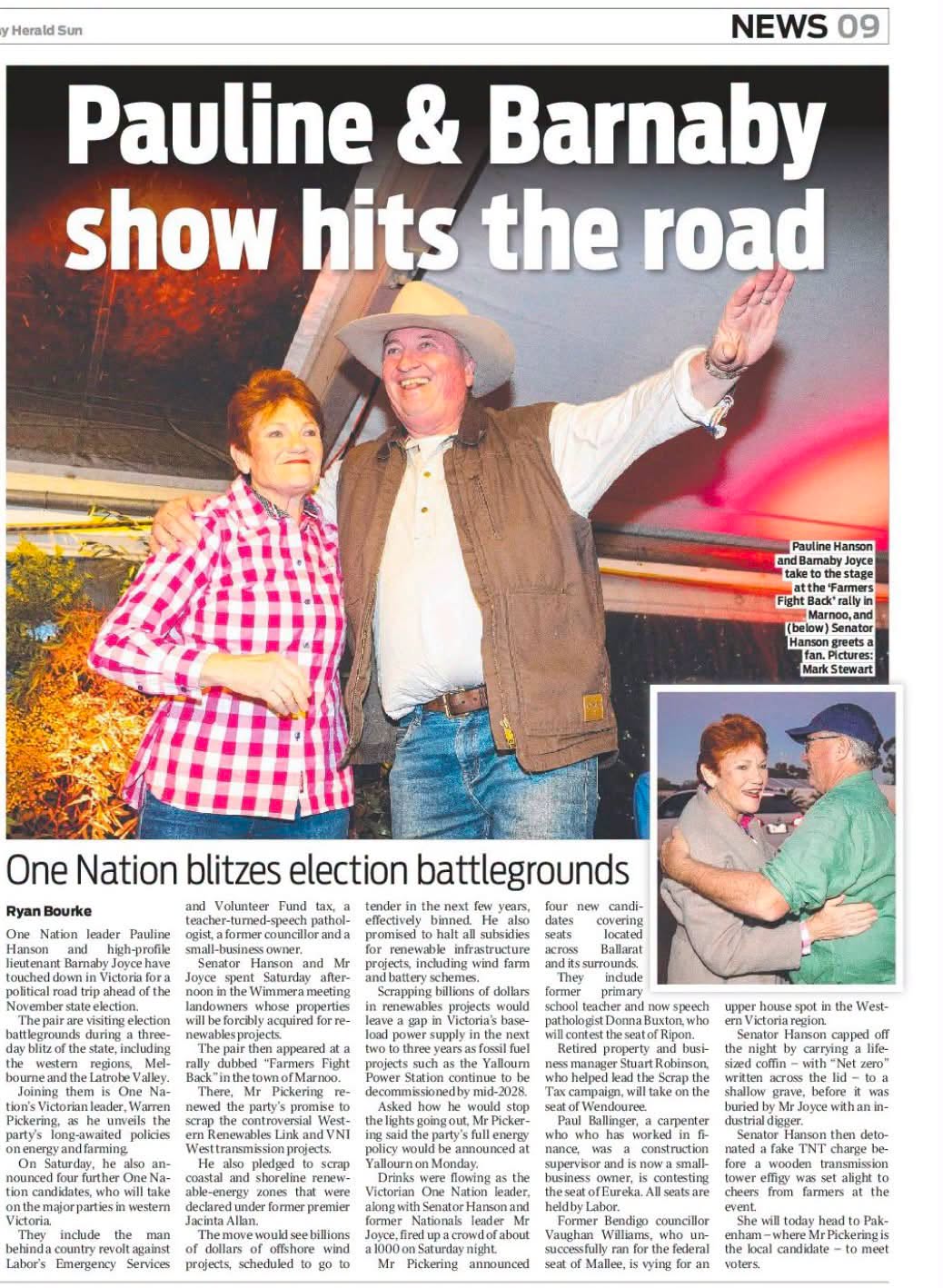
The Farmers Fightback event on 29 August, headlined by Pauline Hanson and Barnaby Joyce, gave that anger a national platform. One Nation’s Victorian leader, Warren Pickering, told the crowd that the party would remove VicGrid’s compulsory acquisition powers and abolish the renewable energy zone covering the district. ABC News reported that the gathering attracted around 1,000 people.
Farmers Fightback subsequently reported that the commitments announced from the stage included scrapping VNI West, the Western Renewables Link and net zero.
That matters.
For years, affected communities have been told that these projects are inevitable that the towers will come, the easements will be taken and resistance will eventually be exhausted.
Marnoo delivered a very different message:
We are not exhausted. We are organised, politically powerful and impossible to ignore.
Twelve families walked onto the stage
The most powerful moment did not come from a politician.
Farmers Fightback founder Ben Duxson invited 12 farming families onto the stage who had received fines after refusing government-authorised entry to their properties for VNI West surveys.
These were not radicals. They were farmers defending land their families depend upon.
Greg and Robyn Roberts spoke about VicGrid’s attempts to enter their Wycheproof property. Another farmer, Billy Baldwin, described the stress placed on his family after he faced charges that were subsequently dropped.
Greg Roberts captured the mood in one devastating sentence: “When a government has to fine its farmers, they’ve admitted that they’re desperate.”
The Buloke Times’ account of the Marnoo event records both the human cost and the determination of these families to continue fighting.
This is what Labor’s energy transition now looks like from the ground: not cooperation, trust or shared purpose, but forced entry, fines, legal battles and families placed under intolerable pressure.
That is not social licence. It is enforced compliance.
The net zero argument has changed
Pauline Hanson used Marnoo to attack the assumption that net zero is beyond political debate. She argued for continued coal-fired generation and consideration of nuclear power, while One Nation presented itself as the only party prepared to reject the existing transition model outright.
The government must explain the full cost of its transmission projects, their repeated delays, their consequences for farming and the environment, and why lower-impact alternatives have not been tested on an equal basis.
The real choice is not between accepting Labor’s plan without question or abandoning reliable electricity.
The choice is between an ideology-driven rollout and an independently tested energy system that protects reliability, affordability, productive agriculture, the environment and the rights of regional communities.
The political ground is moving
The Coalition’s commitment to cancel VNI West if elected did not emerge in a vacuum. It followed years of resistance from landholders and growing electoral pressure across Western Victoria.
One Nation has now gone further by declaring that the Western Renewables Link must also go.
That places the central question squarely before every Victorian political party:
If VNI West is no longer justified, why should the WRL the southern section of the same proposed 500 kV transmission architecture continue unchanged?
Labor cannot avoid that question forever. Nor can the Coalition stop at VNI West while leaving Western Renewables Link communities behind.
Marnoo demonstrated that transmission policy and net zero are no longer abstract debates conducted in Melbourne offices. They are questions about who controls regional land, who carries the risk, who pays the cost and whether governments retain the right to impose projects after losing community consent.
One Nation deserves credit for going to Marnoo, standing before affected farmers and making an unequivocal commitment against the WRL.
The next step must be to put that commitment into a detailed written policy—one that guarantees the cancellation of the current WRL route, restores landholder rights and requires an independent assessment of safer, cheaper and more resilient alternatives.
The message from Marnoo is now unmistakable:
Farmers will not surrender their land, their communities or their future to an energy ideology that refuses to listen.
The fight against forced transmission has entered the Victorian election – and it is not going away.
SECRET HARBOUR: THE NIGHT THE “SAFE SEAT” MYTH DIED
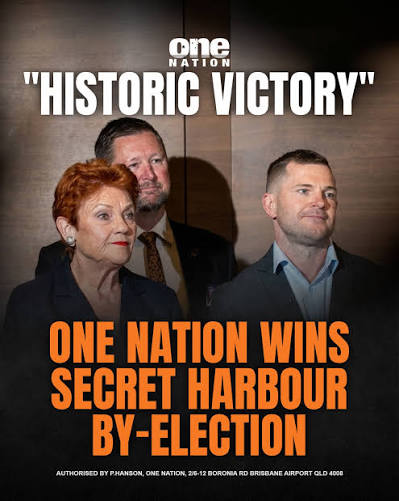
One Nation’s historic victory is a warning to every government that believes ordinary people can be ignored without consequence.
Secret Harbour was not simply another by-election. It was a political rupture.
One Nation’s Luke Herdegen won 57.2 per cent of the two-candidate-preferred vote, overturning an 11.5 per cent Labor margin. One Nation’s primary vote surged to 39.1 per cent while Labor collapsed to just 24.1 per cent a fall of more than 22 percentage points. It delivered One Nation its first lower-house seat in Western Australia. ABC election results
This was territory Labor and its predecessor seats had controlled since at least 1989. It was supposed to be safe. It was supposed to be part of Labor’s permanent political architecture.
Then the voters demolished it.
Some will blame preferences, personalities or social media. But electoral analyst Antony Green found nothing extraordinary about the preference flows. The real story was the primary vote: One Nation’s dramatic rise and Labor’s devastating collapse. Antony Green’s analysis
Secret Harbour was not a referendum on the Western Renewables Link. But it was a referendum on political arrogance the belief that governments can stop listening because their majorities, institutions and traditional loyalties will protect them.
That is why this result matters profoundly to Western Victoria.
For more than six years, we have been told that the project is inevitable. Concerns about bushfire danger, productive farmland, environmental destruction, property rights, cost escalation and the absence of social licence have too often been managed rather than answered.
Labor has behaved as though resistance will eventually be exhausted and regional communities will be forced to surrender.
Secret Harbour proves that political inevitability is a myth.
A government may control departments, legislation, project announcements and public-relations campaigns. But it does not control what happens when ordinary people enter the polling booth.
The Coalition’s commitment to scrap VNI West if elected has now fundamentally changed the debate. If one half of the proposed interstate transmission architecture is abandoned, Labor must explain why the WRL should continue unchanged on the same route, at the same scale and with the same devastating consequences for Western Victoria.
Secret Harbour is Labor’s massive wake-up call.
Social licence is not a communications exercise. Consultation after the major decisions have already been made is not consent. And no government can indefinitely run roughshod over communities while assuming its old electoral strongholds will remain loyal.
The message from Western Australia to Western Victoria is unmistakable:
No seat is permanently safe. No government is politically untouchable. And the Western Renewables Link is not inevitable.
THE NET ZERO INDUSTRIAL COMPLEX
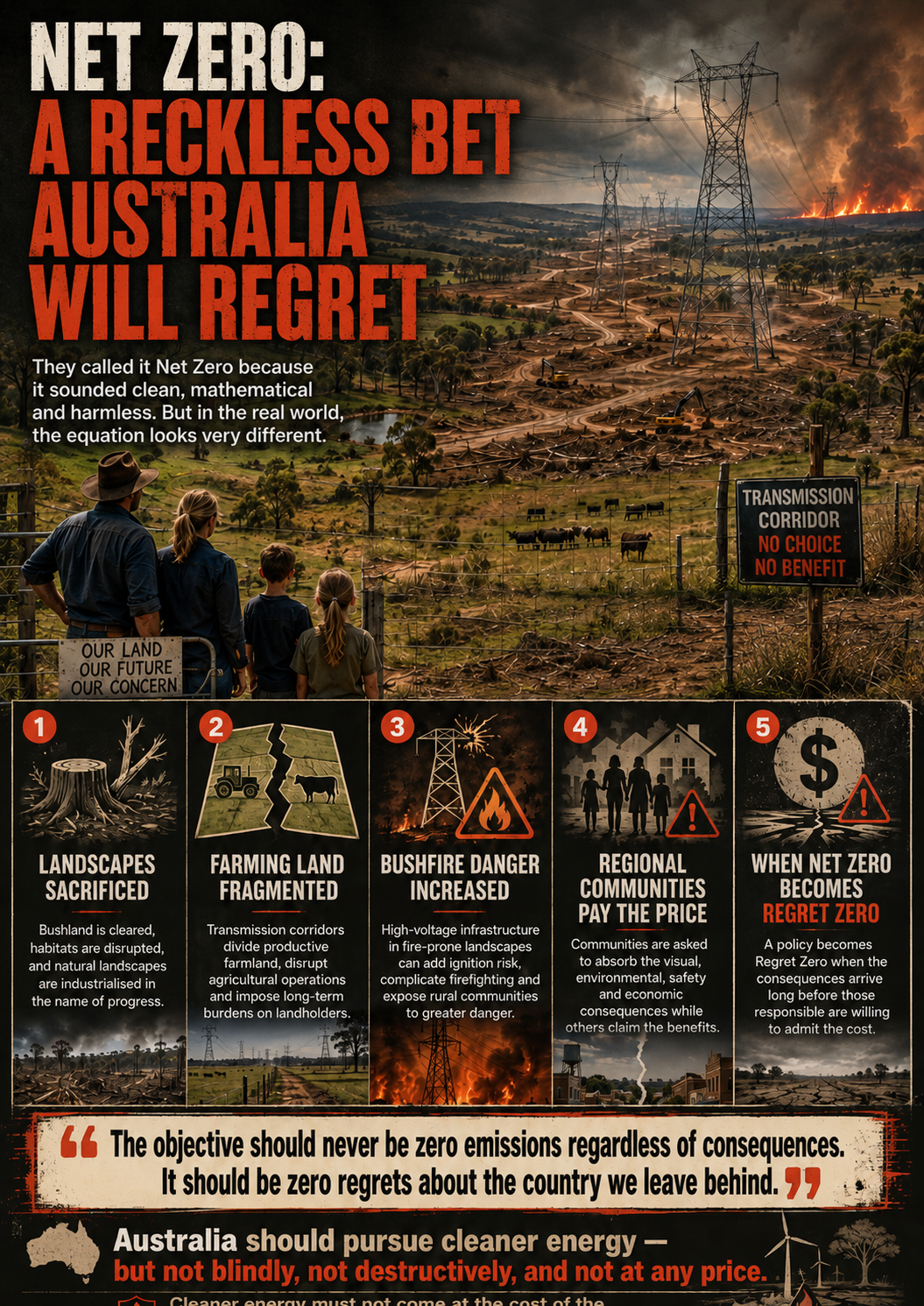
Net zero has created its own political economy. Governments derive moral authority from it. Bureaucracies derive purpose from it. Consultants, developers and infrastructure interests derive revenue from it. International institutions confer status through it. And once that ecosystem exists, admitting that a particular project is unnecessary, excessively costly or socially destructive becomes institutionally more difficult than simply building it.
That gives you a whole vocabulary:
The doctrine.
The political priesthood.
The bureaucracy.
The subsidised industries.
The consultants.
The international prestige economy.
The transmission machine.
And finally, the communities expected to surrender their land and carry the consequences.
THE NET ZERO INDUSTRIAL COMPLEX
There is something almost impressive about the certainty with which Labor pursues net zero.
Not impressive because the policy is right. Impressive because so little now appears capable of causing its architects to question it.
Not cost.
Not reliability.
Not the industrialisation of regional landscapes.
Not the destruction of agricultural amenity.
Not the annihilation of the environment they allege to be saving.
Not the anger of communities.
Not the extraordinary amount of new transmission infrastructure required to make the experiment function.
And apparently not even the possibility that there might be a better way.
That is no longer ordinary policymaking.
It is doctrine.
Labor does not merely support net zero. It has wrapped enormous parts of government around it.
Departments depend upon it.
Regulators administer it.
Consultants advise on it.
Developers profit from it.
International conferences celebrate it.
Ministers announce it.
And communities are expected to live underneath it.
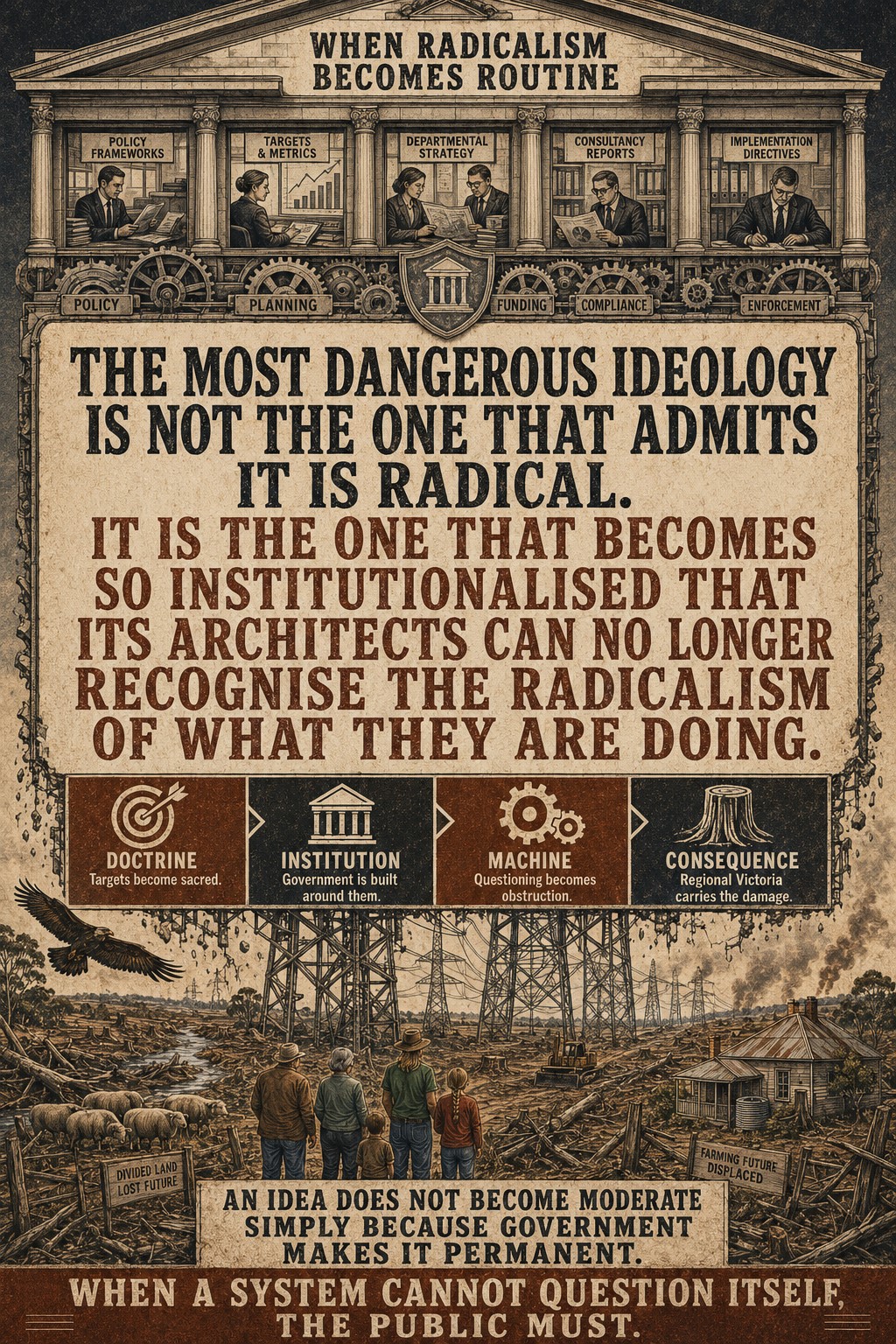
This is how political ideas become political machines.
Once enough careers, budgets, contracts, reputations and institutional ambitions depend upon an objective, questioning that objective becomes enormously difficult.
A government can reconsider a policy.
It is much harder for an entire political ecosystem to reconsider the reason for its existence.
That is the uncomfortable question Australians should now be asking about net zero.
The most dangerous ideology is not the one that admits it is radical. It is the one that becomes so institutionalised that its architects can no longer recognise the radicalism of what they are doing.
WHO EXACTLY IS THIS TRANSITION SERVING?
Labor presents its energy transformation in the language of planetary salvation.
Australia must act.
Australia must lead.
Australia must meet its obligations.
Australia must demonstrate ambition.
And beneath all of this sits the comforting assumption that building vast amounts of renewable generation and transmission infrastructure is not merely one possible response to climate change, but an unquestionable moral necessity.
Yet Australia remains a minuscule contributor to global emissions.
Whatever Australia does must therefore be judged with extraordinary seriousness against what it actually achieves globally, what it costs domestically and what damage is inflicted in getting there.
That is not climate denial.
It is arithmetic.
Yet increasingly, asking those questions attracts suspicion. Why?
Because net zero has acquired something far more valuable than evidence.
It has acquired moral status.
And moral status is political gold.
It allows governments to portray themselves not simply as administrators making difficult trade-offs, but as participants in a historic global mission.
There are summits.
Declarations.
Targets.
Photographs.
International speeches.
Global recognition.
Ministers get to speak not merely about electricity generation but about saving future generations.
It must be intoxicating.
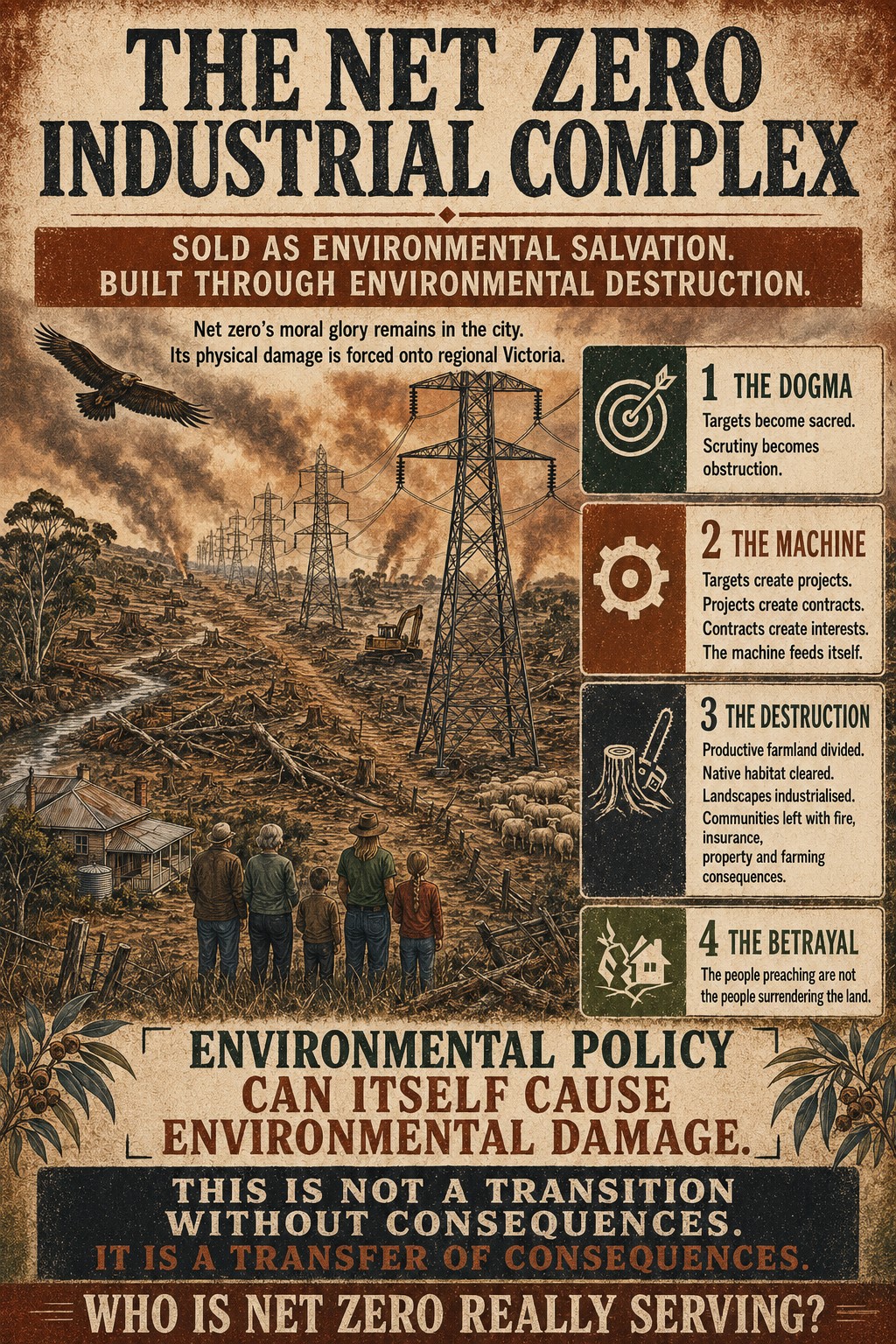
Meanwhile, somebody else gets the transmission tower and everything that comes with it.
Somebody else watches bushland cleared, habitats fragmented and wildlife driven from landscapes being sacrificed in the name of saving the environment.
Somebody else sees productive farmland carved apart by towers, easements, access roads and industrial infrastructure weakening Australia’s food security one farm at a time.
Somebody else is forced to live beneath potential ignition sources in bushfire-prone country, wondering whether firefighters will be able to reach them, whether escape routes will remain open and what will happen when extreme conditions overwhelm the experts’ assumptions.
Somebody else discovers that insurance is harder to obtain, farming operations are compromised, property values are threatened and a family’s life work has been devalued by decisions made hundreds of kilometres away.
Somebody else is told that environmental destruction is progress, that food-producing land is expendable and that exposing regional communities to greater risk is simply the unavoidable price of Net Zero.
And if the experts are wrong – if the fires come, the farms become unviable, the habitat disappears and the promised benefits fail to arrive the people who designed this experiment will not live with the consequences.
And when those people object, they are routinely told that the transition is necessary.
Necessary.
That word is doing an extraordinary amount of work.
THE MACHINE MUST BE FED
There is now an entire economic ecosystem attached to Australia’s energy transition.
Renewable developers.
Transmission companies.
Engineering firms.
Environmental consultants.
Legal advisers.
Planning specialists.
Construction contractors.
Land-access teams.
Government agencies.
Public-relations companies.
Community-engagement consultants.
An enormous procession of organisations has an economic interest in the transition continuing.
The system has developed momentum of its own.
Every new target creates another justification.
Every justification creates another project.
Every project creates another contract.
Every contract creates another constituency that benefits from the continuation of the policy.
Eventually the question ceases to be:
Is this the best thing to do? It becomes:
How quickly can we get it built?
That distinction matters enormously.
Because governments are supposed to test projects.
They are supposed to examine alternatives.
They are supposed to challenge assumptions.
They are supposed to determine whether benefits genuinely outweigh costs.
They are supposed to protect citizens from bad ideas, even fashionable ones.
But what happens when the government doing the assessment has already declared the destination politically sacred?
What happens when abandoning or materially changing a project would be interpreted as weakness on climate policy?
What happens when billions of dollars, years of planning and political reputations are already invested in proceeding?
The answer should trouble anybody who believes in competent government.
THE PEOPLE WHO PAY ARE NOT THE PEOPLE WHO PREACH
There is another peculiarity about the net-zero revolution.
Its loudest advocates tend not to be the people surrendering the land.
They are not generally the farmers looking at transmission easements.
They are not families wondering whether a tower will dominate the view from a property that has existed for generations.
They are not rural firefighters contemplating increasingly complicated landscapes.
They are not communities watching major infrastructure pushed through their districts because metropolitan electricity systems require it.
The moral glory is concentrated at the centre.
The physical consequences are exported to the regions.
What a wonderfully convenient arrangement.
Canberra and Spring Street acquire the virtue.
Regional communities acquire the impacts and risks.
Labor then calls this fairness.
Perhaps Australians should begin asking whether it is instead an extraordinary transfer of political and environmental burden from those who design policy to those who possess insufficient political power to stop it.
AND THEN CAME THE INSURGENTS
This is where Labor’s reaction to One Nation becomes fascinating.
The political establishment increasingly describes Pauline Hanson and the movement around her as an insurgency.
Perhaps they are right.
But insurgencies do not appear in political systems without causes.
They emerge when significant numbers of people conclude that the established institutions no longer hear them.
One Nation does not need to persuade every Australian that it has every answer.
It merely needs to persuade enough Australians that the major parties have stopped asking the right questions.
And on energy, immigration, regional development and government authority, that argument is beginning to bite.
Labor appears far more alarmed by a voter switching to One Nation than by a regional community telling it repeatedly that an infrastructure project is unacceptable.
That tells us something.
Because votes threaten political power.
Communities apparently do not.
At least, they did not.
But perhaps that calculation is changing.
LABOR’S REAL PROBLEM
Labor’s greatest vulnerability is not Pauline Hanson.
It is not Barnaby Joyce.
It is not a hostile newspaper.
It is not social media.
It is the growing possibility that ordinary Australians will look at the scale of the energy transformation being imposed upon them and ask one devastatingly simple question:
Who decided that none of this could be reconsidered?
That question contains another.
Who decided that 2050 should dictate what happens to a farm today?
Who decided that disagreement with a transmission project is disagreement with climate science?
Who decided that environmental concern for global emissions automatically outranks environmental concern for local landscapes?
Who decided that renewable generation deserves moral approval before its consequences have even been counted?
And perhaps most importantly:
Who benefits from making these questions illegitimate?
Labor would prefer the argument to remain simple.
Net zero versus climate denial.
Progress versus obstruction.
Science versus ignorance.
Responsible government versus extremists.
That framing is politically convenient.
It is also becoming intellectually exhausted.
Because Australians are discovering that the real argument is not whether the climate changes.
It is whether governments should be permitted to invoke climate change as a blank cheque for infrastructure, expenditure and intervention without proving that each decision remains economically rational, environmentally responsible and socially defensible.
Those are entirely different questions.
THE NEW ORTHODOXY
Every political age develops beliefs that respectable people are expected to repeat.
Eventually somebody asks whether they are true.
That moment can be uncomfortable.
Because governments that have spent years presenting themselves as courageous reformers suddenly discover that genuine courage might involve admitting the reform is wrong.
That is the test now facing Labor.
Can it examine net zero as policy?
Or can it only defend net zero as identity?
Can it reconsider individual transmission projects?
Can it seriously entertain alternatives?
Can it tell international institutions that Australian interests occasionally come first?
Can it admit that environmental policy can itself cause environmental damage?
Can it listen to regional communities without first deciding that those communities must ultimately be persuaded?
Can it contemplate the possibility that the people resisting its infrastructure are not ignorant obstacles to progress but citizens who have identified costs the political class has chosen not to see?
Because if Labor cannot do those things, then this has ceased to be an energy policy. It has become an ideology with an electricity grid attached to it.
And ideologies have a peculiar weakness. They look extraordinarily powerful right up until the moment people stop believing them.
That is why Labor should be frightened.
Not because Pauline Hanson is an insurgent.
But because the insurgency may be merely the symptom.